WxMoney belongs to the small instant-exchanger end of the market, where the user is generally looking for a direct conversion rather than a full exchange account. This kind of provider can be useful, especially if a particular payment route is hard to find on larger platforms. It is also a category where marketing claims need to be treated carefully. A clean exchange form and a competitive number on a monitoring site do not tell you much about operational resilience.
The service's core attraction is straightforward. Pick a direction, enter an amount, receive payment instructions, and wait for the outgoing asset or electronic money transfer. That flow is easier than navigating a spot market and may require less setup than a major exchange. For users who already know exactly what they need to convert, speed of setup can be genuinely valuable.
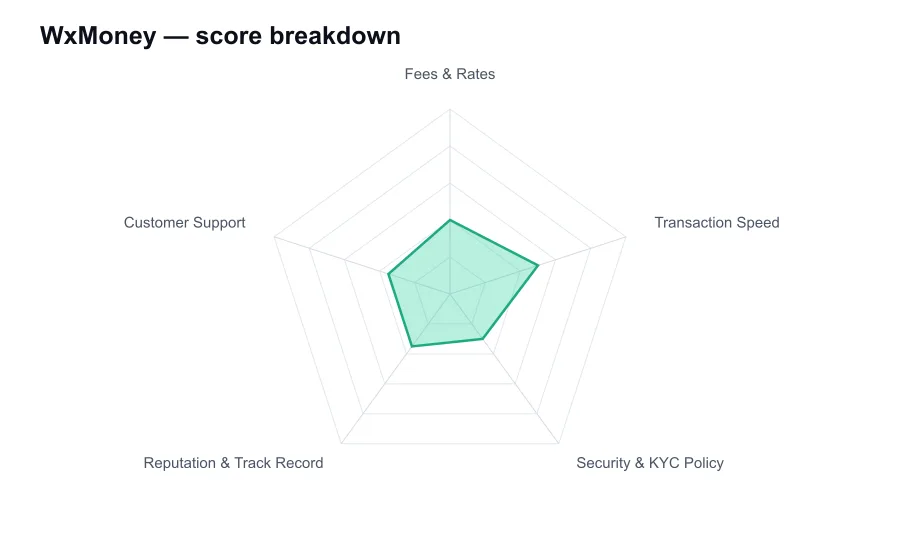
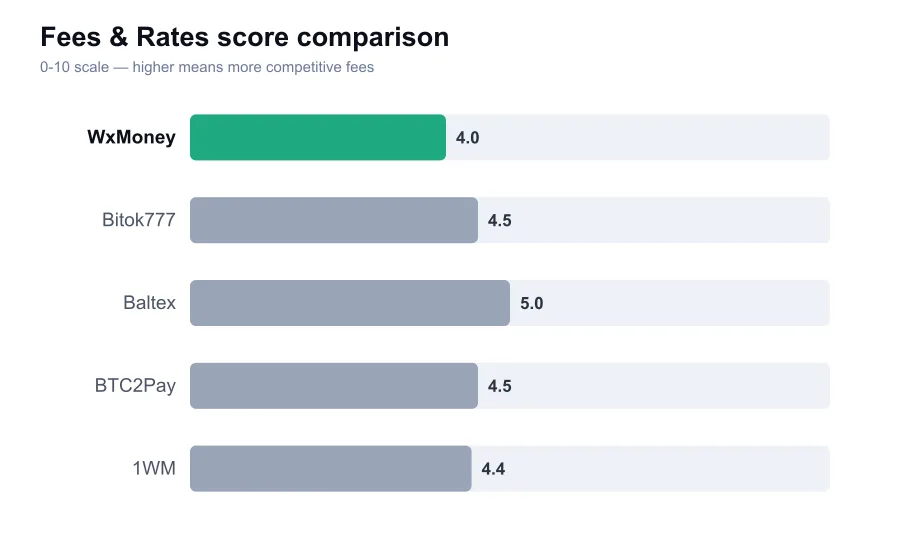
Still, convenience is not the same thing as cheap execution. Instant exchangers earn their money in the spread, through explicit fees, through payment-method charges, or through a combination of all three. WxMoney should be judged against the net amount you receive, not a percentage label or a promising exchange-rate banner. Compare the checkout payout with at least one large exchange and another established exchanger before committing.
Rate stability is a central issue. Crypto prices can move while a user sends payment, particularly if the incoming transfer needs multiple confirmations. If the order uses a floating rate, the final payout may change. A fixed-rate option is preferable for a time-sensitive transfer, provided the service clearly states how long the rate is reserved and what happens if the payment arrives late or short.
Settlement speed depends on the leg of the transaction that is slowest. A transfer from one wallet to another can be quick if the network is quiet and the service has reserve inventory. A bank or electronic-money payment can involve manual review, business-hour limitations, or intermediary delays. Users who need funds for an urgent trade should not assume that the word instant is a guarantee.
I am not persuaded that a small exchanger should receive high marks for security merely because it has a website and a support contact. The important questions are harder: who operates it, where can a user find its terms, what happens during a disputed order, and is there evidence of reliable resolution over time? Where those answers are incomplete, a sensible customer reduces the risk by reducing the transaction size.
WxMoney should not be used as a wallet. There is no good reason to leave coins or e-money in a service designed to settle conversions. Send from a wallet you control, receive to a wallet you control, and verify that the service supports the precise network you selected. Many losses in this category come from avoidable mistakes, such as sending USDT on the wrong chain or omitting a destination tag.
KYC is another area where users often misread the situation. A service can be low-friction without being guaranteed anonymous. It may ask for extra information after an automated risk check, a large order, inconsistent payer details, or suspicious source-of-funds signals. That can be unpleasant if the order is already funded. Read the service rules and avoid sending money from third-party accounts, since mismatched ownership is a common reason for review.
Reputation has to be earned through evidence outside the provider's own promotional material. Check current feedback, not just an aggregate rating. A service can accumulate old positive comments and later change its processing standards. Look at recent complaints, whether operators answer them, and whether there is a pattern around payout delays or unfavorable recalculation. A few imperfect reviews are normal. Repeated versions of the same complaint are not.
Support quality is the pressure test. A small provider may be perfectly pleasant when everything is automatic, then difficult to reach when a transaction needs manual intervention. Before using WxMoney for any meaningful amount, ask support a specific question about the pair, network, or rate type. This is not busywork. It is a cheap way to see whether there is a real response channel before funds are in transit.
The service may make sense for users seeking a payment direction that is unavailable or awkward at a full exchange. It may also appeal to someone who wants a one-time conversion without maintaining a trading account. Those are valid use cases. They do not justify sending life savings or a corporate treasury transfer through an operation with limited public disclosure.
A disciplined user will complete a small trial, verify receipt, and only then decide whether the route is reliable enough for a larger amount. Keep screenshots of the order terms and use the exact payment amount requested. Do not round the amount, send after the stated time window, or assume a receiving address can be corrected after payout. Blockchain transactions are unforgiving, and exchange-service terms often put the cost of user mistakes on the customer.
Compared with a large centralized exchange, WxMoney has less friction at the front of the process but much less transparency behind it. That trade-off can be acceptable for a small exchange order. It is not attractive for anyone who values formal regulation, detailed fee schedules, or a mature dispute process. Users should decide which side of that trade-off matters before they transfer, not after.
My assessment is cautious rather than hostile. WxMoney can be useful as a narrow conversion tool if the quote is good, the route has been tested, and the amount is limited. Its weak point is not necessarily the exchange mechanics. It is the gap between a simple front-end experience and the level of public accountability many users should demand. For routine crypto activity, a larger venue is the safer default.