Baltex is a lesser-known online crypto exchange service, not a major centralized venue with public order books and institutional market depth. It appears designed for direct conversions, where users choose a payment direction and receive a quoted result rather than trade manually. That can be useful for someone who knows exactly what they want to swap. It also means the usual safeguards of a large exchange, including extensive public documentation and highly visible operational leadership, are much less evident.
The first thing that stands out is the limited amount of independently verifiable material around the brand. Small exchange services often have perfectly functional websites and quick transaction flows, yet a customer still needs to establish who operates the service, what jurisdiction applies, how disputes are handled, and how long a transaction can remain under review. Those questions are not academic. They determine whether a delayed payment is a temporary technical issue or a problem with no clear escalation path.
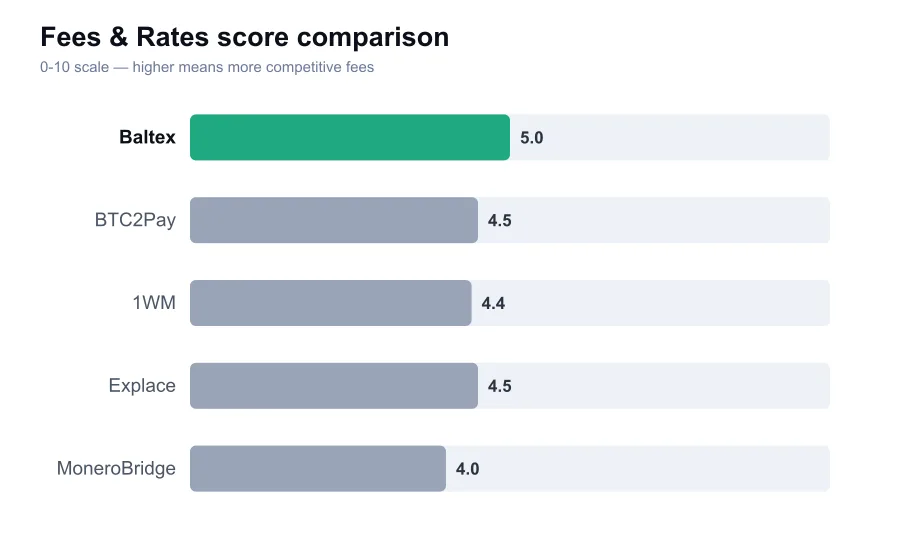
Baltex's fees should be judged from the all-in quote, not an assumed headline percentage. With an instant-exchange model, the actual cost is commonly embedded in the conversion rate. Network charges, liquidity costs, and the provider's margin can all affect the amount that reaches the customer. A low visible fee can therefore be less important than a worse exchange rate. Compare the final amount you will receive, using the same input amount and network, against alternatives before committing funds.
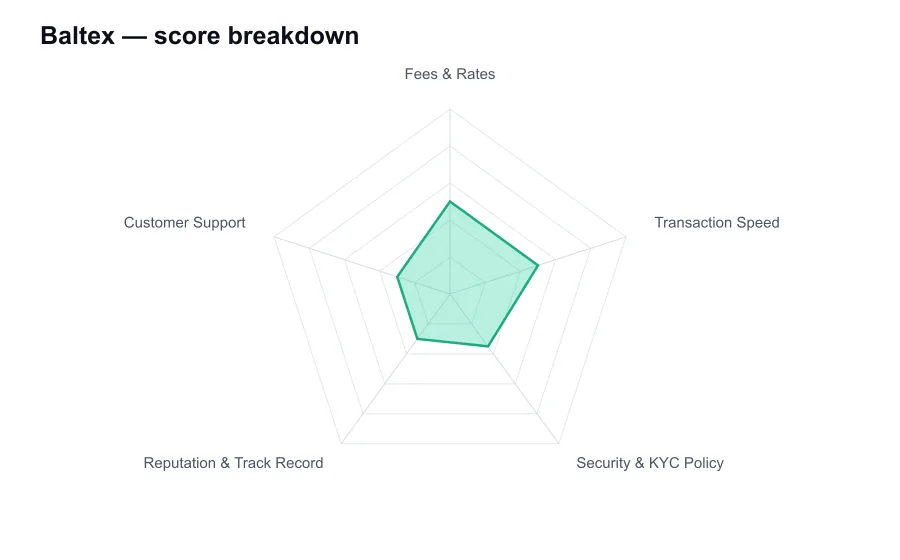
That pricing opacity is the central weakness. A conventional exchange might charge a visible fee while offering a rate close to the wider market. An exchange service can show no separate fee while still producing a less favorable result. Neither approach is automatically bad, but Baltex does not have the broad transparency needed to make the calculation effortless. The service gets a below-average fee score because users have to do more verification work themselves.
Speed is more complicated than marketing language suggests. The order itself may be created instantly, but the transaction is only as fast as the inbound payment network, the confirmation policy, and the availability of the outbound asset. A token transfer on a fast network can settle far sooner than a Bitcoin transaction requiring several confirmations. If the order needs manual review, the term instant stops applying altogether. Anyone with a deadline should have a backup route ready.
For ordinary, low-value swaps, a direct flow can still be efficient. It avoids account funding, trading, and withdrawal stages. That can reduce the number of moving parts, especially for a user already holding the source asset in a self-custody wallet. Yet fewer clicks do not mean fewer risks. The customer remains responsible for entering the exact destination information and for checking whether the selected asset uses the correct chain.
Baltex does not offer enough public security detail for a strong score. There is a meaningful difference between saying that a website uses basic transport encryption and demonstrating cold-storage practice, key management, incident handling, penetration testing, or independently reviewed reserves. Larger providers do not always reveal every control either, but they usually offer more evidence than a small quote-based exchanger. Here, the evidence gap is too large to overlook.
The KYC question also deserves caution. A service may allow an order to begin with little registration, yet retain the ability to stop a transaction for compliance screening. That can be appropriate in some circumstances, but customers should know the policy before paying. Baltex is not the kind of provider I would choose if I needed predictable documentation requirements, a written tier structure, or a clearly defined review timetable.
Reputation is another area where scale matters. Baltex does not carry the multiyear public scrutiny of exchanges such as Coinbase, Kraken, Bitstamp, or even established regional brokers. A small footprint is not proof that a business is unreliable. It does mean there are fewer independent data points from which to assess how it deals with disputes, technical outages, or unusually large transactions. That is why I would not rely on a handful of favorable reviews alone.
Support should be tested before money is sent. Ask a specific question about the intended asset route, confirmation requirements, or a destination memo. The usefulness of the answer, and how quickly it arrives, provides more information than a generic contact page. Support is especially important for direct exchangers because a customer may have only an order number and a blockchain transaction hash to prove what happened. A vague response can turn a simple delay into a frustrating dead end.
The lack of a widely known mobile ecosystem or public account infrastructure is not necessarily a flaw. Some users prefer a browser-based tool for a single transaction. Still, the absence of visible product depth reinforces Baltex's narrow role. This is a service to evaluate order by order, not a platform where I would keep balances or build a recurring trading process.
Baltex can be reasonable for an experienced crypto user who has checked the rate, understands the network, and is converting an amount they can afford to have delayed. It is a poor fit for a novice looking for guidance, a merchant settling customer payments, or a user who needs transparent legal and compliance protections. Those users should prioritize a provider with clearer identity, established support channels, and documented policies.
My concern is not that every small exchanger must look like a multinational exchange. It is that Baltex asks for trust during the period between deposit and payout while providing limited public material for assessing that trust. The fee quote may be acceptable on a particular route, and a normal order may complete without trouble. That does not erase the underlying information gap.
I would approach Baltex as a convenience option of last resort, not a default choice. Run a small test first, record every detail, and do not send a large amount because a quote looks slightly better than competitors. The potential saving is rarely enough to justify weak transparency. For routine use, a more established provider is the safer bet.