Bitok777 is a small online exchange brand with little of the public depth associated with established exchanges. It appears to fit the direct-conversion category, where a customer selects an exchange direction, sends funds, and receives a payout rather than trading against a visible market. This kind of service can be useful for a narrow task. It should not be judged by the same assumptions people bring to a regulated, large-scale exchange with extensive public reporting.
The main problem is informational. A financial service that asks users to transfer crypto should make it easy to understand who operates it, what its rules are, how it calculates rates, and what happens during a dispute. With Bitok777, the public reputation and corporate footprint are too limited to provide much comfort. A functioning order page is not enough evidence of dependable execution, particularly for a customer considering a significant payment.
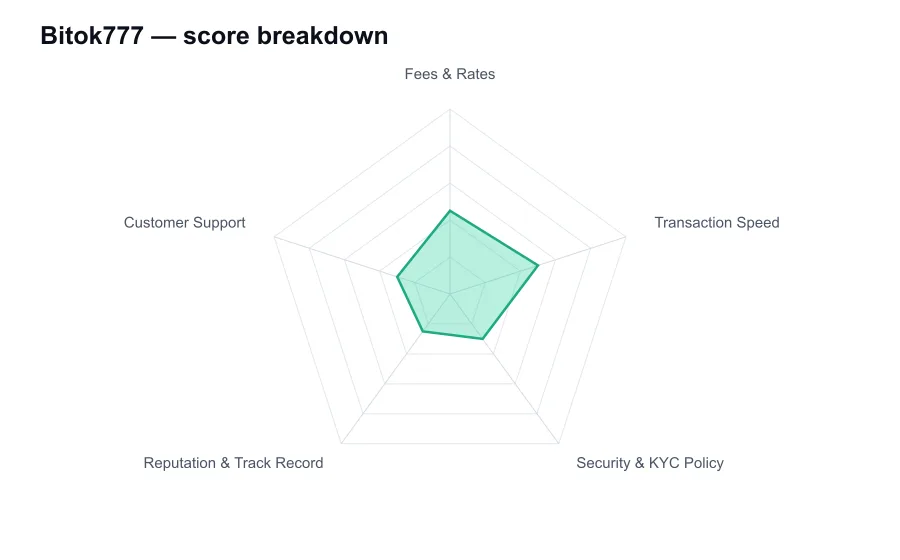
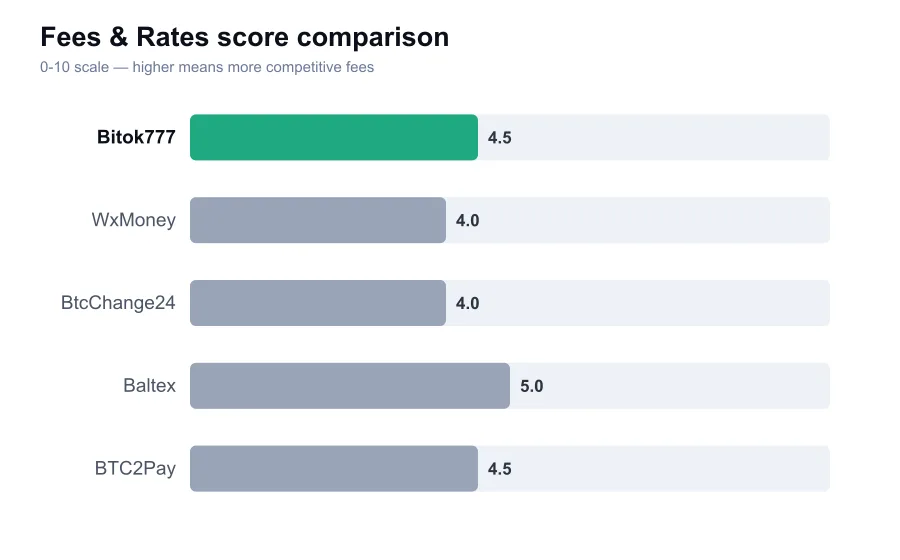
Fees are likely to be embedded in the offered conversion quote, as is common with direct exchangers. This means a customer cannot safely infer value from a visible service-fee label, if one is shown. The relevant question is simple: after paying the same amount of the same asset on the same network, how much arrives in the destination wallet compared with alternatives? If Bitok777's payout is meaningfully lower, a smooth interface does not make up for it.
This is an area where large exchanges have a clear advantage. Their trading fees may look more complicated, but a customer can usually see market prices, fee tiers, and withdrawal charges separately. With a small exchanger, those elements can merge into one number. That may be convenient for a quick conversion, but it leaves the user with more homework. Bitok777 earns a weak fee score because it does not offer enough pricing clarity to establish a consistent value case.
Speed can be good on a straightforward order, particularly where the incoming asset confirms quickly and the outgoing wallet is available. But no direct exchanger can reliably outrun the chains it uses. Bitcoin confirmation delays, token-network congestion, maintenance, reserve issues, and manual checks can all slow the process. If an order is time-sensitive, such as settling an invoice or meeting a trading deadline, relying on an obscure service is an unnecessary risk.
The right way to use a service of this type is with discipline. Start with an amount small enough that a delay will not create a serious problem. Use the exact network and include any required memo or tag. Save the order page and transaction ID before closing the browser. These steps sound basic, but they are especially important where support, legal identity, and public operating history are not easy to verify.
Bitok777 does not offer enough visible security disclosure for a strong assessment. Customers cannot reasonably assess wallet segregation, cold-storage practice, staff access controls, external security testing, or reserve management from a simple exchange form. Lack of disclosure is not evidence of a breach, and it would be irresponsible to claim one without evidence. It is still a reason to reduce exposure. Security confidence should be proportionate to the evidence available.
The same restraint applies to KYC. A customer may encounter a streamlined order path, but that does not mean the service cannot ask for identification or supporting information later. Compliance checks can be triggered by transaction patterns, asset type, or source-of-funds concerns. Bitok777 should not be used by someone whose transaction depends on a guaranteed no-document outcome. That guarantee is rarely safe to assume with any provider that handles financial transfers.
Reputation is the weakest part of the proposition. Bitok777 does not have the established public record of a major exchange, a prominent local broker, or a recognizable long-running instant-swap brand. In crypto, that gap matters because customers are often sending irreversible transactions. There may be successful orders, but isolated positive reports cannot substitute for years of public accountability and tested dispute handling.
Support has to carry too much weight when a provider lacks a deep reputation. If a deposit goes missing, an address was entered incorrectly, or a payout is held for review, the customer needs an identifiable channel that can investigate quickly. I found insufficient basis to score Bitok777's support highly. Before using it, submit a precise pre-sale question and evaluate whether the answer is specific, timely, and consistent with the order terms.
The brand name itself does not help build confidence. It is not a substantive fault, but it does not communicate a clear corporate identity, regulatory home, or service specialization. That makes independent due diligence harder. Customers should be able to distinguish between a real operating business and a temporary web presence before placing funds at risk. With Bitok777, I would want much more evidence before moving beyond a test payment.
There are cases where an obscure exchanger can still be rational. Perhaps it offers a route unavailable elsewhere, a payment method that is locally useful, or a competitive quote for a very small amount. In those cases, a controlled transaction may be fine. The important word is controlled. Do not let a minor rate advantage turn into a decision to send a sum whose delay or loss would materially affect you.
Bitok777 is not suitable for storing funds, repeated business settlements, first-time crypto purchases, or conversions involving money needed urgently. It is too lightly documented for those roles. A user who has access to established exchanges, regulated brokers, or a well-known regional provider should normally choose one of those first. Better support and clearer accountability are worth paying for.
My rating is intentionally conservative. The service may process ordinary swaps, but the available public evidence does not justify a high trust score. Its quote-based model can be convenient, yet convenience is a thin reason to accept ambiguity around pricing, security, and recourse. A small test may be defensible. A large transfer is not.
Bitok777 needs stronger transparency before it can be recommended with confidence. Publish clear terms, explain compliance holds, identify operational responsibility, and make support performance easier to assess, then the evaluation could change. Until then, it belongs firmly in the high-caution category. There are too many better-documented options for most users to need this compromise.