BtcChange24 belongs to the long tail of small online crypto exchangers that offer direct conversion rather than a full brokerage account. Services in this category can be useful, particularly for a one-off exchange between assets, but they need to be judged more harshly than their clean checkout pages suggest. The important questions are about execution, ownership, support, and recourse after something goes wrong.
The service does not have the public profile of established names such as ChangeNOW, Kraken, or Bitstamp. That is not a cosmetic issue. A lesser-known provider may have less public scrutiny, fewer independent customer reports, and less evidence of how it handles difficult cases such as wrong-network deposits, delayed payouts, or a compliance hold.
BtcChange24's exchange flow appears designed for simplicity. Pick a pair, provide a receiving address, accept a quote, then send funds. For a user who already understands wallets and network selection, that can feel refreshingly direct. For a beginner, it removes some protective friction that a major exchange would provide through address books, confirmations, account controls, and detailed transaction history.
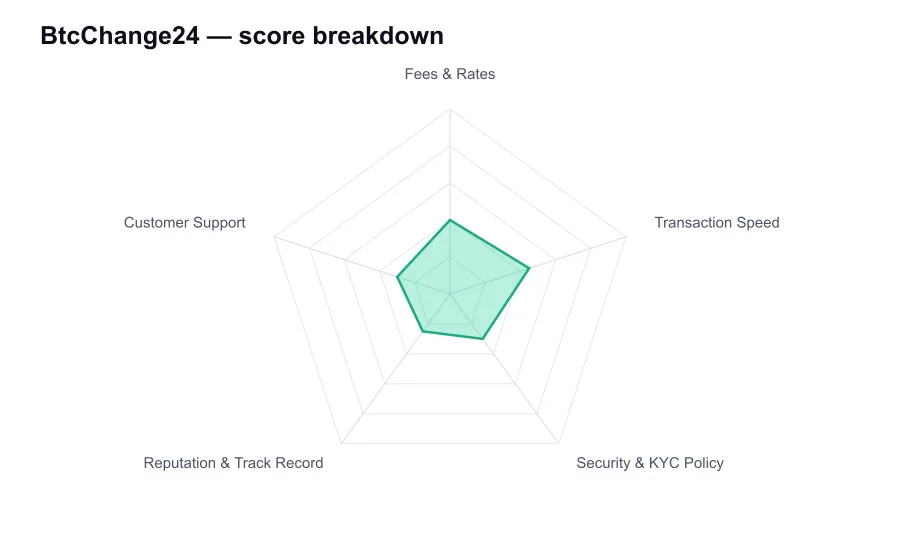
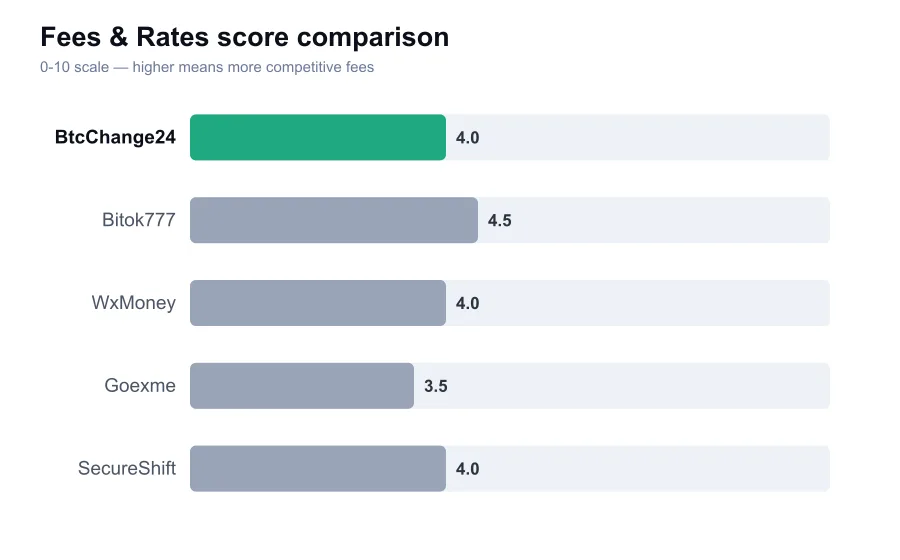
Fees are the first point where I would slow down. I could not verify a clear, durable public fee table that says exactly what the provider takes on each route. The amount shown at checkout is therefore more useful than any general claim about low fees. Check the receive amount against another provider for the same pair and the same minute, then factor in the outgoing network fee.
Quote-based exchange services commonly make money through a spread. That is not improper. The problem starts when the spread is not visible and a user mistakes a floating market rate for a guaranteed payout. If BtcChange24 offers a rate that can move while the deposit is awaiting confirmation, the result can be worse than expected during volatile conditions.
Speed has the same caveat. It may be quick for a liquid crypto-to-crypto pair after the deposit arrives, but no instant exchanger controls Bitcoin block times, congested networks, or a wallet provider's need for confirmation. A service can also pause an order for manual review. Anyone moving funds to meet a deadline should use a provider with a documented service level and a tested support route.
There is little reason to use a small service for a large transaction simply because it looks faster than an exchange account. The time saved at the front end can disappear if there is a mismatch in the deposit amount, a tag or memo error, or a request for documents. With a larger venue, there is at least usually a formal case number and a published support process.
Security disclosure is another weak point. I could not verify enough public information about BtcChange24's legal entity, wallet-security model, penetration testing, reserves, insurance, or incident response to score it highly. Those aren't luxuries. They are the evidence a customer needs before trusting an intermediary with assets that cannot be recalled after transfer.
KYC deserves careful reading here. A no-registration-looking flow is not the same thing as a contractual promise of no identity verification. Risk systems may flag a transaction, and an exchanger can then ask for identification or source-of-funds information. Users should know whether a refusal to provide documents leads to a refund, how any refund is calculated, and whether network fees are deducted.
The public reputation signal is weak simply because there is not much independently verifiable history to inspect. A small number of positive comments doesn't prove consistency, and anonymous complaint sites are not decisive either. I would give more weight to transparent ownership, dated policy pages, clear legal terms, and a record of resolving public disputes. BtcChange24 does not provide enough of that reassurance.
Support is likely to be the deciding factor in a problem case. Before sending anything, test the contact channel with a specific question about a pair, network, or timing. A quick, intelligible answer is not proof of quality, but silence is useful information. Do not wait until money is in transit to find out whether support is reachable.
There are valid reasons to use small exchangers. They can support a particular pair or route that is awkward elsewhere, and they can be less cumbersome for a modest transaction. Still, the convenience premium should be small. If the quote is noticeably worse than a reputable alternative, there is no compelling reason to accept the additional counterparty risk.
BtcChange24 is therefore a service I would approach as an experimental convenience tool, not a financial home. Keep the amount low, use a self-custody wallet you control, and take screenshots before confirming. Don't rely on it for payroll, merchant settlement, or moving a substantial personal holding.
My final assessment is sceptical. BtcChange24 may perform adequately on a straightforward small order, but the thin public record, opaque effective pricing, and limited evidence of mature security controls leave too many unanswered questions. It has not shown enough to compete with established instant exchangers except where a user has a very specific reason and is willing to test the route first.