1WM is an obscure crypto exchange provider name with a very limited public profile compared with major exchanges, established instant swap brands, and recognized decentralized protocols. That does not automatically mean the service is unsafe. It does mean a reviewer has to be more demanding about what can actually be confirmed. A crypto customer is being asked to send irreversible assets into a process they cannot fully see, so vague branding and sparse external documentation are not minor shortcomings.
The available picture suggests an instant exchange style service rather than a mainstream centralized exchange. In that model, the customer selects a pair, provides a destination wallet, sends funds to an address generated for the order, and waits for an outgoing payment. It is a useful model for people who do not want an exchange account or a standing custodial balance. It is also a model where the provider temporarily controls the customer's funds, which makes operational reliability far more important than the checkout screen suggests.
A service such as 1WM should never be assessed by its name, logo, or a claim of fast automatic processing. The questions that matter are more concrete. Who operates it? Is there a clear legal entity? Are terms, refund rules, compliance procedures, and contact methods visible? Is there a history of independent user feedback over time? Can a prospective customer verify that support replies accurately and promptly? Without strong answers, the responsible use case narrows to a small experiment, if any.
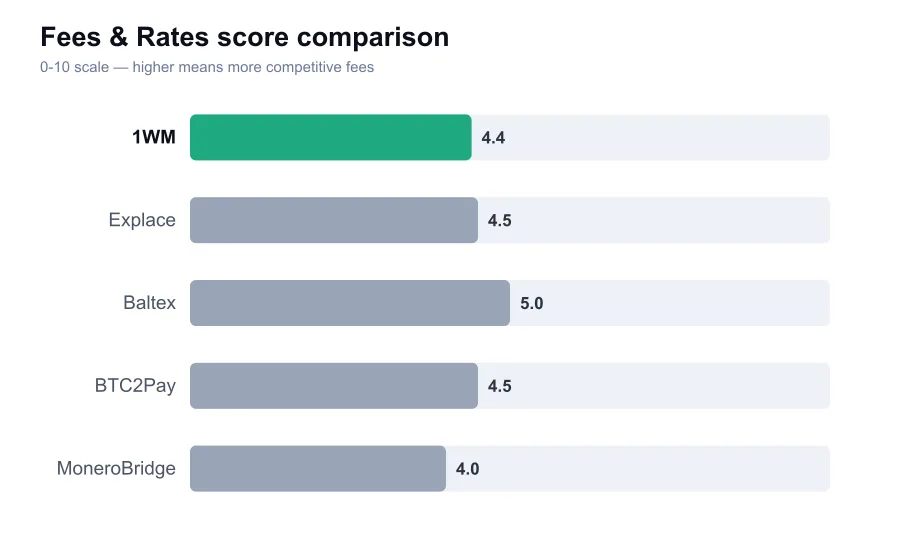
Fees are the first place where instant exchangers often look better than they are. The site may show a rate and a projected output without labeling a separate commission. That is not inherently deceptive. It is how many exchange services price an order. Still, the customer must calculate the real cost by comparing the net amount received with other live options. The spread can include the provider's revenue, liquidity cost, volatility protection, and the blockchain fee. Only the final amount matters.
There is no reliable reason to assume 1WM will consistently beat a liquid centralized venue or a well known DEX aggregator. A large platform may charge a visible trading fee and a withdrawal fee, yet still offer a better final result because its market depth is stronger. A decentralized route may be cheaper for some tokens, particularly on lower fee chains. Before placing an order, compare like for like: same asset, same network, same approximate transaction size, and the same moment in the market.
Speed is similarly dependent on conditions outside the operator's control. Bitcoin and Ethereum transactions must be confirmed. Stablecoins must arrive on the correct chain. The provider must have liquidity and release the output payment. If any of those stages slows down, a supposedly instant exchange can become a pending transaction. This is why a provider should be judged not just by its fastest possible settlement, but by how clearly it communicates during an exception.
A customer should assume that any misstep involving a blockchain network may be difficult to fix. Tokens such as USDT, USDC, ETH, and wrapped assets may have similar names across different networks. A deposit address can be technically valid for one chain while being unusable for the order selected. Memo based assets add another hazard. Sending without the needed memo can require manual intervention. Small providers may have fewer resources or less incentive to perform complicated recovery work.
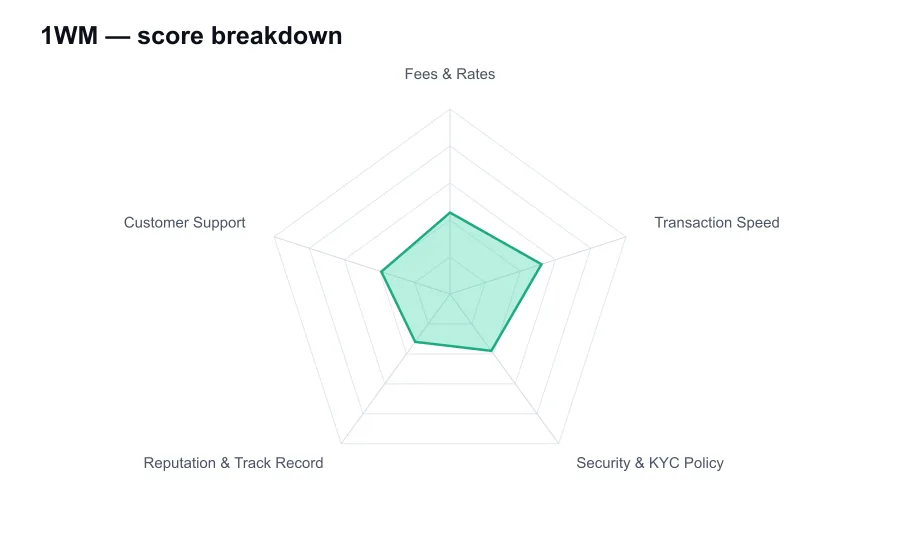
The security case for 1WM is not strong enough to inspire confidence for major transfers. An instant exchanger does have one structural advantage over a custodial exchange account: it does not require customers to leave money on the platform after the swap. But that advantage lasts only outside the order window. During an exchange, the service holds the input funds and the user cannot enforce payout through the blockchain unless the underlying design uses a trust minimizing mechanism, which is not something that can be assumed here.
Identity verification deserves a realistic explanation. Many instant exchange services market a low friction process, and a user may not need to create a conventional account for every order. Yet virtually any provider can stop an order and request information under its risk or anti money laundering procedures. A customer should read the terms before sending, especially if the transfer is large or comes from a source that may trigger blockchain screening tools. The risk is not simply that verification exists. It is that the process and release rules may not be transparent enough to predict.
Reputation is 1WM's weakest category. There is not enough broad, independently verifiable reporting to put it in the same trust tier as Coinbase, Kraken, Bitstamp, 1inch, or established swap services with years of public scrutiny. That is not an accusation of fraud. It is a reason to withhold trust. In crypto, a new or obscure service must prove itself with transparent information and consistent support, because customers do not have chargeback protection for ordinary blockchain transfers.
Support may be perfectly adequate for routine questions, but it is impossible to rate highly without a deeper public record of dispute handling. The real support test begins after a transaction is late, a customer sends slightly less than required, or an address is questioned by a compliance system. Before using 1WM, ask a specific support question and judge the answer. Generic reassurance is not enough. You want to know whether a human understands the asset, network, and error scenario you describe.
There are also basic operational checks that users should make themselves. Confirm that the domain is authentic through a trusted source. Read the exchange terms and privacy policy, not just the homepage. Check whether the order gives a unique reference and whether the deposit address is clearly tied to your selected network. Screenshot the quoted output before sending. These habits will not eliminate counterparty risk, but they make a support dispute much easier to document.
For users who already hold assets in self custody, a recognized decentralized exchange aggregator often provides a more transparent alternative for tokens on compatible chains. The user can see the route, gas, and smart contract interaction, while keeping control of funds until the trade executes. For fiat conversions or large crypto transfers, an established centralized exchange may be less convenient but far more accountable. 1WM's main selling point would have to be a notably superior quote or a route unavailable elsewhere. A generic quick swap is not enough.
I would not advise using 1WM as a primary exchange, wallet, savings account, or operational bridge between major holdings. A small test transaction may be a reasonable way to assess it for someone who accepts the risk. Anything larger should go through a better documented service. The burden of proof is on the provider, and a limited public footprint does not meet that burden for substantial funds.
My final assessment is conservative. 1WM may offer a functional instant exchange flow, but there is too little independently verifiable information to score it well on security, reputation, or support. Its apparent convenience has value only for a user who keeps the amount small, verifies every network detail, and has an alternative if the order is delayed. In a market full of better known options, obscurity is a material disadvantage, not a charming feature.