Vobmenka is a small online exchanger serving users who want a direct conversion rather than a full trading account. The name and service style place it in the same broad category as many regional exchange desks: choose a direction, receive a quote, pay into the order, and wait for the payout. That can be easier than registering with a global exchange, especially for a familiar local payment method. It is also a category where transparency varies enormously from one operator to the next.
A customer should not confuse a clean exchange form with the protections of a large regulated platform. Vobmenka is not the sort of venue people use for deep liquidity, limit orders, audited reserves, or professional custody. Its value proposition is speed and convenience for a particular conversion. The service should be judged on whether it gives a fair quote, communicates clearly, and completes the specific route reliably.
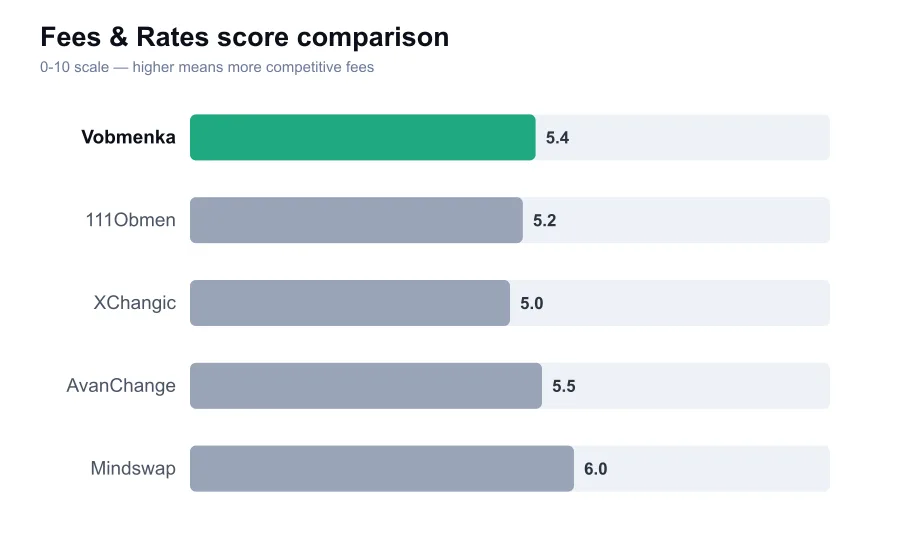
Pricing is the first place where critical thinking pays off. Many exchange desks do not charge a single visible trading fee. Instead, they set a buy or sell rate that incorporates their operating margin, liquidity cost, payment-provider exposure, and sometimes a risk premium. That approach is not inherently deceptive, but it creates a simple rule: the number that matters is the amount arriving in your wallet or bank account.
Compare that net payout against alternatives at the moment you intend to transact. A quote can move quickly if Bitcoin or stablecoin demand changes, and card-related routes may carry costs that a crypto-only swap does not. A service may have a competitive rate for one direction and a poor rate for another. Do not extrapolate from one successful exchange of USDT into a claim that every Vobmenka route is cheap.
For small orders, convenience can be worth a somewhat wider spread. For large orders, the spread becomes the whole story. A two percent pricing gap on a $100 conversion is annoying. On a $10,000 exchange it is a $200 decision. Anyone moving meaningful value should compare the direct quote with a liquid exchange, the relevant withdrawal fee, and a second regional exchanger before committing funds.
Speed has the same route-specific character. A straightforward crypto payout can be quick after the deposit receives enough confirmations. A bank, card, or electronic-money transaction can require additional settlement time or manual verification. If Vobmenka uses a reserve system for a payment direction, the service may also need to confirm that sufficient payout capacity is available before it can finalize the order.
That is why customers should distinguish between an automatic order and a manual one. An automatic crypto-to-crypto exchange may be processed around the clock, while an order involving a local bank rail might depend on an operator or a payment provider. If the site does not make that distinction clear, ask support before paying. Never assume that an urgent same-day obligation can be met by a small exchange desk.
The security model is typical of a transaction exchanger. It may reduce the need to keep a permanent balance on a central platform, which is a real advantage. But the customer still hands assets or payment funds to an operator during execution. If there is a dispute, the practical questions are whether the operator can be identified, how its terms define the order, and how quickly it can provide a human response.
Vobmenka does not have the broadly documented global security record that would justify treating it like an institution. That should lead to sensible caution, not panic. Use a wallet you control for crypto payouts. Make sure the asset ticker and network are correct. Do not send a token through a network that the order does not explicitly name. Wrong-network deposits are one of the most common and costly mistakes in this part of the market.
KYC is another subject where customers often make bad assumptions. An exchanger may have a simple form and still reserve the right to review a suspicious order, request documents, or pause a transaction linked to a compliance alert. That is particularly plausible where fiat payment methods or blockchain monitoring are involved. If you cannot provide a clear source for the funds, do not put yourself in a position where a compliance request can lock up money you urgently need.
Reputation should be read with a sharp eye. Reviews on exchange-monitoring sites can help identify whether an operator has processed routine orders over time. They do not prove the quality of handling in an exceptional case. Check the dates, read negative reports rather than only the average score, and focus on the exact direction you plan to use. A provider can be competent at card-to-crypto exchanges while struggling with an obscure electronic-money route.
Customer support matters more here than on a self-directed order-book exchange because the order may be partly manual. A good response should identify the issue, request relevant evidence, and give a realistic next step. It should not promise an undefined resolution soon. Before making a substantial first order, test whether there is a live and responsive support channel, and keep the order page, transaction hash, and payment receipt available.
The main appeal of Vobmenka is practical rather than glamorous. A user who has a specific supported route and sees a good quote may find it quicker than onboarding to an international platform. That usefulness should not be inflated into a blanket endorsement. Small exchangers rarely have the legal disclosures, public incident reporting, or deep operations team that make a major exchange safer for large balances.
I would use Vobmenka only for a contained transaction after verifying the current domain, rate, and payout details. Start small, especially if using an unfamiliar payment method. If the service successfully handles a test order, that gives some evidence about that route at that moment. It does not turn a small exchanger into a place to store capital or route business-scale payments.
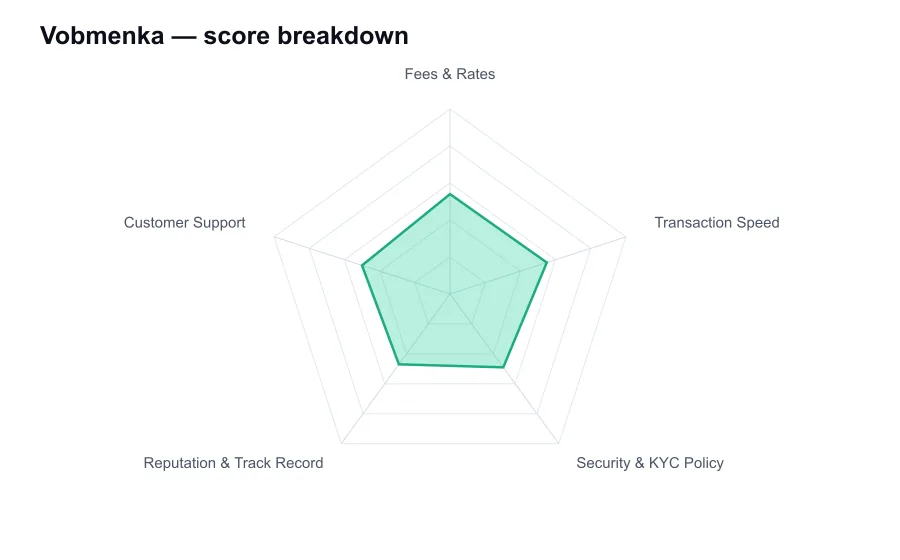
My final view is reserved. Vobmenka can be useful if its live quote beats better known options and the conversion is modest enough that a delay would be manageable. The lack of broad public transparency limits its score, as does the uncertainty around route-specific processing. Convenience has value, but it should be purchased with a small order and careful record keeping, not blind trust.