Transfer24 appears to operate as a small online exchange service rather than a full custody exchange with order books, margin products, or a large public trading community. That distinction matters. Users are generally looking for a direct conversion or payment-style transaction, not a place to hold a portfolio for months. It occupies the less transparent end of the exchange market, where a service may be convenient for a particular pair or local payment method, yet offer far less public documentation than established instant swap brands.
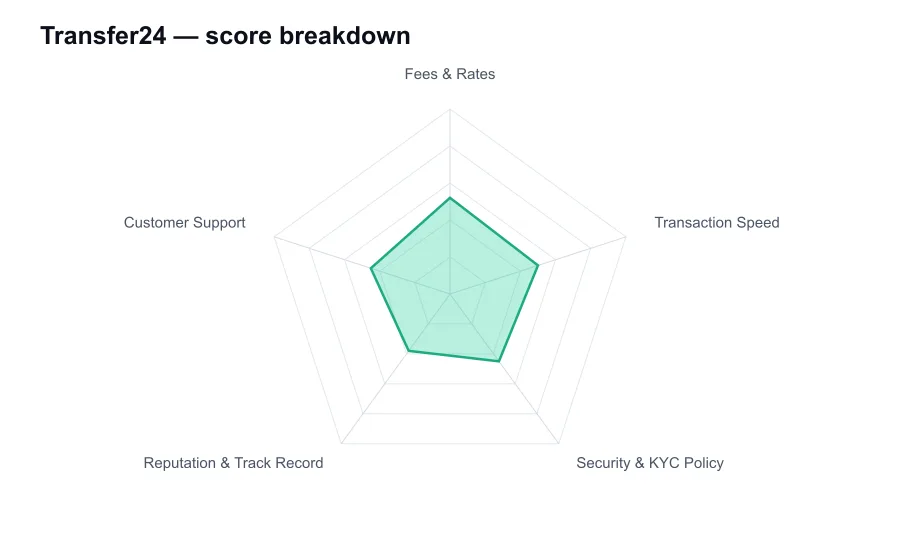
The first issue is identity and verifiability. Transfer24 has a much thinner public footprint than names such as ChangeNOW, Trocador, Kraken, or Coinbase. A small exchange is not automatically unsafe, and plenty of legitimate regional services began this way. Still, a reviewer cannot give a strong reputation score to a provider whose legal entity, operating history, reserves, and independently verifiable volume are difficult to establish from public information.
That lack of depth changes how I would use it. I would treat Transfer24 as a transaction counterparty, not a wallet. Send the exact amount needed for a conversion and move the received funds to a self-custody wallet or a well established exchange promptly. Leaving a balance with a lightly documented exchange means taking credit risk without receiving much in return.
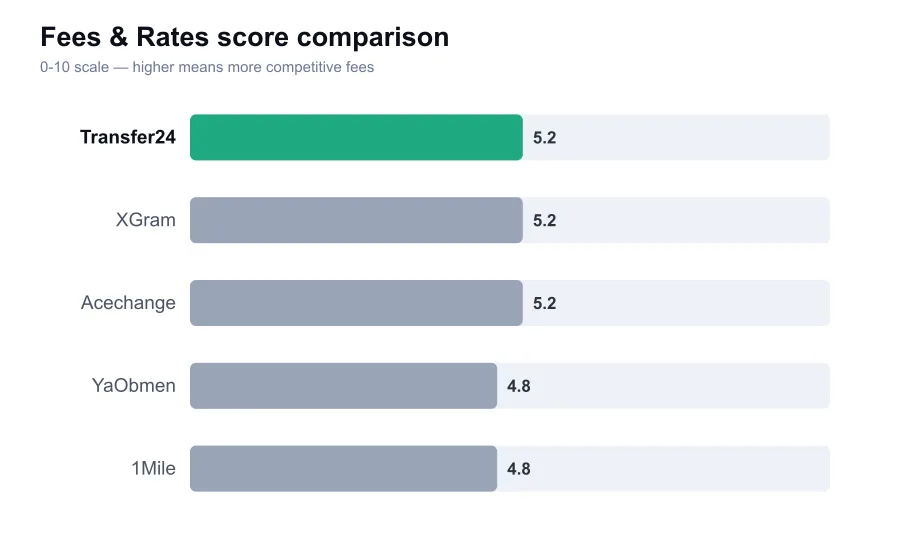
Fees are another area where customers need to slow down. Smaller exchangers often advertise a rate rather than a separate commission, and the real cost sits inside the spread between the quoted send amount and receive amount. That is common practice, but it makes comparisons harder. A rate that looks free can still be expensive if the quoted Bitcoin, USDT, or local-currency conversion is a few percentage points away from an executable market price.
Before submitting an order, compare the final output with at least two alternatives. For crypto-to-crypto swaps, Trocador and ChangeNOW can provide a useful benchmark because they show offers from multiple liquidity sources. For fiat transfers, compare the exchange quote with the rate on a major exchange plus the cost of a bank transfer. Transfer24 needs to win on the amount received, not on a vague promise of low commission.
Transaction speed may be perfectly adequate for a straightforward, liquid transfer, but users should not assume that every transaction is instant. A conversion still depends on blockchain confirmations, liquidity at the provider, manual review procedures, and the destination network. Bitcoin deposits can take materially longer than a stablecoin transfer on a fast network, while bank-related operations may depend on business hours and payment-provider checks.
The difficult part is that Transfer24 does not have the kind of extensive status reporting, incident archive, or publicly searchable processing data that lets a reviewer estimate its normal settlement time with confidence. That is a material weakness. A customer with an urgent payment has little basis for knowing whether a delay is ordinary, whether support is handling it, or whether the service has encountered a liquidity issue.
Security should be judged separately from speed. A no-account or low-friction exchange flow can reduce the amount of personal data a customer hands over, which many privacy-conscious users appreciate. It does not remove transaction monitoring, blockchain tracing, sanctions screening, or the possibility that a transfer is held for review. Any service touching fiat rails may also have more compliance obligations than its marketing first suggests.
I would not describe Transfer24 as a proven no-KYC service unless its current terms state that clearly for the specific payment rail and transaction size. In this part of the market, the practical policy is often conditional. A routine small transfer may pass without documents, while a flagged source address, unusual amount, chargeback risk, or compliance alert can lead to a request for identification and source-of-funds evidence.
That possibility creates a serious user responsibility. Never use an exchanger like this to move funds that you cannot document, and never send a large amount before testing the service with a small transaction. If a review occurs after funds are deposited, customers need to know which entity holds the funds, what documents can be requested, and how quickly a dispute can be escalated. Publicly available information does not make those answers especially clear here.
Support is likely to be the deciding factor during a problem. A responsive chat agent can rescue a minor address-format mistake or confirm a pending transfer. Yet small providers often rely on messaging channels or a simple support form rather than a staffed ticket system with detailed case tracking. That may be fine for a small exchange, but it is not comparable to the operational depth of a regulated platform with dedicated compliance and dispute teams.
I would keep records from the start. Save the exchange quote, transaction ID, wallet address, payment receipt, and every support message. If Transfer24 provides an order page, capture it before it expires. This is sensible with any exchange, though it becomes especially important where public policies and the legal operating structure are not easy to inspect.
Reputation is not just a collection of star ratings. It is the ability to see how a company handles difficult cases over time, including delayed payouts, compliance holds, wrong-network deposits, and customer complaints. Transfer24 does not have the long, widely scrutinized record needed to compete with established brands on that measure. A handful of positive exchanges proves that a service can process routine orders. It does not prove that it will handle a costly exception fairly.
My view is cautious rather than dismissive. Transfer24 may suit someone who has independently verified the current website, checked the quote, and needs a small, specific transaction. It is a poor choice for first-time buyers, large conversions, business payments, or anyone who needs clear legal accountability and predictable escalation paths. The convenience case is real only if the final quote is meaningfully better than a more established alternative.
Use Transfer24 as a limited-purpose exchanger, if you use it at all. Start small, check the receiving network character by character, and do not treat a low-information service as a savings account. Its weak public track record and limited transparency outweigh any convenience advantage for most serious users. I would choose a better documented provider for substantial value.