AvanChange is a small online exchange service aimed at people who want to convert one digital asset or payment balance into another without opening a conventional trading account. It sits in the same broad category as the many instant exchangers listed on monitoring sites, rather than competing directly with deep-liquidity platforms such as Kraken or Binance. That distinction matters. You are buying convenience and a simple order form, not an exchange account with charts, order books, custody controls, and institutional disclosures.
The service's strongest appeal is straightforwardness. A visitor selects a direction, enters an amount and recipient details, receives payment instructions, then waits for the payout. For a user who already understands wallet addresses and network confirmations, that can be less cumbersome than registering at a major exchange. The catch is that the apparent simplicity leaves little room for a mistake. Sending the wrong asset, choosing an incompatible network, or entering an incorrect destination can be much harder to resolve than it would be at a large platform with formal operations teams.
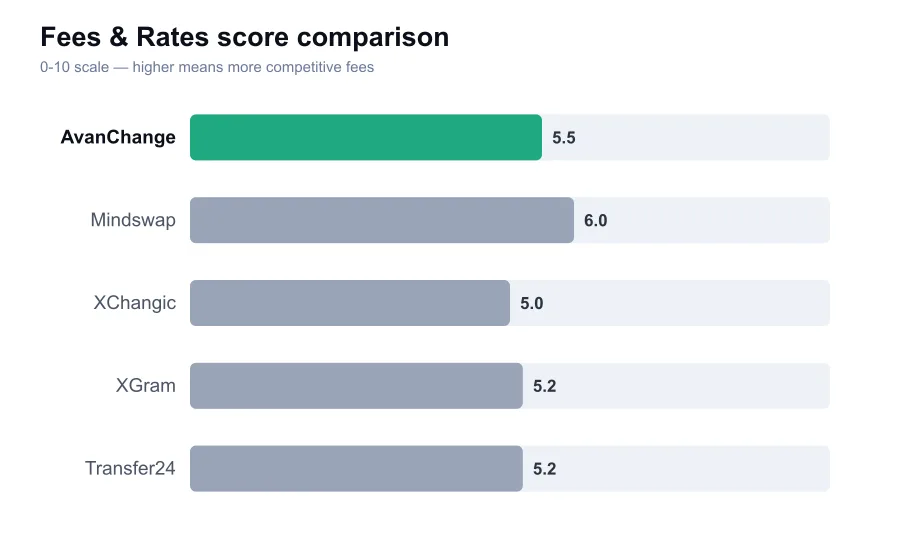
Pricing is the first area where I would slow down. AvanChange presents a quoted conversion amount, but a quote is not the same thing as a clearly published trading fee. The effective cost can include the service margin, network fee, reserve constraints, and a rate movement if the order is floating rather than fixed. That is common in this corner of the market, but it makes comparison shopping essential. A customer should compare the final payout against at least two monitored alternatives, not merely compare the number shown next to the word fee.
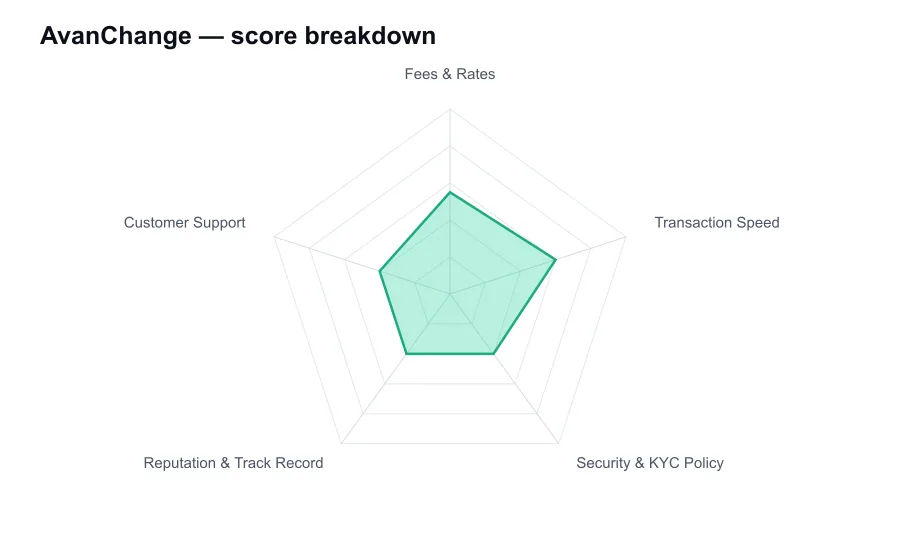
For modest, urgent conversions, that spread may be acceptable. It becomes less acceptable as order size rises. A 1 percent or 2 percent worse all-in rate can be easy to miss on a small swap, then become material on a larger payment. AvanChange does not have the kind of transparent maker and taker schedule that lets a trader forecast costs with confidence. I score its fees as middling because the checkout quote can be useful, but the lack of broad, independently auditable pricing documentation is a real weakness.
Speed depends less on the site interface than on the assets involved. A transaction cannot be completed until the inbound payment is detected and the required blockchain confirmations are received. Bitcoin transfers may therefore take substantially longer than a payment sent over a lower-fee, faster network. Manual review can also interrupt what appears to be an instant process. The service should not be treated as a guaranteed real-time cash-out tool, particularly during volatile markets or congested network conditions.
That said, this model can be efficient for a routine order. There is no need to fund an account, wait for an internal trade to fill, then submit a withdrawal request. If the route is liquid and both sides use a familiar network, the direct flow is attractive. I would still make a small test transaction before using an unfamiliar route. That is not paranoia. It is standard practice with a lightly documented exchange service where the consequences of an address error are severe.
Security is where AvanChange needs more evidence than its basic website flow can provide. An instant exchanger necessarily receives customer funds for a period, so users are exposed to its wallet management, operational controls, and staff procedures. Publicly available material does not put AvanChange in the same transparency class as a regulated exchange that publishes detailed custody practices, audited reserves, executive information, and incident reporting. That does not prove misconduct. It does mean trust has to be earned transaction by transaction.
The KYC position should be read carefully rather than reduced to a simple yes or no. Many exchange services market a quick process, while retaining the right to request identity documents or proof of source of funds when an order triggers a compliance check. A user who assumes every payment will be anonymous can be caught out by that. If privacy is central to the transaction, ask about the review process before paying, and do not send funds until you understand what happens if the service requests documents.
Reputation is limited by scale and visibility. AvanChange has a far smaller public footprint than longstanding names such as ChangeNOW, FixedFloat, or major centralized exchanges. Monitoring-site feedback may help identify recurring operational complaints, but it is not a substitute for a long corporate record. Reviews can be selective, disputed, or influenced by whether a user received a smooth routine order. I would regard the available reputation signal as provisional rather than bankable.
Customer support matters more here than many users expect. The usual questions are not about how to click a button. They are about a missing deposit, an expired rate, a destination tag, a delayed confirmation, or an order that has entered review. A support channel is only as good as its response during those awkward cases. AvanChange has not established the public support reputation of a large, round-the-clock exchange with published escalation procedures, so a customer should preserve transaction IDs, screenshots, timestamps, and correspondence from the start.
There is also a practical reserve issue. Small exchangers may list routes that are temporarily unavailable or have limited capacity. The displayed amount can change between a quote and a completed payment, and a large request may require manual coordination. That is not unique to AvanChange, but it is one reason I would not use it as the sole route for a time-sensitive business settlement. A platform with public liquidity, multiple withdrawal methods, and a named compliance team is better suited to that job.
AvanChange can make sense for someone making a small conversion who values a simple, account-light workflow and is prepared to check the final rate carefully. It is not a compelling choice for a newcomer sending their first crypto payment, a high-volume trader, or a customer who needs regulated-custody assurances. Those users should accept the extra registration friction of a larger platform. Convenience is useful, but it is not a replacement for accountability.
My score reflects that narrow use case. The service may handle routine swaps adequately, yet it offers too little independently verifiable information for me to treat it as a trusted primary venue. The lack of a clear, universally comparable fee schedule hurts its value proposition, and the limited public record puts pressure on support whenever anything goes wrong. Use a small amount first, confirm every address character, and keep alternatives available.
AvanChange is best seen as a transaction tool, not a financial home. If the quoted output is competitive and the order is modest, it may be a reasonable option. If the payment is large, urgent, or connected to funds you cannot afford to have delayed, I would choose a provider with stronger public disclosures and a longer operational record.