UAchanger is a Ukrainian-focused online exchanger that sits closer to the practical payments and currency-conversion market than to the polished global crypto exchanges. Services in this category often exist to solve immediate local problems: exchanging crypto, electronic money, bank-related payment methods, or local currency routes that are not always convenient on major platforms. That can be genuinely useful. It also means customers should examine the exact direction of exchange rather than assuming a uniform crypto-only product.
The attraction of a regional exchanger is usually convenience. A customer may find a UAH-linked route, a local card option, or a payment direction unavailable at a global exchange. The drawback is concentration. Liquidity, support, banking relationships, and compliance policies are tied to a much narrower operating environment than at a major international platform. Current availability can change quickly when banks, payment processors, or local rules adjust their approach.
UAchanger should therefore be assessed as an exchange counterparty, not as a trading venue. There is no reason to use a service like this for long-term coin storage. The sensible use is to obtain a quote, make a conversion, confirm receipt, and withdraw or move funds to the destination you intended. Customers who want charts, advanced order types, proof of reserves, or deep institutional liquidity are looking in the wrong category.
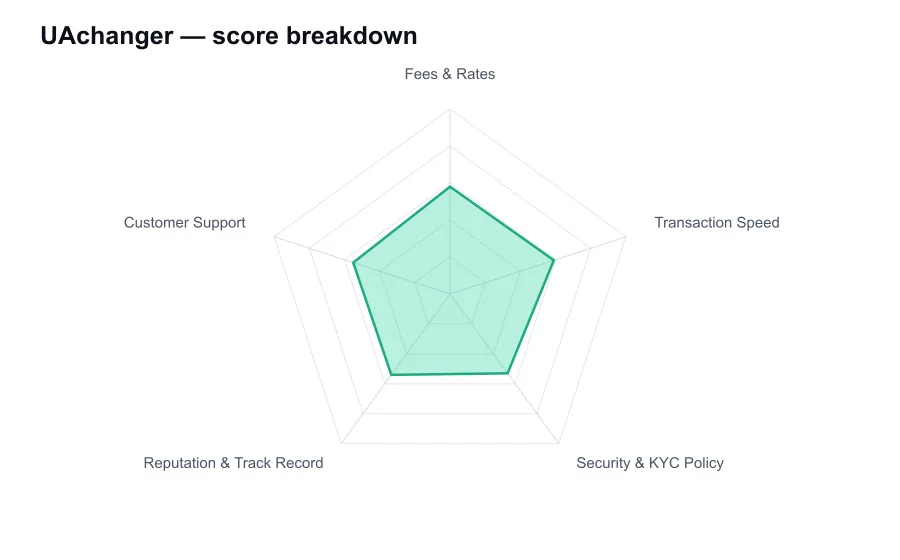
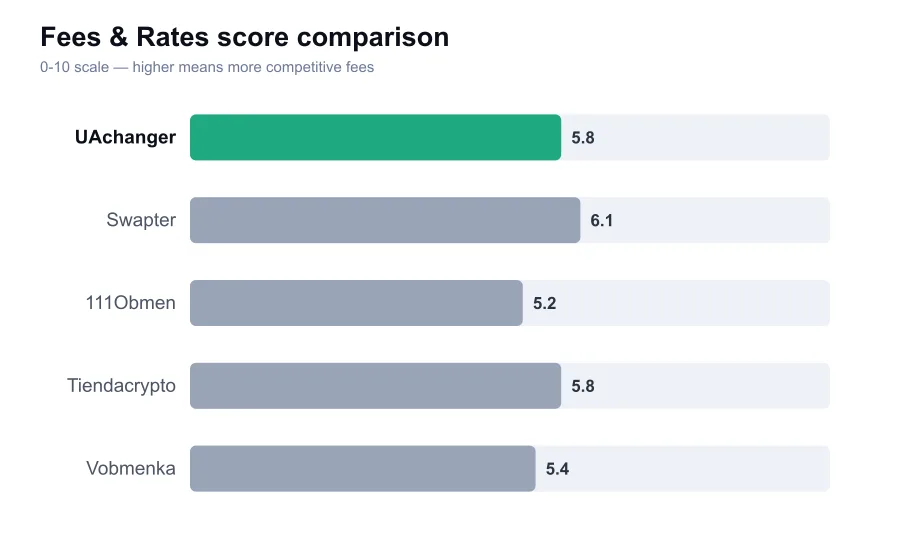
Fees require more work here than a simple percentage comparison. Regional exchange services commonly build their revenue into the displayed rate. That is not automatically a problem, because a bundled rate can still beat a low headline fee once card charges and withdrawal costs are added. But it does mean that a user must compare the final amount received, not merely search for a commission field.
For a UAH-to-crypto or crypto-to-UAH route, check at least three things before paying. Compare the quoted conversion against a market reference, account for any bank or card fee, and confirm whether the payout method has its own charges or limits. A quote may be attractive for a small amount and uncompetitive for a larger one. The spread can also widen sharply outside local banking hours or during volatility.
Speed depends on what is being exchanged. A stablecoin sent on a fast supported network can be processed much faster than a Bitcoin transaction waiting for confirmations. Card payments and bank transfers introduce another layer, since the exchanger may need to see settled funds before releasing crypto or fiat. If the order is manually processed, business hours and staff workload matter too. Do not promise a recipient a payment time based only on the word instant.
The operational context in Ukraine deserves respect. Payment connectivity and banking availability can be disrupted by events beyond any exchanger's control. That does not excuse poor communication, but it does make realistic expectations important. A platform serving Ukrainian users should explain whether an order is automatic, requires operator confirmation, or waits for a bank transfer to settle. Users should seek that answer before funding an urgent transaction.
Security is mixed in this segment. A direct exchanger limits exposure to the sprawling account features of a large centralized platform because there may be no standing account balance at all. On the other hand, the customer is trusting a relatively small business with payment details and a one-off transfer. There is less public infrastructure for independently checking reserves, custody practices, and incident response.
KYC should be approached as conditional. Crypto and fiat exchange businesses can be required to monitor transactions, while card and bank payment providers can add their own verification rules. A customer should not rely on a simple website flow as proof that documents will never be requested. If your funds come from legitimate trading, employment, mining, or savings, keep records that can explain the source if a compliance question arises.
Privacy-minded customers should also understand the difference between limited registration and anonymity. A bank card, transfer reference, phone number, or blockchain transaction can create a record even where no traditional account is opened. Do not use an exchange service in an attempt to bypass legal reporting, sanctions restrictions, or source-of-funds requirements. That is a fast route to a frozen order and a painful support case.
UAchanger's reputation appears primarily regional rather than international. That is not a criticism by itself. A Ukrainian customer may care more about whether an operator reliably handles a local card route than whether the brand has English-language reviews from every continent. Still, it means public evidence is less abundant than for major exchanges. I would look for recent independent feedback about the precise exchange direction, not merely a high aggregate rating.
Support is especially important where payments may require manual intervention. Ask whether there is a visible order status, how to provide a bank receipt, and which channel handles a missing payout. A useful support team will ask for a transaction hash or payment reference and explain the next verification step. A poor one will simply repeat that the order is pending. Save evidence before a payment session closes.
There is a practical advantage to a provider that knows local payment habits. Big global exchanges can be awkward with regional banks, local currency withdrawals, and changing card acceptance. UAchanger may be the more convenient answer for a customer whose needs are specific to the Ukrainian market. That advantage disappears if the rate is materially worse or if the route is unclear about timing and verification.
My recommendation is to use UAchanger selectively. It can make sense for users who have confirmed a currently supported route, understand the payment method, and need a local conversion rather than speculative trading. Start with a modest amount, especially for a new card or bank direction. For large crypto purchases, recurring trading, or assets that must be held securely, a well regulated exchange plus self-custody remains the stronger arrangement.
UAchanger's value is local utility, not global scale. It may solve a real problem that an international exchange does not solve elegantly, and that deserves credit. Yet the limited public transparency and variable nature of payment routes mean it should be used carefully. Check the net payout, preserve your records, and keep transaction size proportional to the evidence you have that the particular route is functioning well.