111Obmen is a small instant crypto exchange service aimed at people who want to swap coins without opening a conventional exchange account. It sits in the same broad category as services listed on exchange comparison sites, where the appeal is speed and a short checkout flow rather than trading tools, order books, or custody. That makes it useful for a narrow job. It does not make it a substitute for a major exchange or a wallet you should treat as your long term home for assets.
The service appears built around a straightforward exchanger model. You choose a send asset, choose the asset you want back, enter a receiving address, and transfer funds to a generated deposit address. The provider then completes the conversion through its own liquidity arrangements. That sounds simple because it is simple. The tradeoff is that customers have less visibility into how pricing, routing, and reserves are handled than they would on a transparent decentralized protocol or a large regulated platform.
111Obmen's first attraction is that it is not trying to trap users in an elaborate registration funnel. For a person with USDT who needs Bitcoin, Litecoin, or another supported asset sent to a personal wallet, a direct exchanger can be much less irritating than depositing into a full service exchange, waiting through checks, placing an order, and then withdrawing. The user experience has value, especially for occasional swaps. It is also where people need to slow down, because convenience can conceal a mediocre quote.
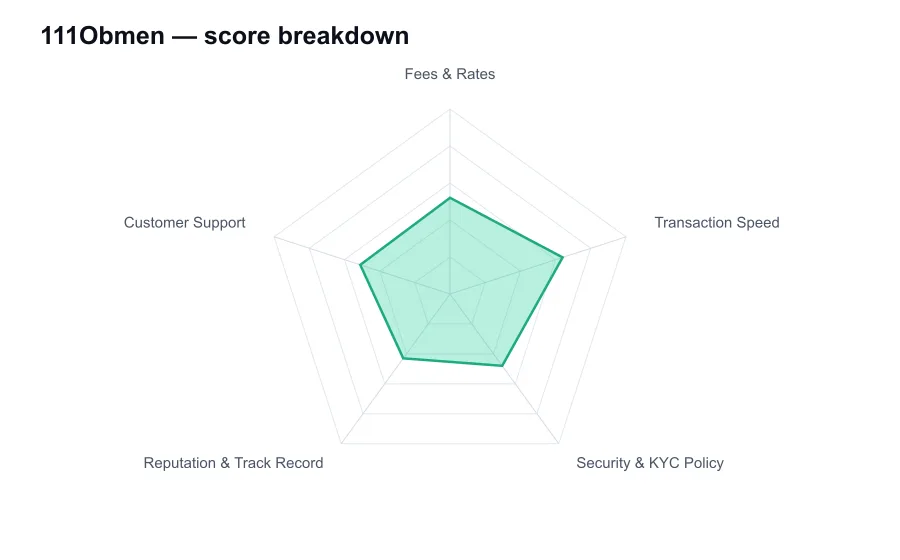
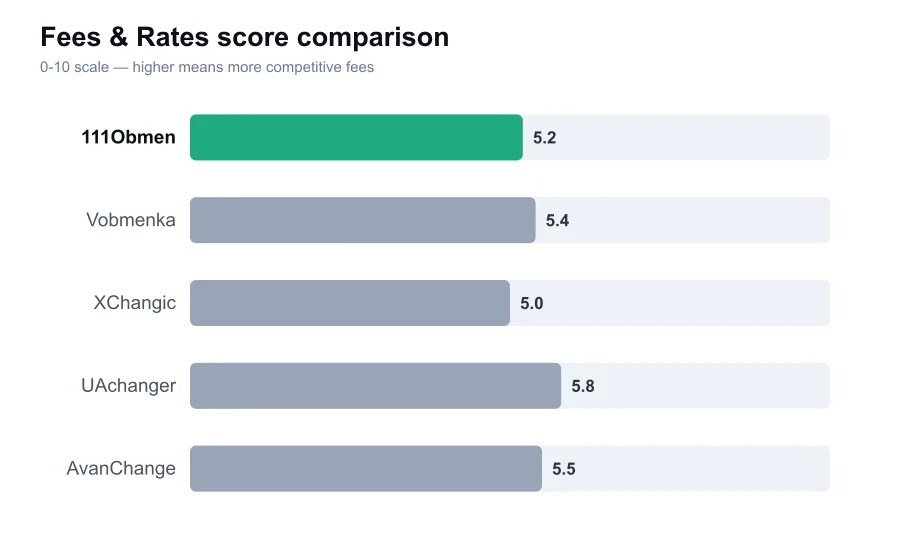
The fee question is less clear than it should be. Like many instant exchangers, the service generally presents a final amount rather than separating a tidy platform commission, spread, network charge, and liquidity cost. That means the effective price is the number to judge. A displayed rate may include the service's margin, the blockchain fee, and protection against market movement. If 111Obmen quotes materially less than the amount a major exchange or an on chain swap would deliver after withdrawal costs, the difference is the fee in practical terms, regardless of what the site calls it.
For small transactions, that all inclusive approach can be acceptable. Someone moving a modest amount of crypto may care more about avoiding several account steps than shaving a small percentage off the conversion. For larger orders, opaque pricing becomes a real weakness. A spread of even one or two percent can be far more expensive than a transparent maker or taker fee on Kraken, Coinbase Advanced, or Binance, particularly if the buyer already has an account there. Get at least two live quotes before committing a meaningful amount.
Fixed rate versus floating rate matters here as well. If the site offers a fixed quote for a limited time, that can protect the user during a sharp market move, though it may come at a less favorable initial rate. Floating quotes can settle better or worse depending on market conditions and the time it takes for the deposit transaction to confirm. This is not merely a technical distinction. A slow Bitcoin deposit during volatility can change the economics of a swap substantially.
Speed is one of the more plausible reasons to use a service like 111Obmen. Once the incoming transaction receives the confirmations the provider requires, many routine swaps should complete in minutes rather than hours. Yet customers should understand the two clocks involved. The blockchain controls the first clock, then the exchanger's liquidity and payout process controls the second. A congested Bitcoin or Ethereum network can slow the first part even if the service is responsive.
The practical danger is sending money before checking the exact network. USDT is especially easy to mishandle because it exists on multiple chains. A USDT transfer sent through an unsupported network cannot be treated as a routine exchange issue. It can become a recovery request, and recovery may be impossible or expensive. The deposit address, blockchain selection, memo requirement for assets such as XRP or XLM, and expected amount should all be checked twice before the transaction is broadcast.
111Obmen's security model is fundamentally different from an account based exchange. It does not appear to require users to leave a standing balance under its control, which reduces the risk of a dormant exchange account being drained later. Still, every swap requires temporary trust. You send funds first, and the provider has possession of them until it sends the return asset. That is a meaningful counterparty risk, especially compared with an atomic transaction or a self custodial decentralized exchange.
The service presents itself as a no registration style exchanger for ordinary transactions, but that should never be read as an unconditional promise of anonymity. Most exchanges reserve the right to request identification or transaction source information where automated risk controls, compliance screening, or unusual transaction patterns trigger a review. A user who cannot tolerate delay should not send funds that may need to be explained later. No KYC at the front door is not the same thing as no compliance review under any circumstance.
Public reputation is where 111Obmen needs the most scrutiny. It does not have the institutional history, audited public reporting, regulatory footprint, or broad independent coverage of the industry leaders. A presence on monitoring sites and user review pages can be useful, but it is not a guarantee. Reviews can be genuine, selective, outdated, or manipulated. The sensible approach is to look for recent feedback about completed payouts, support handling, rate changes, and unresolved complaints rather than counting star ratings alone.
Customer support is likely important if something goes wrong, because the standard exchange flow leaves little room for self service correction after a deposit is sent. Keep the order ID, transaction hash, wallet screenshots, and the exact amount sent. A good support team can reconcile a delayed transaction. It cannot reverse a transfer to the wrong blockchain or repair an address typo. Before placing a larger order, test the responsiveness of the listed support channel with a specific question about the route you intend to use.
There is no compelling reason to make 111Obmen your default venue for all crypto conversions. It is more defensible as a convenience tool for small, carefully checked, one off exchanges where the quote is competitive and you understand the network. The lack of broad public transparency means the service has to earn trust transaction by transaction. Start small, verify the output independently, and move on if the pricing or communication is vague.
My view is cautious rather than dismissive. A no account exchanger can be genuinely practical, and 111Obmen may suit users who value a direct wallet to wallet path. But its limited public profile and less transparent effective pricing prevent a strong recommendation for substantial sums. Experienced users should compare it with better documented instant swap services and conventional exchanges before choosing it. Treat it as a transactional service, not a financial institution.