ClickPay should not be reviewed as though it were another instant cryptocurrency exchange. It is primarily a payment gateway and payment technology provider for merchants, with a focus on card processing, online checkout, payment links, invoicing, and related business tools. That puts it in a different category from ChangeHero, Changelly, and ChangeNOW. A person looking to swap Bitcoin for USDT will not find the same product here.
The distinction matters because payment companies are often included in broad fintech or crypto payment lists despite not operating a public crypto exchange. ClickPay's core customer is a business that wants to accept online payments and manage checkout rather than a retail trader seeking liquidity. Its value should be assessed through merchant onboarding, settlement, payment success rates, fraud controls, integrations, and support, not through token pair coverage.
For a merchant, ClickPay's payment stack can be useful. It offers hosted checkout functions, payment links, invoices, plugins, and application programming interfaces intended to connect a business website or app to payment acceptance. These are the normal building blocks of a gateway provider. They can reduce the work required to accept cards and local payment methods, especially for merchants serving the regions where ClickPay has established commercial relationships.
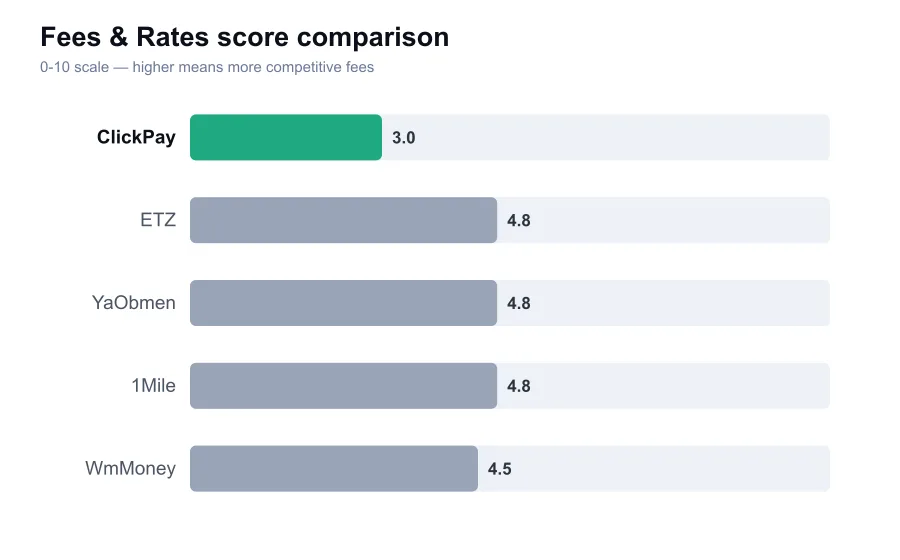
Fees are harder to score than they are for a public crypto exchange. ClickPay does not operate with one publicly universal trading commission because merchant rates commonly depend on country, payment method, business category, transaction volume, settlement currency, and underwriting outcome. That is ordinary for acquiring services, but it reduces price transparency for a small business evaluating options. You need a written quote, including refund, chargeback, settlement, and cross-border costs.
This lack of a simple price card is my central criticism. A merchant payment service can appear inexpensive at the checkout level while charging more through foreign-card uplift, refund handling, rolling reserves, or currency conversion. None of those charges are inherently improper. They become a problem when a sales team quotes only the attractive percentage and the merchant discovers the rest after integration. Demand the full commercial schedule before committing engineering time.
Transaction speed also has two meanings here. Payment authorisation is usually near-instant, as it should be with card gateways. Merchant settlement is separate and can take longer depending on the acquiring arrangement, banking days, fraud review, and local market setup. Do not confuse an approved card payment with cleared money in your bank account. A business that needs same-day liquidity should ask ClickPay for settlement terms in writing.
ClickPay's security value lies in payment controls, not self-custody of cryptocurrency. Its merchant tools are designed around the familiar needs of payment acceptance: secure checkout, fraud management, card-data protection, access control, and operational monitoring. A sensible merchant should still verify the exact compliance scope for the account and integration being purchased. Security badges alone do not answer whether your own site, staff permissions, and refund process are well protected.
KYC is not optional in the way it can be at an instant exchanger. Merchant onboarding requires business verification, beneficial-owner information, and underwriting appropriate to the service and jurisdiction. This is normal, and in fact it is what a serious merchant should expect from a payment provider. If someone wants to process payments without sharing business details, ClickPay is the wrong type of company from the start.
The cryptocurrency angle needs particular caution. A payment gateway may support crypto-related merchants or offer particular digital-asset payment features through partners in some markets, but that does not make it a crypto exchange or wallet. Availability can change by country, merchant category, and regulatory approval. Before advertising crypto acceptance, obtain confirmation that your entity, market, asset type, and settlement preference are actually supported under your agreement.
ClickPay's reputation is tied more to regional merchant payment operations than to public crypto user reviews. That makes the evidence different from a retail exchange. You should look for merchants in your country and industry, speak to a reference if possible, and ask about approval rates, dispute handling, account management, and settlement reliability. A glossy checkout page is easy to demonstrate. Reliable acquiring support during a dispute is what tells you whether the relationship has value.
Support is also more consequential for merchants than for consumers. If an API integration breaks or a checkout page rejects legitimate customers, every hour can cost sales. ClickPay provides business support channels and implementation materials, but prospective clients should test responsiveness before a full migration. Ask pre-sales questions that need a technical answer. That gives a much better impression than judging a provider solely by how fast it replies to a generic contact form.
There is a real use case here for businesses operating in markets where local acquiring, language support, and regional payment knowledge are more valuable than another global processor's polished dashboard. A merchant may reasonably prefer a provider that understands local cards, invoicing habits, and settlement expectations. The trade-off is that pricing and service terms need more direct scrutiny than a self-serve payment product with one global public rate.
For crypto users, however, the recommendation is simple. Do not choose ClickPay expecting a place to buy, sell, swap, stake, or self-custody digital assets. It does not compete with Coinbase, Kraken, ChangeNOW, or decentralised exchanges on those functions. If ClickPay appears in a crypto-related directory, treat that listing as a payment infrastructure reference, then verify exactly what digital-asset capability, if any, is live for your merchant account.
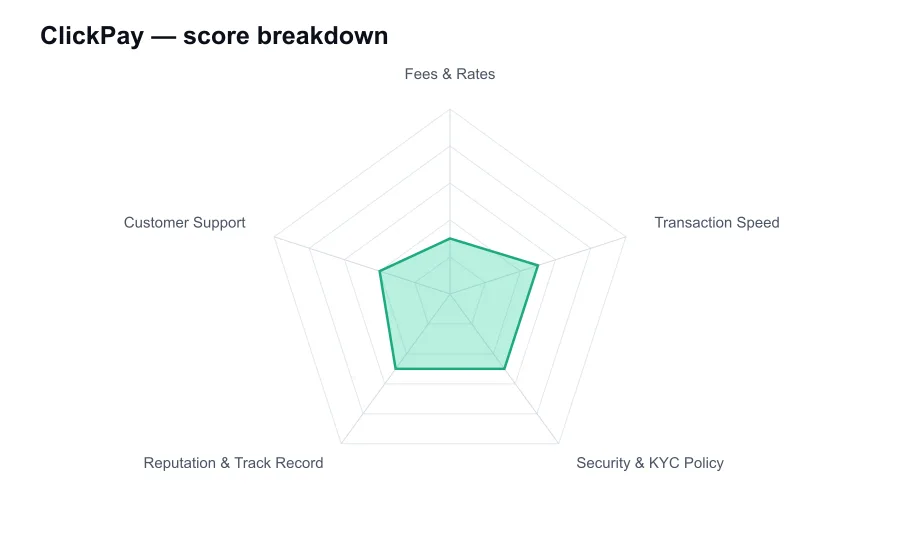
My view is that ClickPay can be a legitimate option for a merchant seeking a payment gateway, especially where its regional coverage matches the business. It is a poor fit for a retail crypto exchange comparison because it is not a retail crypto exchange. The fee score is deliberately modest because public merchant pricing is not universally simple, and the crypto-specific score cannot be high where the core product is elsewhere. Judge ClickPay as a commercial payments provider, get its contract terms in writing, and do not buy a service category it does not actually offer.