Acechange is a small instant cryptocurrency exchange service aimed at users who want to swap one asset for another without opening a conventional trading account. It sits in the same broad category as ChangeNOW, SimpleSwap, and LetsExchange, but it has never built their visibility, liquidity profile, or public operating record. That matters more here than a polished swap screen. With a minor exchange, the central question is not whether the form accepts your order. It is whether you can confidently predict what happens after funds leave your wallet.
The basic flow is familiar. Select a pair, enter the amount and destination address, receive a deposit address, then send the source asset. Acechange quotes a rate before the deposit is made and subsequently delivers the output asset after network confirmations and its own conversion process. It is convenient in the narrow sense that there is no order book to understand, no custody balance to maintain, and no trading interface full of advanced settings.
That simplicity should not be confused with a low-risk experience. Instant exchangers are intermediaries, even when they market themselves as non-custodial. For a period of time, they control the coins you sent and determine when the replacement asset is released. A user can avoid maintaining a standing account, but cannot avoid counterparty risk during the swap. Acechange gives prospective customers relatively little independently verifiable material with which to assess that risk.
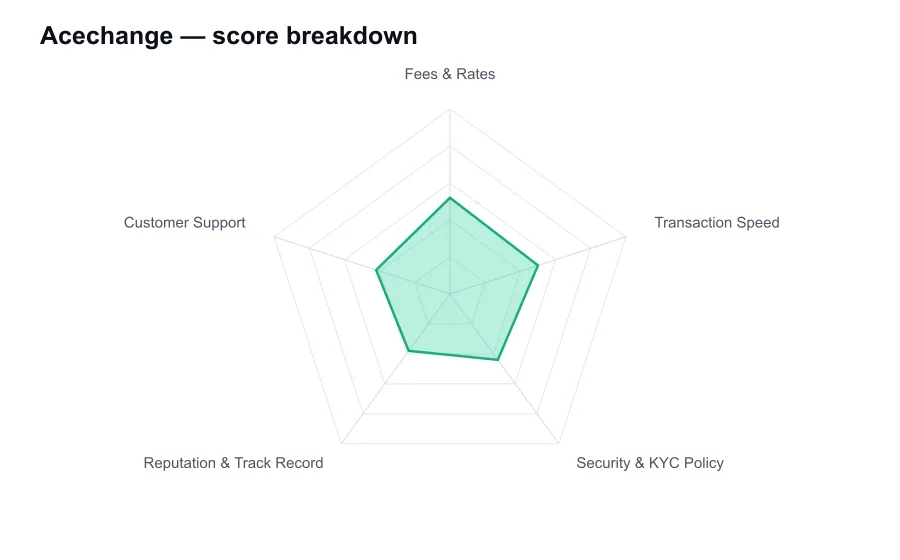
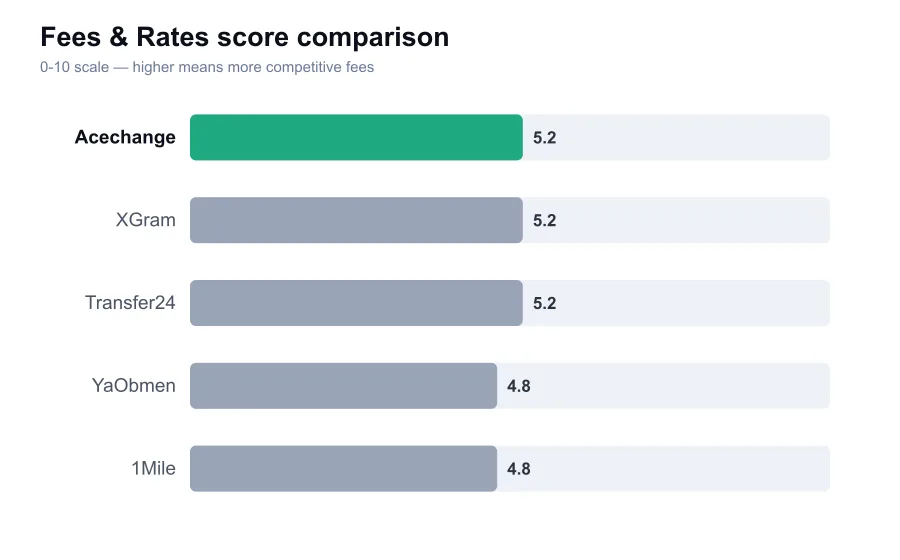
Fees are the first area where this lack of disclosure becomes frustrating. The service presents an all-in quoted amount rather than a clean, durable public fee schedule. That is common in this category, but good operators still explain whether a quote is fixed or floating, where network charges enter the calculation, and what happens if the market moves before confirmation. Acechange's pricing is better treated as a live retail quote than as a transparent exchange fee. Compare the final receive amount against at least two larger competitors before sending anything.
A floating quote can look competitive at the start and become less attractive after a volatile asset takes several confirmations to arrive. Bitcoin and Ethereum swaps are especially vulnerable to this issue during a fee spike or sharp market move. If Acechange offers a fixed-rate option for a particular pair, read the conditions carefully. Fixed rate normally means a time-limited deposit window and a defined tolerance, not a promise that any late or underfunded transfer receives the original quote.
Small swaps are the sensible way to test this service. The rate difference on a modest conversion may be acceptable if the transaction completes cleanly, but the economics change quickly on a four-figure order. A visible quote does not show the service's spread against the underlying market, and users should not assume the lack of a separately labelled fee means the swap is cheap. A spread is still a fee in practice, even if it is buried in the exchange rate.
Speed depends partly on the networks involved and partly on the liquidity provider behind the transaction. A swap cannot begin in earnest until the incoming transfer reaches the required confirmation threshold. Bitcoin may take materially longer than a token transfer on a fast chain, while congested Ethereum transactions can be delayed at both ends. Acechange does not have the broad operational evidence of established providers that would make me comfortable treating its advertised timing as a dependable service commitment.
The support process is therefore more important than it looks. When a swap works, support hardly matters. When a deposit is sent with an incorrect memo, a token uses the wrong network, or a quote expires, support becomes the entire customer experience. Acechange appears to rely on web-based contact channels rather than a mature, publicly documented support operation with obvious escalation paths. That can be adequate for routine questions, but it is not what I want around a time-sensitive, high-value transfer.
Security and identity checks require a similarly cautious reading. Instant exchange services often advertise a low-friction experience, yet reserve the right to request verification under anti-money-laundering procedures. Acechange should be approached on that basis. Do not interpret an initially account-free swap as a guarantee that no documents will ever be requested. If a transaction is flagged, the service may pause the exchange while it asks for information about identity, source of funds, or the transaction's purpose.
That policy is not automatically unreasonable. Screening obligations are a reality for centralized conversion services. The problem is whether the provider clearly communicates the trigger, the evidence it accepts, the expected review process, and its treatment of an incomplete case. Acechange does not offer the depth of compliance and corporate transparency that would let a cautious customer assess those questions before funds are committed. Larger regulated brokers are more intrusive, but at least their rules and legal entities are easier to identify.
Its public reputation is the weakest part of the proposition. Acechange has a far lighter independent footprint than the established names in instant exchange. Scarce reviews are not proof of misconduct, and a young or niche business can serve customers perfectly well. They do mean there is less evidence from which to judge settlement consistency, complaint handling, ownership, and the provider's response to difficult transactions. That is a meaningful distinction, not a cosmetic one.
I would also be careful about third-party review pages. A handful of positive comments can be genuine, but they do not establish how a service behaves in the cases that create real losses: delayed deposits, chain reorganization issues, compliance holds, or a wrong destination tag. Look for dated reports with transaction details, then weigh them against the service's own published terms. Anonymous praise with no useful context should not carry much weight.
Acechange may appeal to someone who needs a small, straightforward conversion and has independently found a rate that is clearly better than alternatives. Even then, send a test transaction first, retain the transaction ID, and make sure the receiving address supports the exact network selected. Never send a token to an address generated for a different chain merely because the ticker symbol looks identical.
My view is blunt. Acechange is usable only as a cautious, low-value option for experienced self-custody users who understand instant-exchange mechanics and can absorb a delay. It does not provide enough public transparency or established reputation to justify making it a default service. For a substantial conversion, I would choose a better documented provider, a regulated broker, or an exchange where support and custody arrangements are easier to verify.