1Mile is a little known crypto exchange brand that appears in the instant exchange corner of the market rather than among major custodial platforms. It should be evaluated as a transactional service, not as a broad trading venue. Its likely appeal is a quick conversion between assets with less account friction than a conventional exchange. Its problem is equally clear: there is far less independently verifiable information available about the business, its operators, reserves, security practices, and long term performance than there is for established names.
That information gap matters. Small exchange services can work perfectly well for years, and a limited marketing footprint is not proof of misconduct. But a consumer cannot responsibly treat absence of evidence as evidence of strong operational controls. The more money a service asks you to trust it with, even briefly, the more you should expect clear ownership information, meaningful legal documentation, responsive public support, and a track record that can be checked outside its own website.
The basic instant exchange model is familiar. A customer selects a pair, obtains a quote, enters a destination wallet address, and sends the input asset to a deposit address. The provider processes the exchange and sends the output to the supplied address. This flow has a genuine advantage over opening a full exchange account for one swap. There is no need to maintain a trading balance, and the customer can receive the result directly into a personal wallet.
The downside is that the user sends funds before receiving the converted asset. That creates a temporary custody relationship whether the brand uses that language or not. If a transaction is delayed, repriced, blocked for review, or sent to the wrong network, the customer depends on the operator to resolve it. On a large exchange, there may be formal ticketing, published legal entities, and public escalation channels. With a lightly documented exchanger, the customer's practical leverage is much weaker.
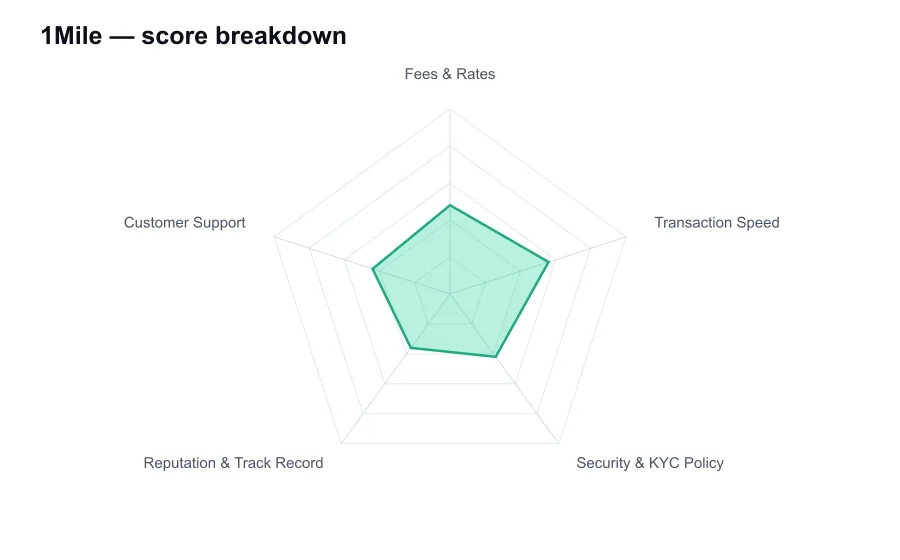
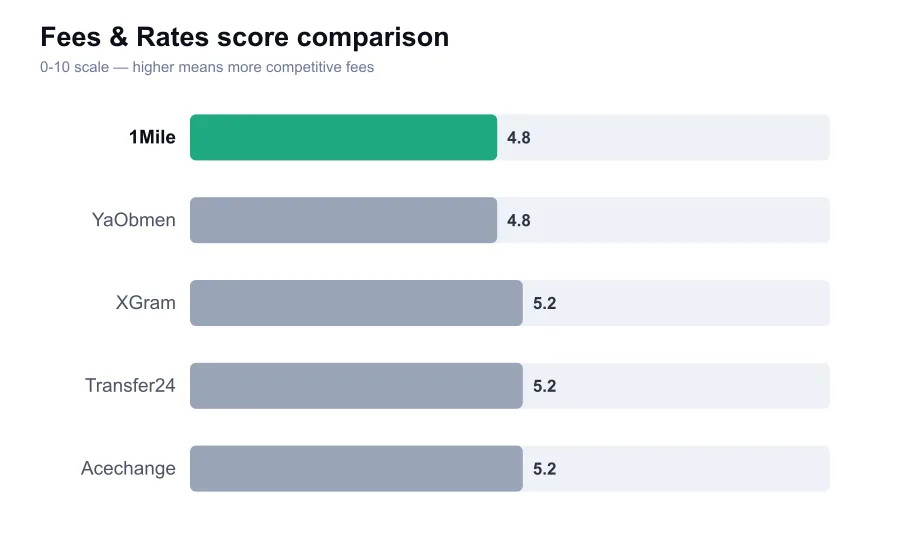
Pricing should be treated with skepticism until the final quote is compared. Smaller instant exchangers rarely provide a clean schedule that separates a platform fee from the market spread, mining fee, and liquidity charge. The effective fee is the gap between the amount you could obtain elsewhere and the amount shown on the quote. A service can advertise attractive rates yet still deliver a weak net result once the spread and network cost are included.
For modest swaps, the difference may be tolerable. Paying a little more for fewer steps can be rational if time and convenience matter. It is not rational to accept an unexplained difference on a large conversion. Compare the result against at least one major centralized exchange after its withdrawal fee and at least one self custodial swap route if you are using compatible assets. If 1Mile's quote is not competitive, there is no special feature here that justifies paying a large premium.
Transaction speed is also best understood as conditional. A provider can begin processing immediately, but it cannot make a Bitcoin transaction confirm faster or undo a congested Ethereum mempool. The input chain's confirmation requirement is the first source of delay. The provider's internal review, liquidity availability, and output network are the next. A quote that says an exchange is fast should be read as a target for ordinary conditions, not as a guarantee during volatility or network congestion.
Users should be especially careful with stablecoin networks. USDT and USDC exist on several blockchains, and an asset label alone is not enough to identify a route. Sending a token on a different chain from the one selected in the order can leave the provider unable or unwilling to recover it. Some assets also require a destination tag or memo. Those details are unglamorous, but they are much more important than a polished landing page.
On identity verification, the sensible reading is that an instant exchange may allow a basic order without traditional registration, while retaining the ability to ask questions later. Anti fraud systems can flag unusual amounts, addresses associated with risk tools, or payment patterns. Anyone who needs an uninterruptible transfer should use a provider with a clearly explained verification policy and should be ready to document the source of funds. No account requirement does not guarantee that every payment will be processed without review.
1Mile's reputation score is held back primarily by limited public evidence, not by a documented claim that the service has failed every customer. That distinction is important. I would not repeat anonymous accusations as fact without proof. I also would not give the benefit of the doubt that one can give to a company with many years of transparent public operation, regulatory registrations, recognized security audits, and broad professional coverage. Reputation is earned through evidence, and there is not much of it to inspect here.
Support is where a small exchanger either earns repeat business or loses it. A short form, chat button, or email address is not enough by itself. What matters is whether a customer with a delayed transaction receives a clear explanation tied to a transaction hash and an order identifier. Before using 1Mile for anything significant, send support a precise pre sale question. Ask whether your chosen network is supported and how a transaction sent with an incorrect amount is handled. The quality of the answer is useful information.
Security advice for customers starts with reducing the amount exposed. Do not send a wallet's full balance because an exchange form looks simple. Start with an amount you can afford to have delayed while you assess settlement and communication. Use a wallet address under your control, save every transaction record, and never rely on a search advertisement or a random social media link to find a crypto service. Phishing clones are common precisely because exchange forms are easy to imitate.
I would also avoid using a small instant service as a bridge for complex activity. It is not the right venue for margin trading, recurring purchases, large treasury conversions, or moving assets under time pressure. A direct swap can be fine for a narrow task. It is a poor foundation for a financial workflow that needs reporting, formal support commitments, or multiple layers of security.
1Mile can be considered only as a small transaction tool, and only after the live quote and network details are independently checked. It may satisfy users who already understand self custody and simply want an account light conversion path. It does not clear the bar for a confident recommendation on substantial sums because too much about the operation is difficult to verify publicly.
My final take is blunt. The service has the basic convenience of an instant exchanger, but convenience is abundant in crypto and trust is not. The lack of a strong public track record and clearly verifiable operating detail weighs more heavily than a short checkout flow. Use a test transaction if you decide to try it. For larger transfers, choose a better documented provider with deeper liquidity, transparent support channels, and a long record of completed operations.