StealthEX is an instant cryptocurrency exchange broker built around quick wallet to wallet conversions. It occupies the same practical niche as SimpleSwap, ChangeNOW, and LetsExchange: users choose an asset pair, send crypto to a generated address, then receive the chosen output coin in a personal wallet. There is no conventional order book for customers to trade against, and there is no reason to treat it as a decentralized exchange. The service sits in the middle of the transaction, sources execution, and manages the payout.
Its main selling point is friction reduction. A person holding Bitcoin in a hardware wallet who wants USDT on Tron does not have to open a centralized exchange account, wait through a deposit workflow, place a market order, and request a withdrawal. StealthEX offers a direct route. That can be genuinely convenient, especially for users who already understand blockchain transfers. It is less attractive for people who need fiat deposits, advanced trade orders, proof of reserve reporting, or a support team capable of restoring account access.
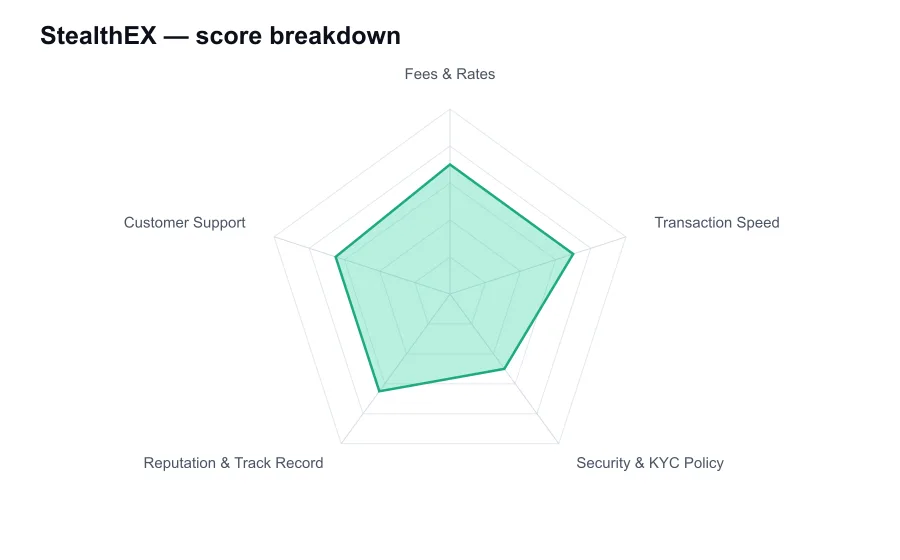
StealthEX has been active since 2018 and has built a larger public profile than many instant exchange sites. The brand has wallet and ecosystem integrations, an affiliate program, public reviews, and a sizable list of supported assets. Those facts give it a meaningful reputation advantage over a newly launched broker. They do not put it in the same risk category as a regulated centralized exchange. An instant exchange is still an intermediary handling a transfer during execution, even if it does not operate a long term customer balance.
The service advertises support for more than 1,400 cryptocurrencies. That breadth is useful, but it needs context. A listing can mean a route is technically available through a partner, not that it has the liquidity, price quality, or settlement reliability of Bitcoin, Ethereum, USDT, USDC, or Solana. I like StealthEX for ordinary, liquid conversions. For a thinly traded token, I would check the quote against alternatives and avoid assuming the provider can resolve every obscure network issue quickly.
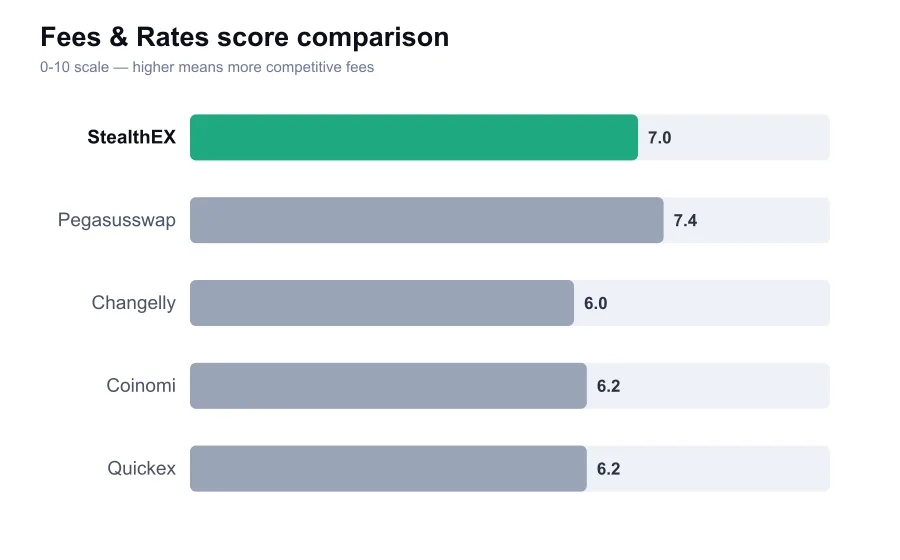
Fees are embedded in the exchange rate. StealthEX does not use a simple published universal percentage that can be applied to every swap. The quote includes the provider's routing economics and normally accounts for the network cost needed to send the output. That is standard for this business model, but customers need to judge it by results. The right question is not whether the homepage uses the word low fee. The right question is how much of the destination asset reaches your wallet compared with competing quotes at the same minute.
StealthEX can offer both floating and fixed rate routes, depending on the asset pair. Floating transactions expose the final result to market movement while the swap is being processed. Fixed rate transactions offer more certainty, usually at a slightly less favorable price because the service takes the volatility risk. I prefer fixed rate for a payment sized conversion where the exact output matters. For a routine swap between liquid assets during a calm market, a floating quote may produce a better result, but it should be monitored rather than forgotten.
Speed is generally solid on popular routes. After the deposit receives the required confirmations, a liquid conversion can often complete in a matter of minutes. The bottleneck is frequently the source chain rather than StealthEX. Bitcoin may require more waiting than a fast network, Ethereum can become costly or delayed during congestion, and cross chain stablecoin routes depend on both deposit confirmation and output network conditions. Anyone promising an exact completion time for every pair is selling a story, not describing crypto infrastructure.
The service provides a transaction status page and order ID, both of which are essential for an exchange broker. Keep them. If an order gets stuck, those records plus the deposit transaction hash are what support will use to trace the route. Users should also know that a quote can be invalidated by practical errors. Sending less than the required amount, using an unsupported network, omitting a destination tag, or depositing after a fixed rate window has expired can turn a quick swap into a manual support case.
StealthEX markets itself as a no registration service, which is broadly true for standard swap initiation. Yet no registration should never be read as no compliance controls. The company can request KYC documents when a transaction is flagged by anti money laundering systems or a liquidity partner's policies. That is a major point of friction for customers who expected a completely private service. The best defense is not outrage after a hold. It is recognizing in advance that a brokered swap service can screen blockchain activity and pause an order.
Security is adequate for the category, but it is not exceptional. The noncustodial description means users do not need to leave funds in a permanent exchange account. During an active swap, however, the service controls the operational path from deposit to payout. A customer is trusting its systems and liquidity partners to execute correctly. StealthEX has more years of visible operation than many competitors, which helps. It does not have the kind of public proof of reserves, regulated custody framework, or formal consumer protections that justify treating it like a bank.
Support is one of StealthEX's better points. It offers live chat, email support, an order tracking function, and an established help center. Public customer sentiment is still uneven. Routine swaps usually generate little drama, while complaints commonly arise around delayed payouts, KYC requests, or misunderstanding floating rate results. That is not unique to StealthEX, but it does reveal the limit of the model. Support can investigate an order, but it cannot make a congested chain instant or guarantee a compliance review will disappear.
The provider also has a mobile application presence, which may appeal to users who exchange from their phones. I remain cautious about using any exchange app for a high value transfer on a mobile connection. A browser wallet on a carefully verified site is not automatically safer, but a phone makes it easier to rush, mistype, or overlook the selected network. The safest transaction is the one reviewed slowly, whether it begins from an app, a desktop wallet, or a hardware wallet.
StealthEX compares well with SimpleSwap in convenience and broad coverage. Its large asset list is a genuine strength, while its quote based cost model is a reason to shop around. ChangeNOW often has similar strengths and similar compliance caveats. For the best pricing on major assets, a centralized exchange can be cheaper if the user already has an account and is willing to manage deposits and withdrawals. StealthEX wins on simplicity, not on transparent trading economics.
My assessment is positive with boundaries. StealthEX is a credible option for modest, carefully checked crypto swaps and has done enough over several years to avoid the unknown provider category. It is still an exchange broker with variable effective fees, possible compliance holds, and no guarantee that a difficult transaction will feel painless. Compare rates, choose the correct network, retain the order details, and keep large value transfers on platforms with stronger accountability if that accountability matters to you.