SimpleSwap is one of the more recognizable names in the instant exchange category. It is built for users who want to convert crypto quickly from a wallet, without maintaining balances on a centralized trading platform. The company acts as a swap broker, sourcing liquidity and sending the customer an output asset after the incoming transaction confirms. That puts it in the same broad camp as ChangeNOW, StealthEX, SwapSpace, and LetsExchange, rather than Coinbase, Kraken, or an onchain automated market maker.
The attraction is obvious. Pick a pair, enter a receiving address, send funds, and wait for the payout. There is no charting terminal, no maker and taker order book, and usually no account setup for a basic crypto to crypto swap. SimpleSwap has operated long enough to be a familiar option in wallet integrations and exchange comparison results. That history makes it easier to trust than an unknown swap widget, although it does not remove the ordinary risks of sending coins to an intermediary.
SimpleSwap supports a large catalog of crypto assets and networks, which is useful for people moving beyond Bitcoin, Ethereum, and a handful of stablecoins. Asset availability is not the same as deep liquidity, though. A popular BTC to USDT or ETH to USDC route is generally less troublesome than an obscure token conversion. For thinly traded assets, the quote can be less competitive, the minimum may be higher, and the provider may need more time to source liquidity. I would always check the exact network before treating an asset listing as usable.
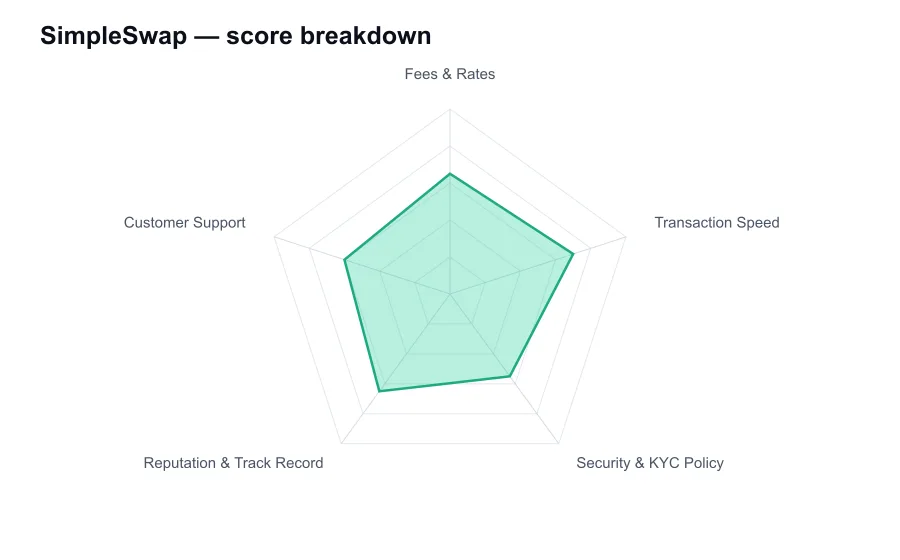
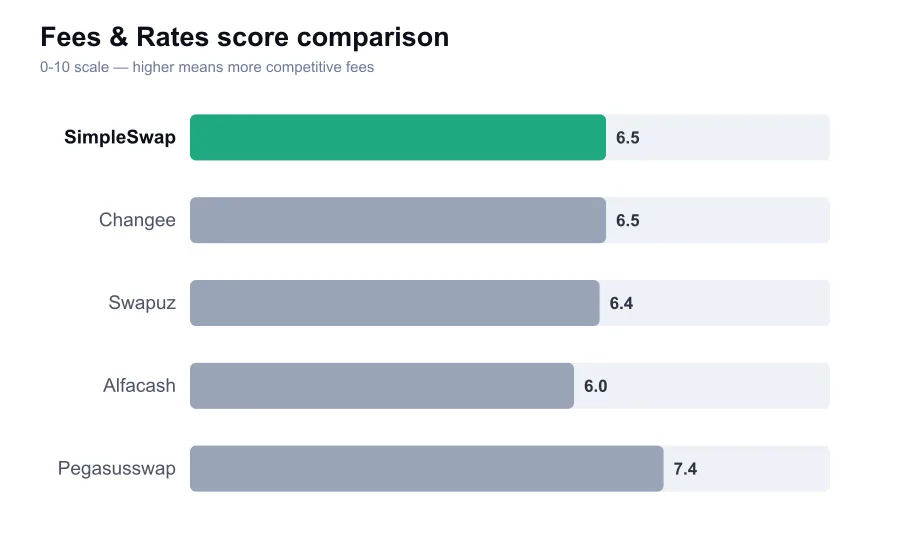
Fees are not presented as a clean universal percentage because SimpleSwap's effective cost is embedded in the rate shown for a particular route. It offers floating and fixed rate options. Floating rate swaps track the market during execution, while fixed rate swaps are intended to lock the quoted output subject to the provider's stated conditions and deposit requirements. The fixed option is valuable when a user needs price certainty, but it is usually priced less generously than a floating quote. That is normal, because the provider is taking market movement risk.
My experience of this category is that the rate comparison matters more than any headline about low fees. Open SimpleSwap, StealthEX, and ChangeNOW at the same time, use the same input amount, and compare the output after all quoted costs. SimpleSwap can be competitive on major routes, but it is not reliably the cheapest. Its margins can become noticeable on smaller coins and complex cross chain paths. A customer who accepts the first quote because the site looks simple is paying for convenience without checking whether the premium is reasonable.
Speed is usually good for mainstream pairs. Once the incoming blockchain transaction has the confirmations required by the selected route, a liquid swap often completes in minutes. Bitcoin deposits take longer because confirmation time is dictated by the Bitcoin network, not SimpleSwap's interface. Ethereum and ERC20 transfers can be affected by gas conditions. Some routes involve several liquidity providers or manual operations, which can stretch a swap far beyond the optimistic estimate displayed before payment. The estimate is useful, but it is not a guarantee.
The fixed rate option can reduce one type of stress, especially during a volatile market. It does not eliminate operational risk. Send the wrong asset, use the wrong network, underpay the deposit, or miss a destination memo, and the order may require support intervention. The recovery process can take time and, depending on the asset, may involve a network fee or be impossible. This is why SimpleSwap is best used by people who understand wallet addresses and network labels, even though its front end is welcoming to beginners.
SimpleSwap's no registration approach deserves a precise explanation. A routine exchange can generally be started without creating a trading account or uploading documents. That is not a promise of unconditional anonymity. Like other centralized swap brokers, SimpleSwap reserves the ability to request verification when automated risk systems or compliance procedures identify a transaction for review. A user who values privacy should understand that distinction before sending funds. If a transaction is held, refusing a verification request may leave the customer with a slow and frustrating resolution path.
The company has public legal and compliance material and a customer support structure that is more developed than what one sees from many small anonymous swap sites. It also uses transaction monitoring in line with the standards common among exchange intermediaries. That is better than silence, but it also means the service should not be treated as a censorship resistant protocol. If you need a permissionless exchange, use a self custody decentralized protocol with full awareness of smart contract and liquidity risks. SimpleSwap is a convenience service, not that.
On security, SimpleSwap benefits from a noncustodial framing in the narrow sense that it does not hold a permanent customer account balance like a centralized exchange. Yet during a swap, it has control of the incoming funds and the payout process. The key security question is therefore operational reliability. Its years of public presence and broad use are reassuring, but users should still avoid leaving a transaction unattended, should verify every address, and should never assume a delayed order is impossible simply because a quote was generated.
Support is accessible through live chat and email, and the site provides order tracking and help content. That is a practical advantage over obscure competitors. Public feedback is mixed in the way it is for nearly every instant exchange. Many customers report routine fast swaps, while complaints tend to focus on compliance requests, rate changes in floating orders, or delays with particular assets. I don't dismiss those reports. The real test of support is the difficult case, and no brokered exchange can promise that a difficult case will be pleasant.
SimpleSwap's reputation is respectable rather than spotless. It has accumulated a real public track record and established partnerships, which counts for a lot in this corner of crypto. Still, it is not a regulated full service exchange with the disclosure obligations and customer protections associated with major fiat platforms. The service should be judged as a mid tier exchange broker. It is materially more credible than a new anonymous site, but it is not where I would park funds or execute a six figure transfer without a serious reason.
The best use case is a wallet user who needs a direct one time conversion and is prepared to compare quotes. For example, converting a mainstream coin into USDC on the correct supported network can be faster and less annoying than moving assets onto a centralized exchange, placing a trade, and withdrawing again. For recurring trading, serious price discovery, or fiat cash out, SimpleSwap is the wrong tool. A conventional exchange provides more control, even if it asks more of the user.
SimpleSwap earns a solid but not uncritical recommendation. Its interface is straightforward, its fixed and floating options give users a useful choice, and its public history is meaningful in a category packed with lookalikes. The cost is variable, the compliance risk is real, and support quality becomes less predictable when an order goes off script. Use it for what it is, a convenient exchange bridge for normal sized self custody swaps, and it does the job well enough.