Quickex is a non-custodial instant exchange service aimed at people who want to swap one cryptoasset for another without opening a trading account. It occupies the same broad category as ChangeNOW, SimpleSwap, LetsExchange, and FixedFloat. The attraction is obvious: choose a pair, provide a receiving address, send coins, and wait for the exchange to complete. For a one-off conversion, that can be far less irritating than registering at a conventional exchange.
The service is best understood as an exchange aggregator and execution layer, not a full order-book venue. Quickex does not offer the trading tools, fiat rails, lending products, or extensive portfolio controls that users get from Binance, Kraken, or Coinbase. That narrower remit is not a flaw. It means Quickex can remain straightforward, though it also leaves users with fewer tools when something goes wrong.
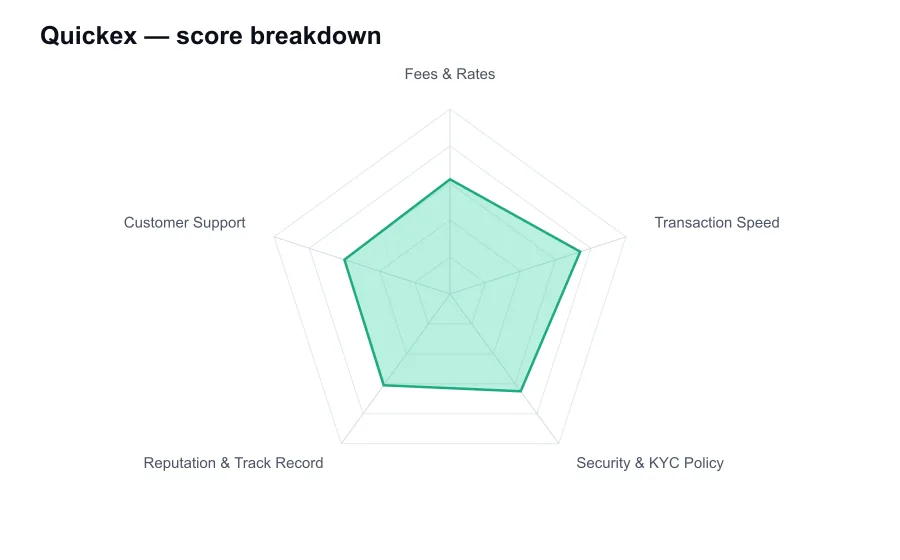
Pricing is the first area where instant exchanges deserve skepticism. Quickex offers floating-rate and fixed-rate quotes. A floating quote is usually cheaper at the point of quotation, but the final amount can move while the transaction is being processed. A fixed-rate quote gives greater certainty, although its quoted spread usually absorbs more market risk. Neither option should be mistaken for a transparent, flat trading commission.
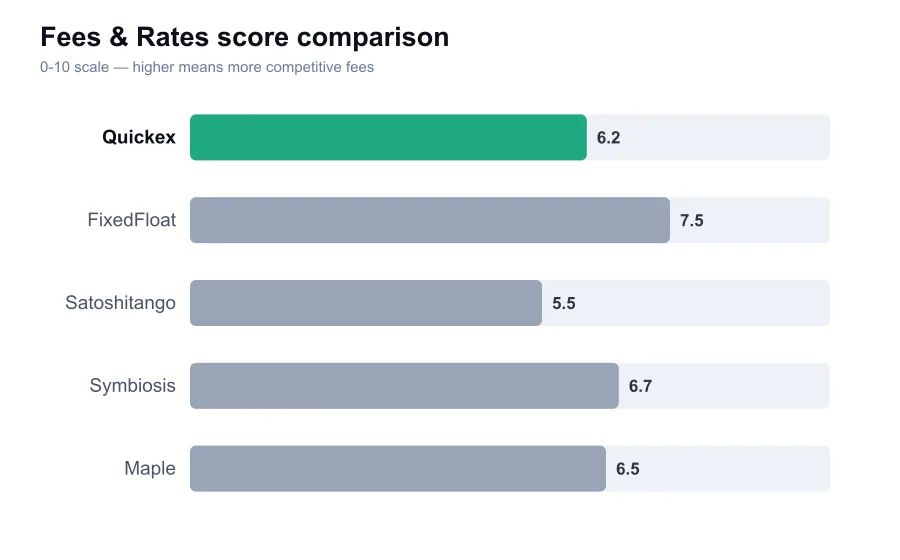
Quickex does not prominently publish one universal percentage fee for every pair. Its effective cost is embedded in the displayed quote and can vary by asset, liquidity source, blockchain congestion, and trade size. That is common in this segment, but it makes direct comparison harder. Before sending funds, compare the net receive amount against ChangeNOW, StealthEX, and a liquid centralized exchange. A quote that looks convenient can still be materially more expensive than a spot trade plus withdrawal.
For small swaps, the premium may be acceptable. Saving twenty minutes of registration and avoiding custody can be worth a few dollars. For a large conversion, it is usually worth doing the arithmetic. The relevant figure is not a marketing claim about low fees. It is how much BTC, ETH, USDT, or SOL reaches your wallet after the provider's spread and network costs have been taken.
Speed is usually good when both networks are functioning normally and the route has adequate liquidity. Many common swaps complete in minutes after the deposit receives the required confirmations. Bitcoin transactions naturally take longer than transactions on faster networks such as Solana, Polygon, or Tron. A busy Ethereum mempool can also make a supposedly instant exchange feel anything but instant.
The weak point is that Quickex cannot control every part of the route. It relies on blockchains, liquidity partners, and its own compliance checks. A swap can pause if an incoming transaction needs more confirmations, if a liquidity provider reprices, or if automated risk monitoring flags the funds. The website's estimate is useful as an expectation, not a guarantee of settlement by a particular minute.
Quickex's non-custodial framing is meaningful, but users should apply the term carefully. The service does not hold a standing balance in the way a centralized exchange does. During a swap, however, you still send assets to an address controlled for transaction processing. That is temporary counterparty exposure. If the trade fails or is held for review, you are dependent on Quickex support and its stated refund process.
The platform can request identity verification in certain circumstances, despite the relatively light onboarding flow. That is a normal feature of services that screen transactions for sanctions, fraud, and illicit-finance indicators. It is not equivalent to a fully anonymous swap. Anyone whose main requirement is certainty that no documents will ever be requested should not send funds to any centralized instant exchange service.
There is little publicly visible corporate history comparable to the long records of Kraken or Bitstamp. Quickex has operated for several years and has built recognition among instant-swap users, but it is still a smaller brand than the market leaders. That matters because reputation in this category is tested during delayed orders, refund disputes, and compliance holds, rather than during a smooth ten-minute conversion.
Public reviews are mixed in the way one would expect from a high-volume service dealing with irreversible transfers. Many customers report routine completed exchanges and quick execution. The harsh complaints tend to concern AML reviews, requests for information after deposit, delayed payouts, and disagreements about a changed rate. Those reports do not automatically prove misconduct, but they are exactly why users should begin with a small test transaction.
Customer support is available through the site's support channels and order tracking tools. For normal orders, the transaction ID is the key piece of information. Keep the deposit transaction hash, the order ID, the receiving address, and screenshots of the quote. Support agents can do much more with those details than with a general message saying that a swap has not arrived.
I would not call Quickex a venue for urgent, high-value transfers where a missed timing window could be expensive. The lack of a deep public fee schedule and the possibility of compliance review make it less predictable than trading on a regulated exchange where you already have an approved account. It is better suited to self-custody users making ordinary conversions who value simplicity and understand that convenience has a price.
My take is that Quickex is a credible utility service, not a default home for crypto trading. Its flow is easy, its asset selection is broad, and a successful swap usually requires very little effort. Still, the opaque all-in pricing and unavoidable reliance on a centralized operator keep it below the best transparent trading venues for serious volume. Use it for the job it does well, check every quote carefully, and keep your own wallet under your control.