Changelly is one of the oldest names in the instant crypto swap business. Launched in 2015, it has survived long enough to become familiar to users who have never opened an account there directly, because its conversion service has also appeared inside wallets and partner applications. It is an instant exchange, not a full order-book trading venue. That distinction is central to judging it fairly.
The basic Changelly proposition is convenience. Pick a pair, enter the wallet address that should receive the output, send the input asset, and wait for the conversion. There is no need to park a balance in an exchange account for a standard transaction. That is attractive for self-custody users, particularly people moving between assets for a specific reason rather than trying to trade a market all day.
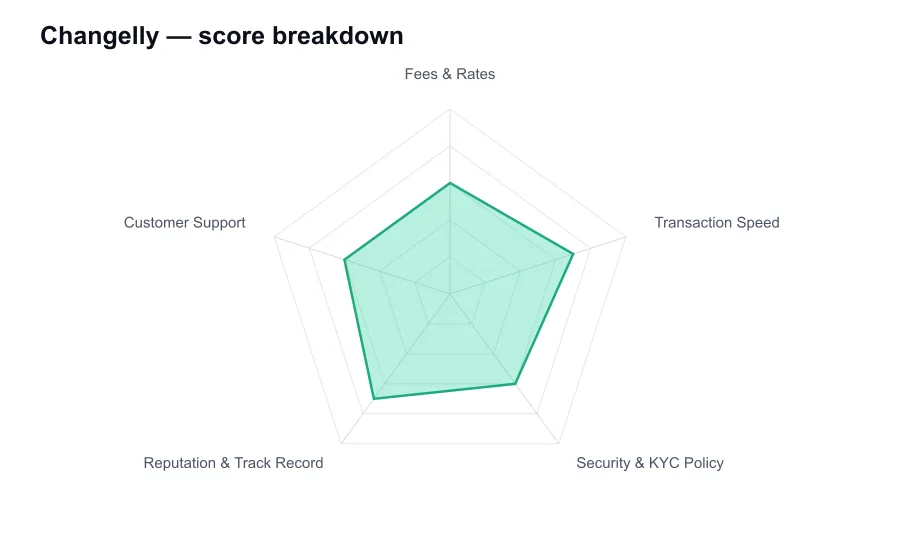
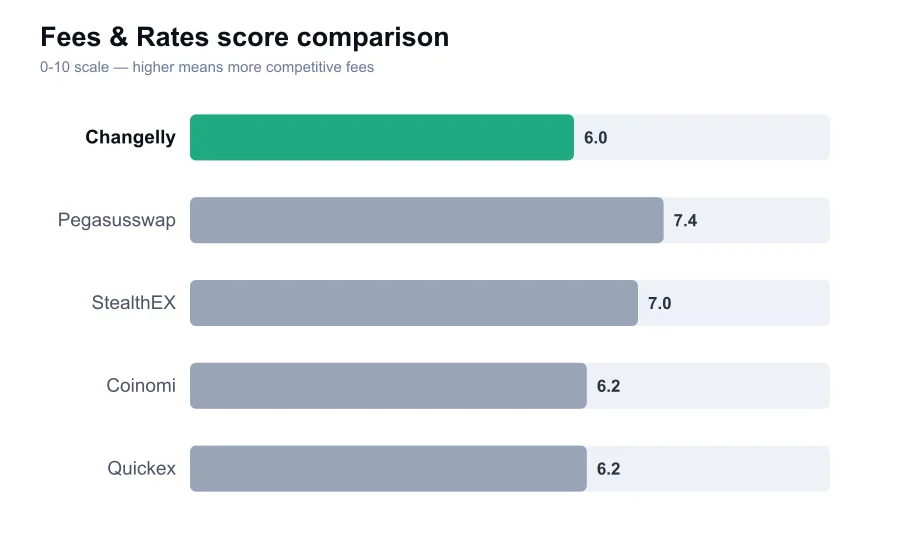
Changelly's headline floating-rate service has historically advertised a 0.25% service fee. That number is real, but it should never be read as the whole cost of a swap. The rate also reflects available liquidity and the spread supplied by exchange partners, while the sending network can impose its own fee. On highly liquid pairs, the final quote can be competitive. On thin coins or volatile periods, the difference versus a major spot exchange can be substantial.
This is why the receive amount is the only fee comparison that matters. Get simultaneous quotes from Changelly, ChangeNOW, and a conventional exchange after accounting for withdrawals. A trader moving several thousand dollars of BTC into stablecoins will often find an order book cheaper. Someone exchanging a modest amount of an obscure token may find Changelly's single-step experience worth the premium. The service is priced for convenience, not for market-making efficiency.
Changelly offers fixed-rate exchanges for selected routes, alongside its floating-rate option. Fixed rates are useful if you need certainty about the output, but they require the deposit to arrive during the stated window and under the specified conditions. Sending the wrong amount, choosing a slow fee on Bitcoin, or waiting until the quote is nearly expired can turn a supposedly fixed exchange into a support case. Read the payment instructions rather than assuming every rate is locked forever.
Speed depends first on the asset you send. A confirmed Litecoin or Tron transfer can move through quickly. Bitcoin and Ethereum can be slower, and their speed is mainly dictated by the network fee you chose. Once funds are credited, Changelly's liquid routes usually process promptly. Its historical scale and broad partner network give it a modest advantage over lesser-known swap brands, although it cannot eliminate network congestion or a counterparty maintenance event.
The security model needs a more critical reading than the phrase non-custodial suggests. Changelly does not operate like an exchange where customers hold an ongoing trading balance. Still, it receives your funds during the swap and controls the conversion process. There is counterparty risk until your output arrives. For a routine conversion this is manageable, but it is not the same as swapping directly through a self-custody decentralised protocol.
KYC is risk-based rather than routinely mandatory for every simple order. Changelly can require verification under its AML procedures, and users have reported that flagged transactions can be held while documentation is reviewed. This is the area where the service's public reputation has taken damage. A person who sees Changelly as a guaranteed anonymous service may be disappointed. A person who understands it as a compliance-screened business that sometimes asks questions will have more realistic expectations.
The company has attracted plenty of positive feedback over the years, especially for straightforward conversions. It has also received serious criticism from users whose funds were delayed in compliance reviews. Those complaints should not be dismissed as mere impatience. A swap service has a duty to explain what it can, provide a clear document path, and return funds where a transaction cannot be completed. Changelly's age lends credibility, but age does not erase frustration around freezes.
Changelly's support is available through its help centre and live support channels, and it has extensive explanatory material for common issues. That is helpful before a transaction. During a review, however, support quality is measured by the clarity and pace of the compliance team, not by a chat widget. The difference can be stark. Do not send funds that you may urgently need before you have considered that risk.
Asset coverage is broad, with hundreds of available cryptocurrencies and multiple network variants for major stablecoins. Breadth is useful, but it creates a major user responsibility. An asset ticker does not identify the network. USDC on Ethereum, Solana, Polygon, and other chains may each be separate routes. Always select the exact chain and inspect the deposit instructions. A wrong-network deposit is not a normal delayed swap and may be impossible to recover.
Changelly also offers an exchange product in some regions, but that should not be confused with the core instant-swap service. The regular swap flow is the better reason to use the brand. If you want charts, limit orders, recurring purchases, fiat banking rails, tax exports, and a more conventional account relationship, there are stronger choices. Changelly excels at a narrow job, and it becomes less compelling when forced into roles it was not built to fill.
I would be particularly cautious with large transfers. A large transaction magnifies any pricing spread, any possible compliance pause, and any error in a receiving address. Splitting a non-urgent transfer into sensible portions is often safer, though repeated swaps can add costs. For a one-off, keep records of the quote, order ID, sending transaction hash, and payout address. Those details are your evidence if support needs to investigate.
Changelly remains a legitimate and useful instant exchange, but its long history should not be mistaken for a blank cheque. The 0.25% advertised service fee is easy to understand, the fixed-rate option is valuable, and the network of supported assets is genuinely extensive. Yet its all-in execution can be costly and its risk-based verification policy can feel harsh once funds have already been sent. I would use Changelly for a carefully checked, ordinary swap. I would not use it for urgent money, opaque coin history, or a trade large enough that execution quality really matters.