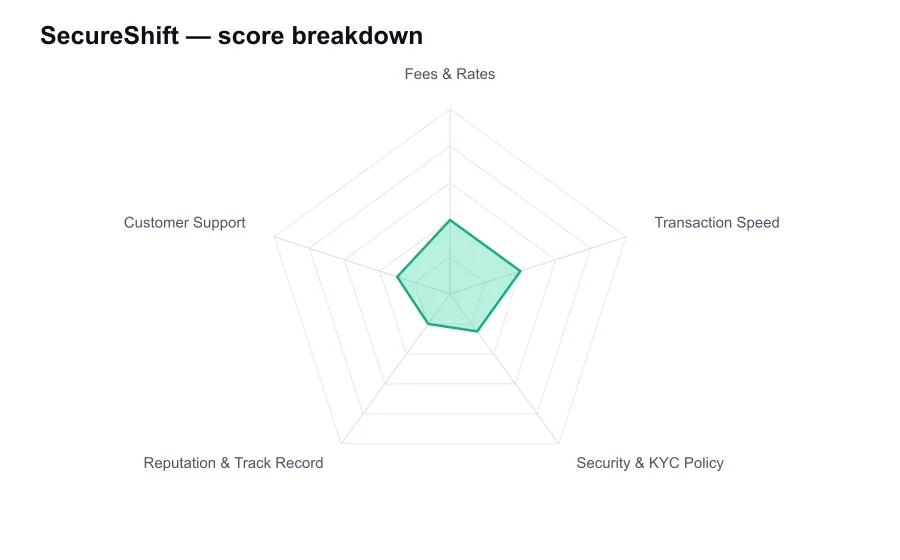
SecureShift presents itself as an instant crypto swap service, aimed at people who want to exchange one asset for another without opening a trading account or learning a traditional exchange interface. That is an attractive pitch, particularly for occasional users who simply want to move from Bitcoin to USDT or exchange an altcoin held in a self custody wallet. The problem is that SecureShift has a very thin public footprint compared with established instant exchangers. Its site and brand do not carry the same volume of independently verifiable operating history as SimpleSwap, ChangeNOW, StealthEX, or SwapSpace.
That lack of public evidence shapes this review more than any marketing claim. An exchange service asks users to send irreversible funds to an address it controls before receiving the output asset. In that situation, reputation is not a cosmetic category. It is the product. A provider can have a clean interface and a long list of coins, but if a user cannot readily establish who operates it, what its escalation process is, and how it handles a failed swap, the convenience has a hard ceiling.
SecureShift's basic flow appears familiar. The user selects an input and output asset, enters a recipient address, receives a deposit address, then waits for the provider or its liquidity partner to complete the conversion. This is a brokered exchange process rather than a decentralized atomic swap. The service is therefore responsible for routing, pricing, screening, and settlement. Users should not confuse an accountless checkout with a trustless trade. Funds are still exposed to operational risk between deposit and payout.
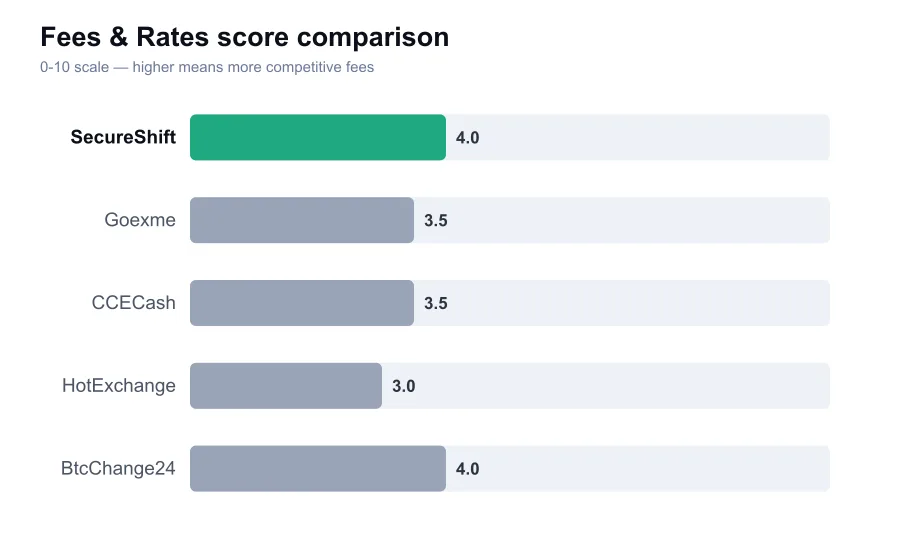
Pricing is difficult to assess with confidence because SecureShift does not have the kind of clearly documented, durable fee schedule that experienced users should expect. Instant exchange providers often build their margin into the quoted rate, then may face additional network costs or liquidity adjustments. That does not automatically mean the quote is unfair. It does mean the only meaningful comparison is the final amount received against two or three competitors at the same moment. With SecureShift, I would treat every quote as a one off offer, not as evidence of a consistent low fee policy.
That approach matters most on small trades. A service can advertise no registration and still deliver a weak rate once its spread, miner fee allowance, and third party routing costs are included. For a $50 or $100 swap, the difference may look trivial in percentage terms but can still be several dollars. On larger transfers, a modest hidden spread becomes much more expensive. SecureShift has not earned enough pricing transparency to be my first choice for a high value conversion.
Speed claims need similar restraint. The actual settlement time for any instant exchanger depends on the source chain's confirmations, the liquidity route, the destination chain, and whether the transaction triggers manual review. A fast Bitcoin to Litecoin swap may finish in well under an hour, while an ERC20 transaction sent during high Ethereum congestion can take much longer. SecureShift does not have a sufficiently broad body of independently documented completed orders for me to rate its consistency alongside better known services.
The weak point is not that delays can happen. Every noncustodial exchange broker has delayed orders, especially when a wallet sends an incorrect amount or a chain is busy. The concern is whether there is a transparent status page, a persistent order identifier, responsive support, and a documented procedure for returning funds if an order cannot be completed. SecureShift does not provide enough readily verifiable evidence on those practical safeguards. That is a serious drawback for a business handling irreversible transfers.
Its KYC position should also be read carefully. SecureShift may offer a flow that does not require routine account registration, but that is different from guaranteeing that identity checks will never occur. Most exchange brokers reserve the right to request information when blockchain screening, source of funds controls, or partner compliance rules flag a transaction. If the service asks for documents after receiving funds, a customer needs to know what will happen if they decline or cannot satisfy the request. Publicly available detail on that process appears limited.
Security is not just about whether a site uses HTTPS or claims to avoid custody. Good instant exchangers explain their operational model, list support channels clearly, publish usable legal terms, and give customers enough information to distinguish a network issue from a compliance hold. SecureShift does not offer the level of externally verifiable security documentation I would want before trusting it with meaningful value. I found no widely recognized security audit program, public proof of reserves, or substantial institutional track record that would offset that uncertainty.
That does not prove wrongdoing. It does mean a cautious reviewer should avoid filling the gaps with optimism. Crypto users have repeatedly learned that a polished swap widget is easy to build and difficult to judge. A new provider can be legitimate, but legitimacy needs to be demonstrated through consistent service, transparent policies, and years of public customer experience. SecureShift has not yet established that record in a way I can independently verify.
Customer support is another area where scale matters. Smaller services commonly rely on web forms, email, and chat. That can work if the team responds quickly and has the authority to solve a stuck order. But there is little public material showing how SecureShift handles complex cases such as wrong network deposits, missing tags, delayed partner payouts, or compliance reviews. A person moving stablecoins for a deadline should not have to discover the support quality after their funds are already in transit.
For users determined to test the service, the sensible method is a very small transaction with a mainstream pair and a carefully checked address. Save the quote, order ID, transaction hash, and screenshots before sending. Do not use it for a first transfer on an unfamiliar network, a time sensitive payment, or a large amount that would be painful to have held for several days. Those are not paranoid habits. They are ordinary precautions for an exchange intermediary with limited public history.
SecureShift also faces a difficult competitive reality. SimpleSwap and StealthEX are far from perfect, but both have more visible market presence, broader discussion among users, and more developed support material. A centralized exchange such as Kraken or Coinbase may require an account and identity checks, yet provides clearer custody, support, and fiat exit options. SecureShift needs to offer unusually strong rates or unusually reliable execution to overcome its transparency disadvantage. I have not seen enough evidence that it does.
My view is blunt: SecureShift may be usable for a small experimental swap, but it has not earned the confidence required for substantial transfers. The issue is not one dramatic public failure. It is the absence of the things a careful customer should be able to verify before sending money. Until the service publishes clearer operating information, firmer policies, and a longer independently visible track record, better known alternatives are the rational choice.