CCECash is another small exchange-style provider operating far outside the public visibility of the major crypto brands. It appears aimed at users who want a direct conversion process rather than a full account with order books and advanced tools. That can make the service easy to understand, but ease of use should not be confused with an established risk framework.
A provider of this size has to win confidence with unusually clear documentation. Customers need to know who operates the service, what jurisdiction applies, how rates are set, which networks are supported, and what happens if an order is stopped. I was not able to verify the depth of public information necessary to give CCECash high marks on those questions.
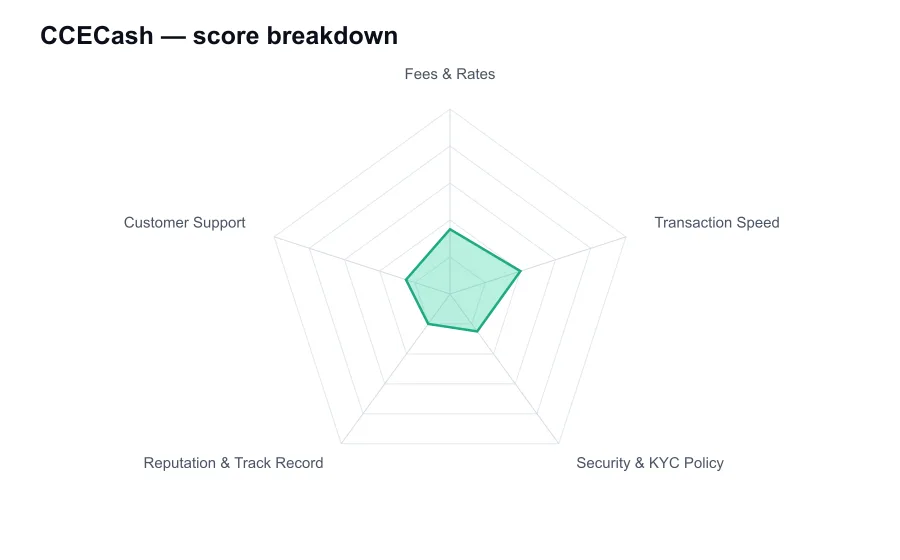
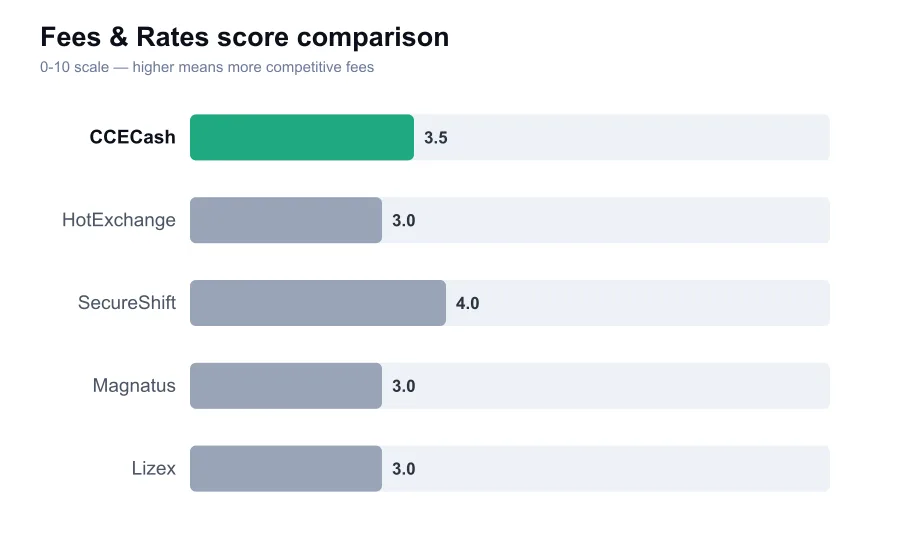
The first practical concern is pricing. A quote-based exchanger can show an attractive rate until the customer notices that the final payout reflects a spread, a network charge, or both. There is nothing inherently wrong with a spread. It becomes a problem when the service does not make it easy to distinguish provider compensation from unavoidable blockchain costs.
CCECash should therefore be judged by the final amount received, not by a displayed market-price comparison. Run the same pair through a well known service and compare like for like. Use the same amount, the same minute, and the same payout network. If the difference is material, the smaller provider's convenience is unlikely to justify the additional counterparty risk.
Transaction speed may be perfectly acceptable on simple liquid pairs, but it is not something I would assume. Any service that receives a deposit and sends a separate payout has operational steps between those events. Blockchain confirmations, treasury management, liquidity sourcing, wallet maintenance, and security screening can all affect completion time.
This matters more for CCECash because a smaller public footprint gives the user fewer tools for judging a delay. With a large exchange, status pages, support forums, public incident reports, and large review samples provide context. With a small provider, a delayed order can leave the customer relying almost entirely on a private support response.
Security is the weakest part of the proposition. I could not verify robust public evidence of independently audited systems, reserve reporting, insurance arrangements, formal security certifications, or detailed incident disclosures. Those items are not mandatory for every small exchanger, but their absence makes it difficult to establish whether operational security matches the promises made at checkout.
The right posture is to assume that any funds sent to CCECash are exposed to counterparty risk until the payout lands in your own wallet. Never leave a balance there. Do not use an address controlled by someone else as the payout destination. And do not send an asset over a network merely because the ticker looks correct, because recovery from a wrong-network transfer may be impossible.
KYC and transaction holds deserve attention before the first transfer. A provider may allow users to create an order without opening a traditional account, while still retaining the right to request identification under anti-money-laundering rules. The crucial details are what triggers a review, whether the customer can cancel, and how a refund is handled if verification is not completed.
CCECash's reputation score is low because I cannot identify the breadth of independently verifiable history that would support a higher score. That is an evidence problem, not an accusation of misconduct. Still, a customer deciding where to send irretrievable crypto should respond to missing evidence conservatively, especially if the amount is substantial.
Support is another area where the burden lies with the prospective customer. Test the channel with a real question before placing an order. Ask about the precise blockchain network, memo requirements, estimated processing, and the procedure for a deposit that arrives below the requested amount. Generic marketing replies are not enough.
There may be narrow cases where CCECash is useful, such as a small exchange involving a route unavailable at a larger platform. Even then, check the liquidity and use a low value test. It is not the right venue for regular trading, business cash flow, or the conversion of savings.
A lack of public information can become expensive during a dispute. Users should save every relevant detail: the quote, the order identifier, sending transaction hash, destination address, timestamps, and communications. These records may be needed to prove that a deposit arrived and to follow any support escalation.
My opinion is blunt. CCECash has not supplied enough independently visible evidence to warrant broad trust. It may be functional for a controlled small transaction, but its opacity on fees, security, operational history, and support makes it a poor choice when established alternatives are available. Use it only if you have a specific reason, and keep your exposure minimal.