HotExchange is another crypto exchange name that lacks the visible standing of major centralized exchanges and established instant-swap brands. The name itself is generic, and that is not a trivial concern in crypto, where cloned websites and similarly named services are common. A user should verify the precise domain before sending any funds.
The available public information does not support treating HotExchange as a proven mainstream exchange. I could not verify the kind of detailed operating history, regulatory disclosures, independently established liquidity, or widely documented customer experience that would justify a high trust score. That is the central fact readers need to understand.
A crypto exchange can mean many things. It may be a custodial platform holding customer balances, an instant converter that briefly receives deposits, or a peer-to-peer service matching users. HotExchange does not provide enough reliably verifiable public detail for me to confidently credit it with the protections associated with any mature version of those models.
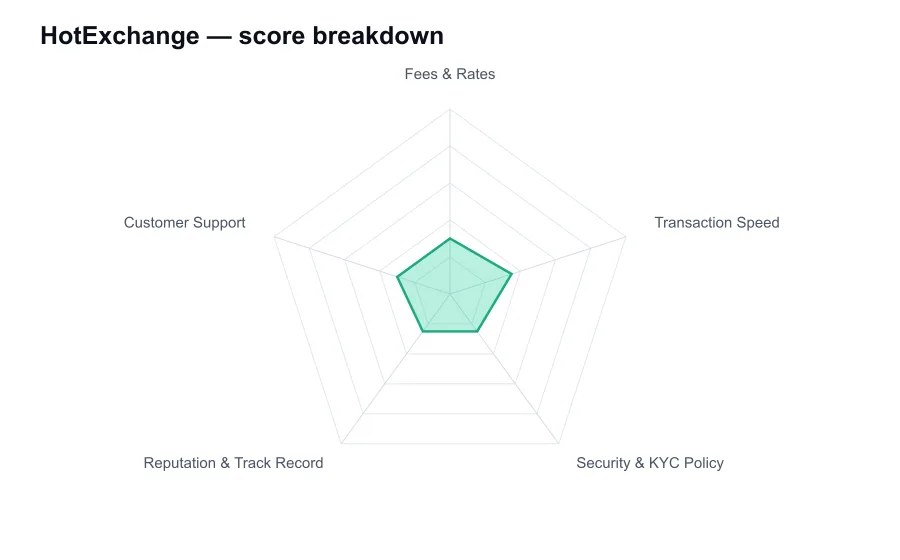
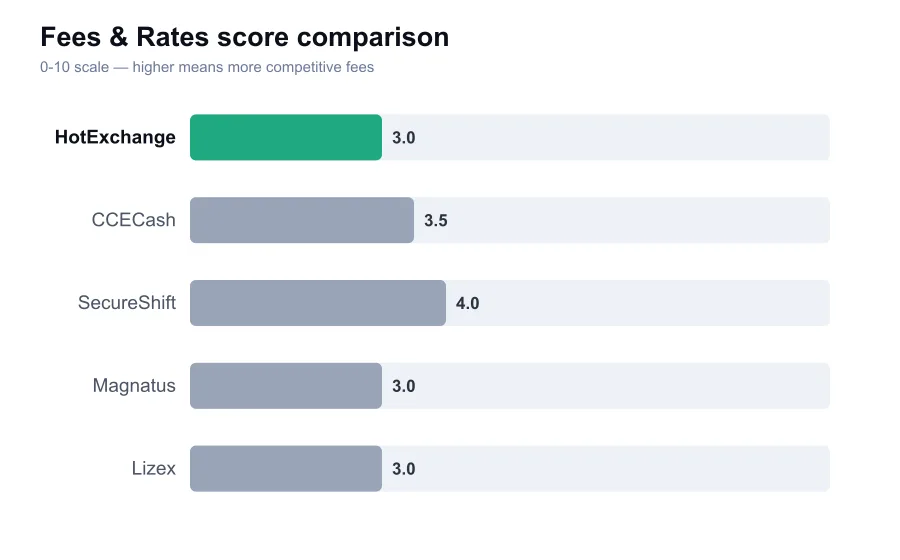
Fees are an immediate concern because opaque pricing is one of the most common ways lesser-known exchange services become expensive. A low advertised trading fee means little if spreads are wide, withdrawal charges are excessive, or users discover a conversion fee only after placing an order. I could not confirm a complete, dependable fee table for HotExchange.
That uncertainty makes direct comparison difficult. A well-run exchange publishes maker and taker fees, withdrawal costs, deposit rules, minimum order sizes, and supported networks. Users should not have to infer the price of moving their own money. If the platform does not disclose these details plainly, it has not earned the benefit of the doubt.
Speed is also impossible to rate highly without evidence. A site can process an on-chain deposit only after the underlying blockchain confirms it. Beyond that, the important questions are whether orders fill from real liquidity, whether withdrawals are processed automatically, and whether manual review creates delays. I found insufficient evidence to treat HotExchange as consistently fast.
Security should be judged by more than a claim that funds are safe. Strong providers describe two-factor authentication, withdrawal confirmation, cold-storage practices, monitoring, incident response, and account recovery. Regulated exchanges can still fail, but at least their control structure is usually visible. HotExchange does not offer enough verifiable security detail to inspire comparable confidence.
KYC policy is another area where ambiguity is dangerous. If HotExchange is custodial, identity checks, source-of-funds questions, and withdrawal holds may affect users. If it operates as an instant exchanger, blockchain screening may still interrupt a transaction. A customer needs to know those rules before depositing, not after an account is frozen or a swap is delayed.
The provider's reputation is too thin for a favorable score. There is a major difference between being unknown and being new with a documented team, transparent terms, and responsive public support. HotExchange does not present a strong enough public record for me to recommend it against recognizable alternatives such as Kraken, Coinbase, Bitstamp, or even longer-running instant exchangers.
Support becomes crucial when a transaction goes wrong. If a user sends USDT on the wrong chain, mistypes a destination address, or faces a withdrawal delay, the quality of support determines whether any recovery is possible. I could not establish a strong, independently corroborated record of HotExchange solving such cases quickly and fairly.
The rational way to handle a platform in this position is not panic, but discipline. Do not deposit a meaningful balance. Do not use it for an urgent conversion. Do not send funds after being contacted through social media or messaging apps. Use an address from the official site only after independently confirming the domain and security certificate.
For someone seeking a niche token, there may be a reason to inspect a smaller exchange. But a niche listing is not enough. Look for verifiable contract addresses, real trading volume, public withdrawal reports, and a clear legal entity. If those cannot be found, the apparent opportunity is rarely worth the custody risk.
HotExchange may eventually build a stronger reputation, but the evidence available now does not support a positive editorial recommendation. The platform lacks the transparency required for users to evaluate its cost, speed, and security with confidence. That is a poor starting point for a company asking customers to transfer irreversible assets.
My recommendation is to look elsewhere unless you have independently verified the service and are prepared to treat any initial transaction as a tiny experiment. A familiar provider may ask for more personal information, but it generally gives you clearer rules, better records, and a credible route for escalation. In crypto, boring and transparent is often the better deal.