Goexme is a far less established name than FixedFloat or Godex. It presents itself as a crypto exchange or swap service, but its public footprint is thin and the available information does not provide the degree of operational transparency I expect before recommending a financial intermediary. That does not prove misconduct, but it is a serious limitation.
The first problem is basic verification. With an established exchange, a reviewer can usually identify operating history, corporate disclosures, consistent user reporting, fee documentation, supported networks, and a meaningful security record. Goexme offers much less material to evaluate. A prospective customer should treat missing information as risk, not as a privacy feature.
The service appears aimed at quick crypto conversions rather than advanced trading. That means users are likely shown a quote, given a deposit address, and asked to wait for an outbound payment. This model can be convenient, but it places the provider between the sender and the recipient. If the operator is hard to identify, that temporary custody becomes more concerning.
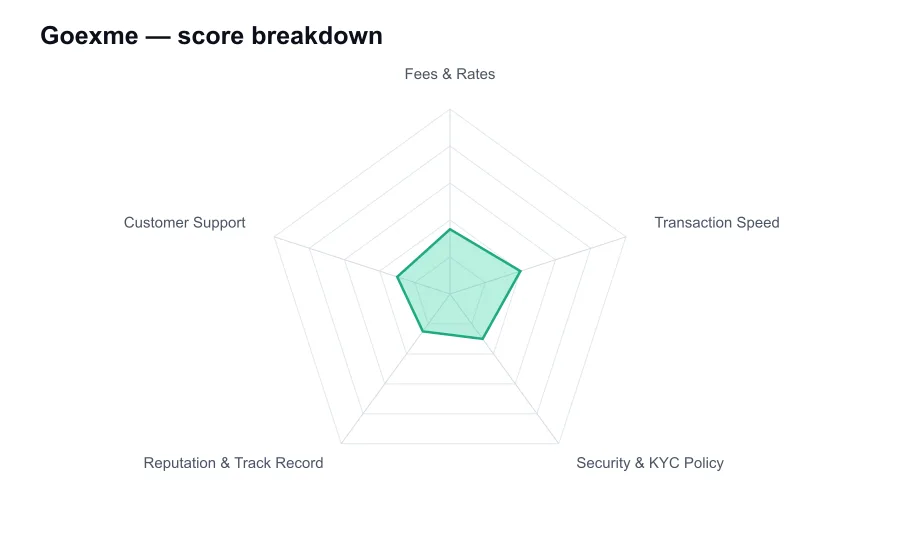
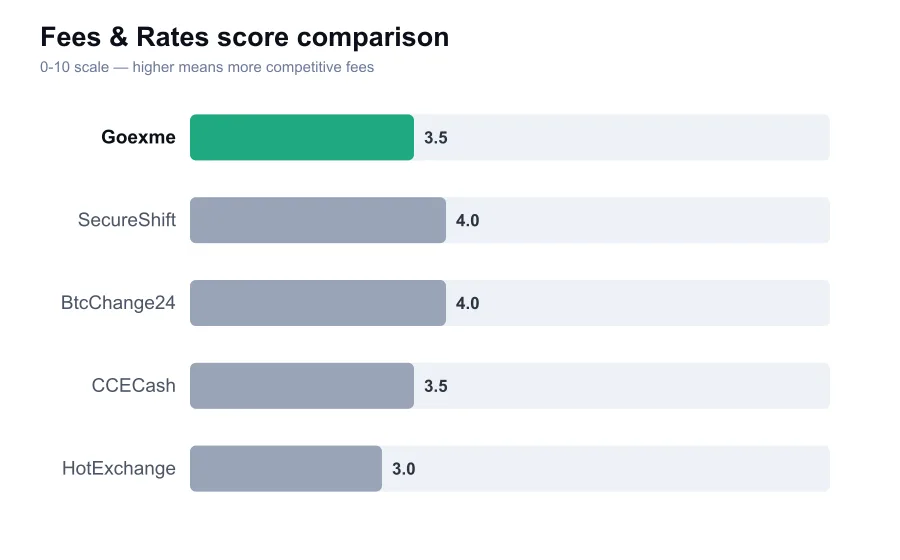
I could not verify a reliable public fee schedule with the same confidence available for better-known instant exchangers. That alone prevents a strong fees score. A platform can advertise a good-looking rate while burying costs in a spread, network markup, or a changed quote after deposit. Users should compare the exact receive amount, not trust a headline claim.
Lack of visible pricing documentation is especially troubling for fixed-rate promises. A fixed quote only matters if the provider clearly explains the payment window, acceptable deposit variance, handling of late transactions, and refund policy. Without those terms, a user has no clear basis for challenging an unfavorable result or a delayed conversion.
Speed is also difficult to assess. Any exchange can say a transaction takes minutes. The relevant questions are whether deposits require a stated number of confirmations, who supplies the liquidity, what happens during congestion, and whether there is a functioning support channel when an order stalls. Goexme has not earned confidence on those details through public evidence.
A thin public record does not necessarily mean every transaction will fail. Small instant exchangers can work perfectly well for long periods. The issue is that users have little way to distinguish a competent new business from a site that will be unreachable after a problem. Crypto transfers are irreversible, so uncertainty should directly affect transaction size.
KYC and compliance policy are similarly unclear from the information I can verify. If Goexme advertises no-KYC swapping, users should still assume it may screen blockchain addresses or pause funds. A provider without a clear policy creates an awkward situation: you may be asked for documents after sending coins, without having known the review process in advance.
Security claims deserve the same skepticism. HTTPS, a modern website, and a wallet address generator are not evidence of strong custody controls. There is no substitute for clear incident reporting, identifiable operators, external security work, and a long history of resolving customer issues. I could not establish those factors to a satisfactory standard here.
Reputation is where Goexme falls furthest behind larger competitors. It does not have the volume of credible independent feedback or the sustained industry visibility of platforms such as Godex, ChangeNOW, or FixedFloat. That makes it unsuitable as a default recommendation, even if its interface or quoted rate happens to look attractive on a given day.
Customer support cannot be treated as a minor feature on an instant exchanger. It is the only route to recovery if a user sends on the wrong chain, misses a memo, underpays, or encounters a compliance hold. I could not verify robust and accountable support performance for Goexme. A contact form alone is not a support system.
There is a temptation to use smaller providers because they list an unusual token or display a better quote. That can be reasonable only after cautious testing. Start with an amount you can afford to lose, use a mainstream asset on the correct network, document every screen, and do not stack multiple transfers before the first one settles.
For traders, the answer is simpler. Use a venue with public liquidity, recognizable legal accountability, and account protections. A centralized exchange may require KYC, but it usually provides stronger transaction records, clearer escalation paths, and better tools for price execution. Privacy should not require accepting avoidable operational obscurity.
My view is blunt: Goexme has not provided enough independently verifiable information to justify confidence beyond a speculative small test. It scores poorly because trust cannot be awarded on branding alone. Until it develops a clearer public track record, documented policies, and independently visible user support history, most people should choose a better-known provider.