Moneta365 presents the kind of name that sounds established, but a serious review cannot treat branding as evidence. The service appears to sit in the online money and cryptocurrency conversion category, where providers may offer electronic payments, digital asset exchange, or both. Its public footprint is too limited to place it beside established European e money institutions or major cryptocurrency exchanges.
That distinction matters because an e money exchange and a crypto exchange carry different risks. E money services may handle bank transfers, payment accounts, or card related transactions under specific licensing rules. A crypto conversion service may simply quote an exchange rate and forward assets after receiving a deposit. Users need to know which role Moneta365 actually plays before assuming that familiar payment protections apply.
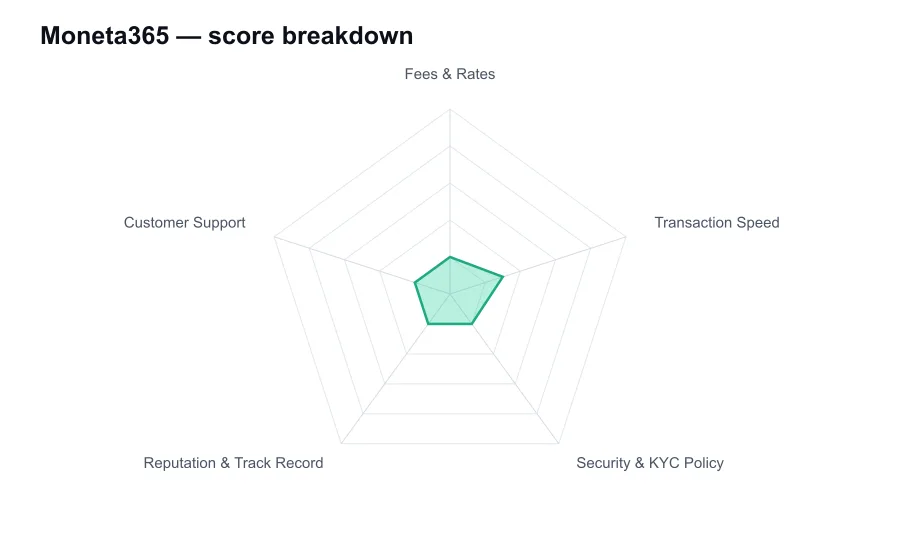
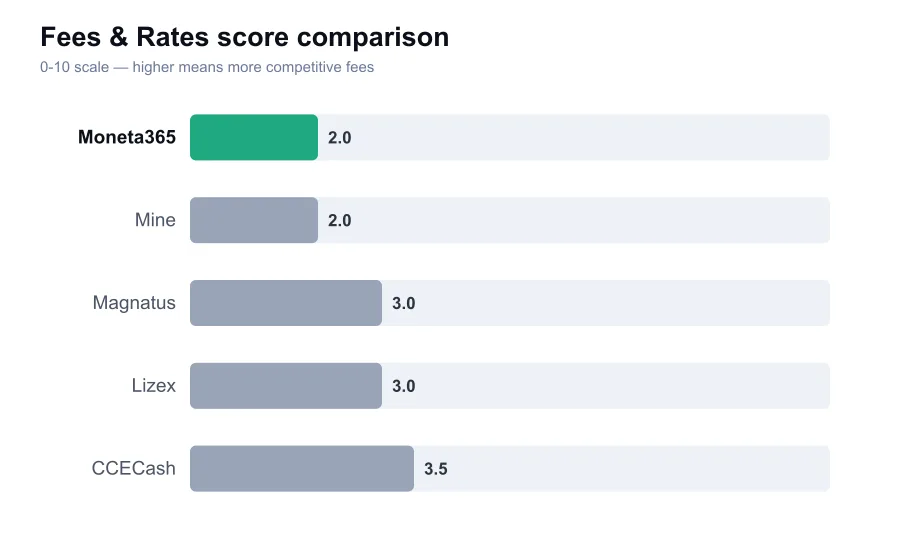
I could not verify a reliable, current public tariff that breaks down conversion charges, deposit costs, withdrawal charges, or spreads. That is a serious weakness. A service may advertise a competitive rate while incorporating its revenue into the currency quote. For a customer, the only number that matters is the final amount reaching the destination after every fee and conversion adjustment.
If Moneta365 offers fiat conversion, bank related costs need particular attention. A low crypto fee can be outweighed by a payment processor charge, a correspondent bank deduction, or a poor foreign exchange rate. If it offers crypto only conversion, the equivalent concern is network selection. Sending a stablecoin on an expensive or unsupported network can turn a cheap swap into an avoidable loss.
Speed cannot be scored highly without a published processing standard. Crypto transfers can settle quickly after network confirmation, but fiat payments may take one or more business days, depend on banking cut off times, and be delayed by name checks or compliance questions. A provider calling itself available 365 days a year does not mean every bank rail or human review operates around the clock.
The security story is also incomplete. For a company that may touch both money transfers and digital assets, customers should expect clear legal identity, jurisdiction, terms of service, privacy documentation, safeguarding information where relevant, and a defined complaints process. I could not establish enough of that information from a durable public record to grant Moneta365 a strong safety score.
Users should be careful not to confuse a website's claim of being secure with regulated protection of customer balances. Two factor authentication, encrypted web traffic, and transaction monitoring are useful controls, but they do not answer who holds customer money or what happens if the operator fails. Those are governance questions, and they matter more than visual security badges.
A vague KYC policy is particularly problematic for a money exchange service. Identity checks may be required by law depending on country, payment method, transaction size, and risk screening. That is normal. What is not acceptable is leaving customers unsure whether verification will be demanded after funds arrive, what documents will be needed, or whether a rejected transaction will be refunded promptly.
Reputation is limited by the lack of readily attributable customer history and independent corporate context. A financial service should be easy to research beyond its own website. Readers ought to find an operator name, formal registration information where applicable, detailed terms, and a coherent support presence. If those basics are difficult to confirm, the prudent score is low regardless of the site's design.
Support is not a minor detail for a provider that might handle fiat. An incorrect beneficiary name, a rejected payment, a blockchain transfer on the wrong network, or an account verification dispute all need a real response channel. Moneta365 has not built enough verifiable public evidence of that service quality. I would not rely on it for a payment with a deadline.
There are situations where a small specialist can be useful. A local currency route or a hard to serve payment corridor may offer better access than a giant global platform. But the customer needs proof, not possibility. Before using Moneta365, obtain the exact total quote, check the legal entity named in the contract, and make certain the receiving bank or wallet details are correct.
For crypto purchases and sales, established regulated exchanges are generally better for users who need transaction records, recurring access, and a structured dispute route. For international fiat payments, regulated payment institutions with transparent transfer estimates are the sensible comparison. Moneta365 has not provided enough public certainty to beat either category on trust.
My recommendation is to avoid using Moneta365 for material funds unless its current legal, pricing, and support information can be independently verified. A tiny test may reveal whether the mechanics work, but it does not establish safety for larger transfers. Do not interpret a successful first payment as proof that a provider can handle a blocked, delayed, or disputed transaction well.
The core issue is accountability. Moneta365 may be a functioning service, but there is too little reliable public information to measure fees, settlement performance, safeguards, and redress fairly. That forces a conservative judgment. In financial services, uncertainty is itself a cost, and users have stronger alternatives with clearer obligations.