Mine is an unusually difficult crypto provider to assess because the name is generic and its public identity is thin. In exchange research, that is not a trivial inconvenience. It is a risk signal. A firm handling customer cryptocurrency should be easy to identify, easy to contact, and easy to distinguish from unrelated mining, wallet, and investment businesses using the same word.
The service appears to present itself as a crypto exchange or conversion provider rather than a major regulated trading venue. That puts it in a crowded category where reputation is earned through transparent pricing, published legal details, reliable settlement, and years of public customer evidence. Mine does not have the recognizable footprint of Kraken, Bitstamp, Coinbase, or even established instant swap firms such as ChangeNOW.
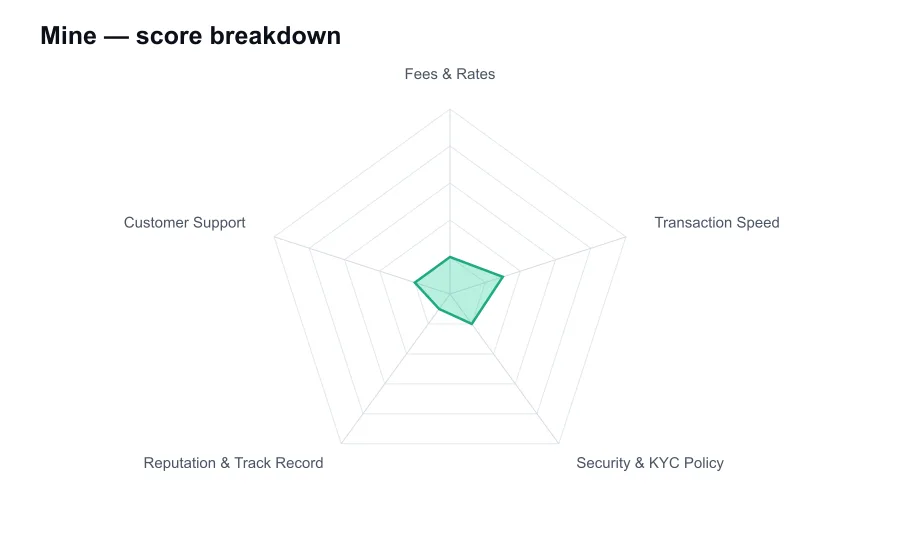
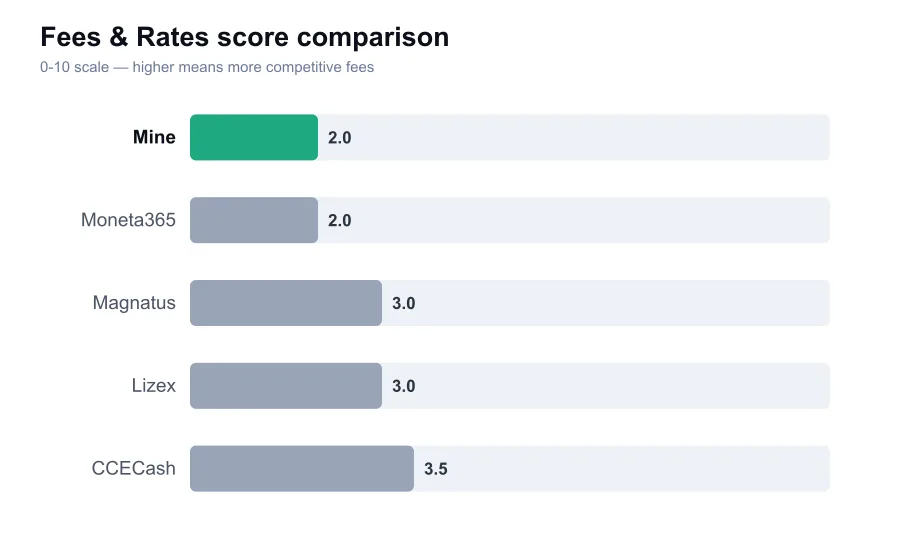
A reviewer should not fill that gap with assumptions. I could not verify a dependable public fee table, a clear maker and taker schedule, or a stable set of terms that explains how spreads are calculated. That means the fee score has to be low. A service can claim low fees while recovering margin through its exchange rate, withdrawal charge, or a quote that changes before settlement.
For a small conversion, the only useful fee test is the final amount received. Compare Mine's quoted output with at least two established alternatives at the same moment, then include blockchain withdrawal cost. If the quote is not fixed, the relevant question becomes how much execution can move between deposit and payout. Any provider that leaves this unclear is asking users to take on avoidable uncertainty.
Transaction speed is similarly hard to judge without a documented operating history. A blockchain deposit may appear quickly, but a conversion service still has to detect confirmations, execute or source the trade, perform compliance checks, and broadcast the payout. Bitcoin deposits can take substantially longer than fast networks, while an internal review can turn a supposedly instant swap into an open ended wait.
The absence of a strong public service standard matters. Reputable instant exchangers normally explain estimated completion time, confirmation requirements, refund conditions, and what happens if an order needs manual review. A user should not have to discover those rules only after funds have been sent. Mine's lack of readily verifiable public disclosure makes it unsuitable for any time sensitive conversion.
Security is not just about whether a website uses HTTPS or offers a wallet address. It includes identifiable ownership, clear policies, sensible handling of suspicious deposits, and a credible process for resolving a failed payout. Mine does not provide enough independently established information for a reviewer to give it the benefit of the doubt in these areas.
KYC policy is another point where vagueness works against the customer. Some conversion services advertise no account registration but reserve the right to request identity documents on specific transactions. That can be legitimate for compliance reasons. The issue is whether thresholds, triggers, document handling, and refund options are explained before a user transfers coins. I could not confirm a transparent policy from Mine.
A generic brand name also creates phishing risk. Search results for "Mine" can lead to unrelated services, mining products, applications, or social accounts. Users should never rely on an advertisement or a similarly named domain to decide where to deposit crypto. Confirm the exact domain through a trusted record, verify the TLS certificate, and be suspicious of social media links that promise unusually favorable rates.
Reputation is Mine's weakest area. There is not enough durable, independently verifiable operating history to put it in the same class as providers with years of visible transaction feedback and regulatory disclosures. Silence is not proof of misconduct. It is still a poor basis for trust, particularly because a swap provider takes custody of funds during the conversion process.
Support is difficult to rate positively without public evidence of reliable response channels, clear escalation procedures, and a real support archive. A contact form is not the same as accountable customer service. The test comes when a deposit is underpaid, sent on the wrong network, or flagged for review. Those are precisely the cases where users need a named policy and a reachable human.
Mine may appeal to a user who finds a favorable quote for a very small, nonurgent transaction. That is the only scenario where I would even consider testing it, and the test should be an amount the user can afford to lose or wait on. There is no persuasive case for sending a large balance or making the service part of a regular trading routine.
The better alternatives depend on the need. For regulated fiat access and account support, a long established centralized exchange is the sensible route. For a self custody swap, a known decentralized exchange can reduce counterparty exposure. For an instant conversion, choose a provider with explicit rates, published compliance rules, and a large body of recent, independently attributable feedback.
My judgment is severe because the standard should be severe. Mine has too little transparent, verifiable information to justify trust with meaningful cryptocurrency amounts. It may be a functioning service, but functionality alone is not enough. Until it offers clearer ownership, fee disclosures, support commitments, and an established record, cautious users should look elsewhere.