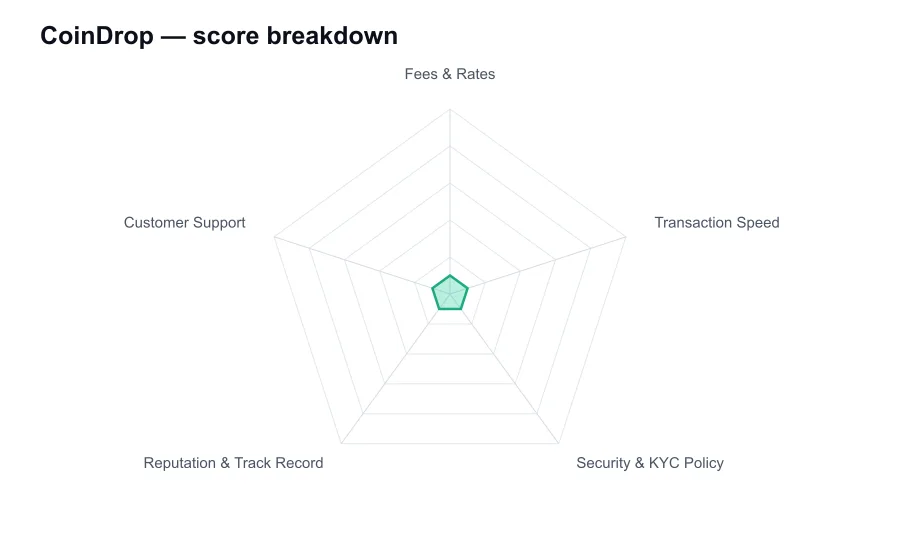
CoinDrop is another crypto provider name for which the first problem is identification. The name is generic, has been used in more than one crypto-adjacent context, and does not point cleanly to a single established exchange with a well documented operating history. That makes a conventional exchange review misleading, because there is no solid basis for attaching trading fees, withdrawal times, or licensing claims to one verified business.
A publication readers trust should not turn uncertainty into a polished profile. I could not establish a reliable official exchange website, a clearly identified operator, a public regulatory record, or a durable customer-service record for an active centralized exchange called CoinDrop. That does not automatically prove wrongdoing. It does mean the name alone is not enough to justify a deposit.
Crypto has a recurring branding problem. Short, friendly names are easily reused by apps, giveaway campaigns, token projects, affiliate schemes, and outright impersonators. A user may search for a name, find a domain with a professional design, then assume it is the same service mentioned in a message or social-media post. That assumption is exactly what fraudsters count on.
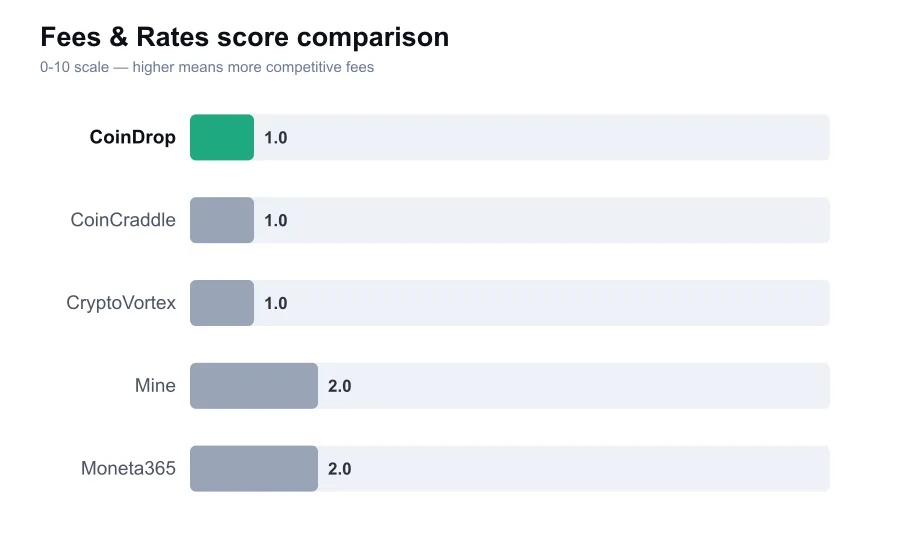
Fees cannot be rated as competitive when they are not verifiably published by an accountable operator. A legitimate exchange tells customers whether it charges maker and taker fees, spread-based pricing, deposit fees, withdrawal charges, or conversion markups. It also states which entity sets those fees and whether the displayed quote can change before execution.
The most dangerous fee model is not necessarily the expensive one. It is the undefined one. If a service can invent a processing charge only after you try to withdraw, then its advertised rate is meaningless. Never pay a separate crypto transfer to release an account balance, and never accept a claim that blockchain fees must be paid directly to a support agent or personal wallet.
Speed is equally impossible to validate without a known service and public evidence of completed customer withdrawals. In crypto, a quick on-screen confirmation is not settlement. A Bitcoin, Ethereum, or stablecoin withdrawal is only meaningful when it reaches the requested address on the correct network and can be independently verified through a public explorer.
Network confusion creates another risk. Scammers commonly exploit the fact that USDT can exist on Ethereum, Tron, BNB Smart Chain, Solana, and other networks. They may show a balance labelled USDT without proving which chain it is on, or send a customer to an incompatible address. A real service should make the network explicit before every deposit and withdrawal.
There is no basis to award CoinDrop a meaningful security score. I could not verify whether a service using this exact name keeps funds in cold storage, permits two-factor authentication, publishes proof-of-reserves, has a breach-disclosure policy, or undergoes security testing. Even if a site displays security badges, those images are claims, not evidence.
KYC is also a major concern with unknown services. Some crypto users assume no-KYC means privacy. Sometimes it just means the operator has not explained who it is. A legitimate platform may request identification for lawful compliance purposes, but it should disclose the collecting company, the privacy policy, and the cases in which an account may be restricted or enhanced due diligence requested.
CoinDrop has no credible, established reputation under this exact provider identity comparable to platforms such as Kraken, Bitstamp, Coinbase, or Coinmotion. Those names are not perfect, and users can reasonably criticize their fees, verification procedures, or support delays. Yet they are identifiable businesses whose terms, regulators, and long public histories can be examined.
The lack of a clear reputation trail matters most when things go wrong. With a known provider, a customer can often identify the legal entity, escalate through a formal complaint route, contact a regulator where applicable, or at least locate a substantial record of similar user experiences. With an ambiguous name, the user can be left arguing with an anonymous chat account.
Support should be judged by accountability, not friendliness. Fast replies from a chat representative are worthless if the agent cannot provide a ticket number, terms reference, transaction hash, or escalation route. An anonymous support channel can be used to pressure users into sending more funds, disclosing recovery phrases, or installing remote-access software.
If you encountered CoinDrop through a giveaway, a social-media direct message, a dating contact, a job offer, or a promise of unusually reliable trading returns, walk away. Legitimate giveaways do not need your seed phrase. Legitimate support staff do not ask for remote access to your phone. Legitimate exchanges do not demand a fresh deposit as proof that you deserve to withdraw.
For users who have already interacted with a CoinDrop-branded service, the next step is evidence preservation. Record the full URL, every wallet address, transaction hashes, payment receipts, and messages. If fiat was sent by card or bank transfer, contact the payment provider promptly. If crypto was sent from a regulated exchange, report the receiving address to that exchange's fraud team.
It is possible that a future, clearly identified company could use this name and publish enough information to warrant a normal review. That is not the position today based on the evidence I can verify. The burden is on the operator to establish its identity and policies, not on customers to prove that an anonymous platform deserves trust.
My assessment is simple: CoinDrop is not a service I would use or recommend for buying, selling, swapping, or holding crypto. The lack of verifiable corporate and operational information overwhelms any hypothetical benefit such as a low quoted price or quick registration. Use a transparent provider instead, and test any unfamiliar platform with research before sending even a small amount.