WmMoney sits in a very different category from WhiteBIT. It is presented as an exchange service for converting electronic money and digital currencies, rather than a full order-book cryptocurrency exchange. That distinction matters. A visitor is usually there to complete one conversion at a quoted rate, not to build a portfolio, set limit orders, or use derivatives. The service may be convenient for a narrow transaction, but it does not offer the transparency or account protections expected from a large centralized exchange.
The first challenge with WmMoney is information quality. Smaller exchanger brands often publish a rate table and a support contact but provide far less corporate, licensing, custody, and operational disclosure than major exchanges. That does not prove bad faith. It does mean a prospective customer has to do more checking before sending funds. In this segment, the absence of detail is itself a meaningful risk factor.
WmMoney's apparent value proposition is speed and simplicity. You choose a direction, enter a receiving address or payment details, create an order, and send the required amount. If the payment arrives cleanly and the pair is available, this can be faster than registering, completing KYC, funding an exchange, and trading manually. That is why these services retain an audience despite their limitations.
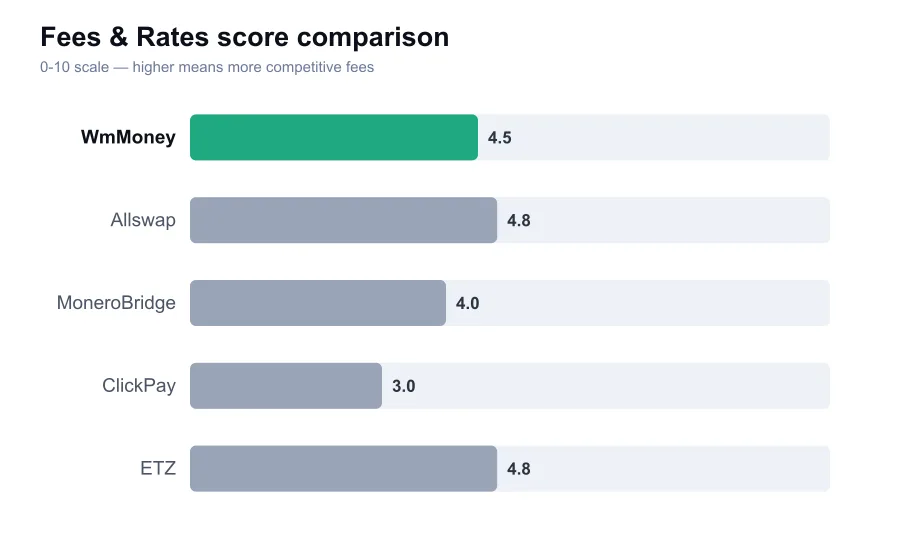
Quoted rates need more skepticism than users often give them. An exchanger can advertise an attractive headline rate while building its margin into the conversion price. The real test is the amount shown in the final order form, compared with a liquid market reference and the withdrawal cost you would pay elsewhere. A low visible service fee means very little if the rate is materially worse than the market.
There is also an execution difference that catches newcomers out. On an order-book exchange, you can see bids, asks, and your executed price. With an instant exchanger, the operator controls the quote and may reserve the right to recalculate it if the market moves before your payment is confirmed. Read the rate type carefully. A fixed rate gives more certainty, while a floating rate can produce a less favorable payout in a volatile market.
Speed depends less on the website interface than on the payment rails. Cryptocurrency deposits require enough network confirmations for the service to accept them. Bank transfers, e-money transfers, wallet payments, and manual checks can all add delay. If staff need to inspect a payment, a supposedly instant conversion may turn into a support ticket. That is common in the exchange-service category and should be planned for rather than treated as a rare exception.
WmMoney does not inspire the same level of confidence as a regulated, widely scrutinized exchange. I would not use a lightly documented exchanger as a long-term wallet, and neither should anyone else. The safe mental model is a transaction counterparty. You send funds for a single conversion, receive the output, and move on. Leaving a balance behind creates unnecessary exposure with no compensating benefit.
KYC expectations deserve special attention. Small exchangers sometimes market themselves as convenient alternatives to full exchanges, yet still reserve the right to request identity documents when an order triggers anti-money-laundering checks or a payment appears irregular. Users should not assume that a service is permanently no-KYC because its order form initially asks for little information. Sending funds before reading the terms can leave you caught between a verification request and a held transaction.
Security is difficult to grade highly where public evidence is limited. HTTPS, a clean interface, and a support chat are not evidence of robust custody practices. What matters is whether the business clearly explains its legal operator, security process, complaint handling, reserve practices, and verification policy. Where that evidence is thin, the sensible response is to keep transaction size small. Trust should be earned by repeated successful use, not granted because a rate looks tempting.
Customer support is especially important here because there is no open market to correct a mistake. If you select the wrong network, send a short payment, forget a memo, or enter a wrong receiving address, the outcome depends heavily on whether the operator can and will help. Before placing an order, test the listed support channel with a concrete question. A service that cannot answer a pre-sale question promptly is unlikely to be pleasant during a payment dispute.
WmMoney's reputation should be judged through current, independent feedback rather than a handful of testimonials on its own site. Look for a consistent record on established exchanger monitoring services, read the newest negative reviews, and pay attention to how complaints are resolved. One angry review proves little. Repeated complaints about recalculated rates, delayed payouts, identity checks after payment, or unreachable support are a serious warning.
This is not a service I would use for a large purchase, a time-sensitive trade, or a first transfer on an unfamiliar blockchain. The operational risk is too concentrated. A person converting a modest amount of one familiar asset to another may find it adequate after checking the final quote and confirming that the receiving network matches exactly. That is a much narrower recommendation than I would give WhiteBIT.
The best practical approach is to run a small test. Save the order ID, screenshots of the quoted amount, the service terms, and your transaction hash. Do not split a large transaction into many orders unless the service explicitly allows it, and do not rely on a support promise made in an unofficial messenger account. Those habits are dull, but they are what protect users when an exchanger transaction goes wrong.
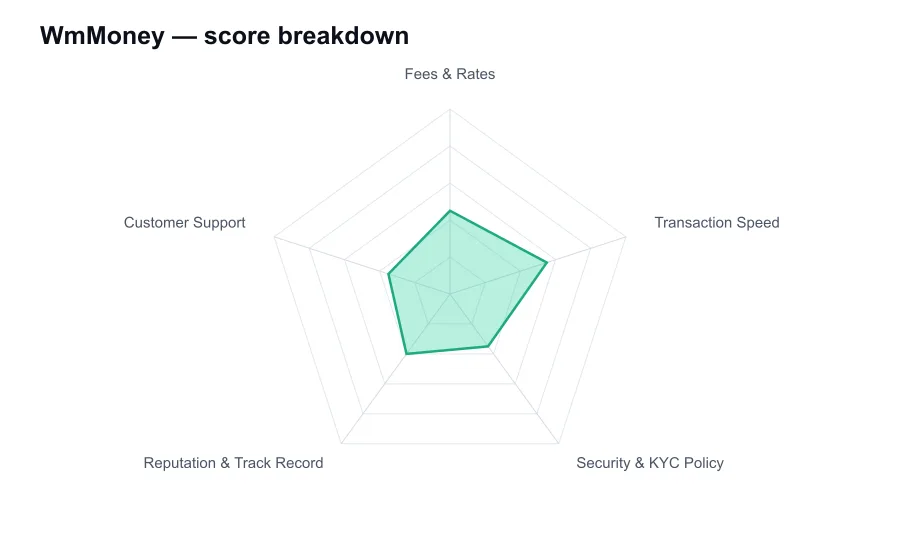
My take is blunt. WmMoney may serve users who need a one-off electronic-money or crypto conversion and are prepared to do their own verification, but it lacks the public transparency needed for a strong trust score. Its utility is convenience, not institutional reliability. Use it as a short-lived conversion tool, keep the amount conservative, and choose a better-documented exchange for repeated trading or significant funds.