Allswap is a small instant-swap provider that presents cryptocurrency conversion as a quick wallet-to-wallet transaction. It belongs to the crowded group of services that promise to remove the friction of exchange accounts, charts, and custodial balances. That pitch has obvious appeal. It can also hide the fact that the customer is still trusting an intermediary to receive funds, source liquidity, apply compliance controls, and send the payout correctly.
The service is best understood as a transaction layer, not a marketplace. You choose the asset you are sending, select the asset you want to receive, provide a destination address, and transfer funds to a generated address. Allswap processes the order and pays out the converted asset. There is no visible central order book, no conventional maker and taker fee structure, and little reason to use it as a place to hold assets.
This format is convenient for an experienced wallet user who only needs one conversion. It is particularly easy to understand compared with a centralized exchange's deposit rules, trading pairs, and withdrawal controls. But the simplicity moves complexity behind the curtain. The service may use one or more liquidity partners, and the customer generally cannot see the precise route or execution venue. That limits the user's ability to judge price quality before the order is funded.
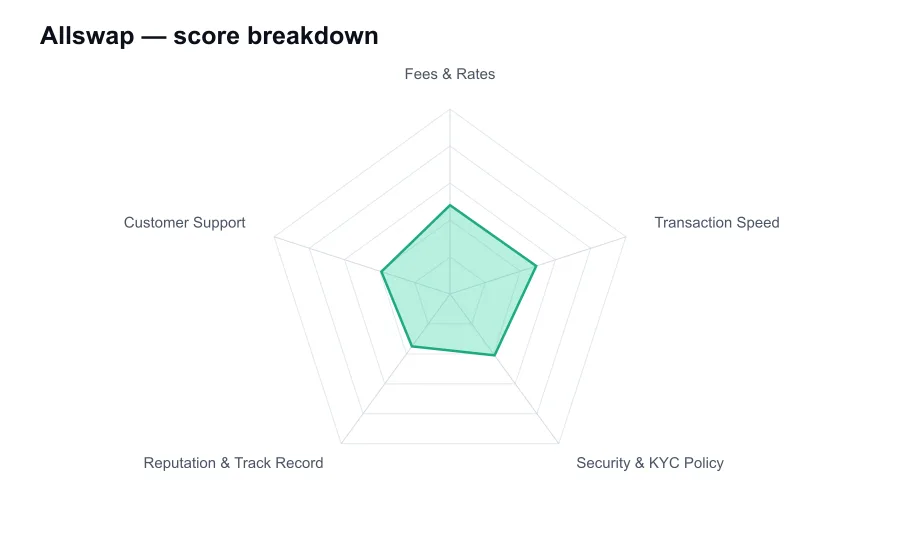
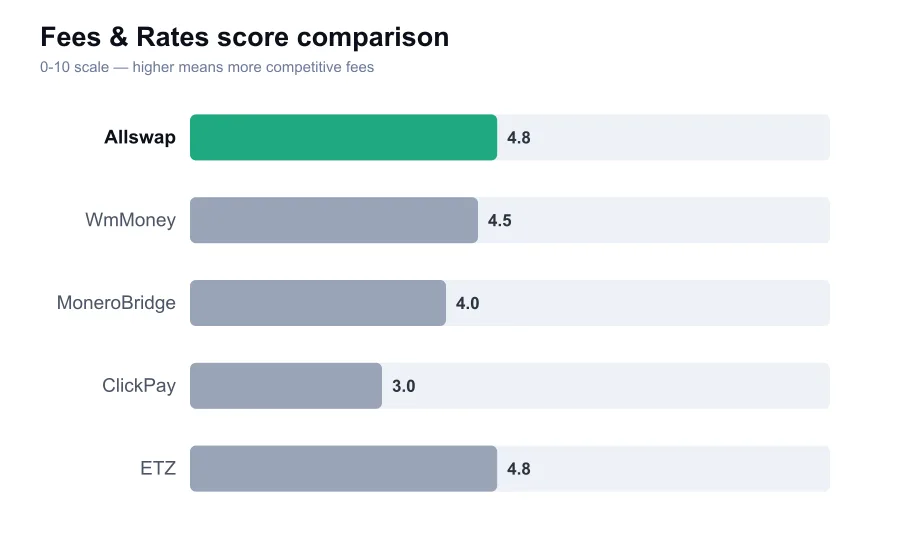
Allswap's fees should therefore be judged through the final output quote, not an advertised percentage. Like many instant exchangers, it appears to present a receive amount that combines market pricing, a service spread, and applicable network costs. That model is not inherently unfair. It becomes a problem if the user assumes a quote is competitive because no separate fee line is visible. For any meaningful conversion, check the same pair and amount on at least two established alternatives.
The danger is greatest on smaller assets and volatile pairs. A wide spread can be hard to spot if the market moves while you compare prices, and a thinly traded token may be priced differently across liquidity sources. You should also distinguish a floating quote from a fixed-rate quote. A floating quote means the delivered amount may be calculated later, after the deposit has arrived and the service can execute. That is a material risk during a rapid move.
For speed, Allswap has the same physical limits as every other instant service. It must see the incoming transfer, wait for whatever confirmations it requires, secure liquidity, then broadcast the outgoing payment. Fast networks can make that feel quick. Bitcoin, congested Ethereum transfers, and transactions requiring a destination memo can turn it into a much slower process. No swap interface can eliminate those dependencies.
The more important concern is predictability. Large providers have many years of customer reports, status pages, and public support histories that offer at least some guide to their normal timing. Allswap has a lighter independently documented footprint. That does not mean every transaction will fail or be delayed. It means there is less external evidence to rely on if you are deciding whether to send a large amount or need to settle a time-sensitive payment.
The service's security posture should also be evaluated realistically. It may allow customers to start an order without creating a conventional account, which reduces password and stored-profile exposure. Yet there is still no technical guarantee that the conversion is trustless. During the exchange, the customer has given control of the source asset to a company-operated process. The provider can also apply screening and can pause an order pending further information.
That point is easy to miss because the phrase no KYC is often used carelessly in crypto marketing. In practice, many account-light exchangers reserve compliance rights in their terms. If Allswap flags a transfer, a user may be asked for identification or transaction-source information. A customer who cannot provide it may face an extended hold. That possibility should be treated as part of the product, not as an unusual exception.
Allswap does not have the public reputation needed to offset that uncertainty. There is a substantial difference between a company with a few visible mentions and a provider with years of independently discussed transactions, clear corporate disclosures, and a track record of handling complaints in public. Allswap currently belongs much closer to the former category. For a critic, that limits how high it can score even if the front-end experience is clean.
Customer support is where smaller services are tested hardest. A routine order can complete without any human interaction. A problem order needs a timely response from someone who can find the deposit, understand the chain, and authorize a correction. Allswap's public support footprint is not strong enough to inspire confidence in edge cases. Before using it, identify the actual support channel, read its terms, and decide whether you could tolerate waiting for an answer.
I would not use Allswap for funds connected to a deadline, an OTC settlement, payroll, or a major portfolio rebalance. A cheaper-looking quote is not worth much if the transaction becomes stuck at the wrong moment. The service can make sense for a small experimental swap, especially if the exact pair is unavailable or uncompetitive elsewhere. That is a narrow use case, but it is an honest one.
Users should be especially careful with network selection. Assets with the same ticker can exist on multiple chains, and a destination address that looks valid may still be wrong for the selected route. Never assume that a USDT address works across every USDT network. Check the chain at both the sending wallet and the receiving wallet, then preserve every transaction record until the payout is confirmed.
Allswap is not a provider I would call unsafe merely because it is small. It is a provider I would call insufficiently proven for serious money. Its convenience is real, and its lack of a conventional account may suit privacy-conscious users who understand the limits of that phrase. But the modest public record, opaque effective pricing, and uncertain escalation quality mean that careful users should keep transaction size low and better-established alternatives close at hand.