Swapter is a non-custodial instant exchange service aimed at people who want to convert one cryptoasset into another without opening a trading account. It sits in the same broad category as ChangeNOW, SimpleSwap, and StealthEX, though it is much smaller and less established than those names. The appeal is obvious: choose a pair, send coins, and receive the destination asset at a wallet you control.
The interface is admirably spare. There is no charting terminal, order book, or portfolio screen to distract from the central job. That simplicity helps occasional users, especially someone moving BTC into ETH or stablecoins without wanting a full exchange relationship. It also means Swapter offers little help to a user who needs market tools, recurring purchases, fiat deposits, or detailed account reporting.
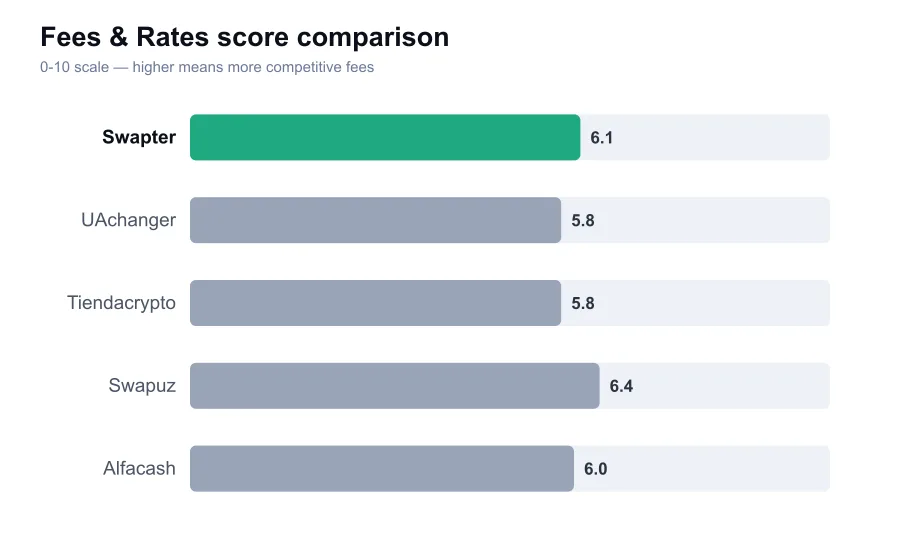
Its quoted price is the real cost to watch. Instant exchangers rarely present a clean trading commission in the way a centralised exchange does. The final rate can include a service margin, liquidity-provider spread, and network fee. A swap can look competitive at first glance, then become less attractive after comparing the received amount against Binance, Kraken, or a reputable decentralised exchange.
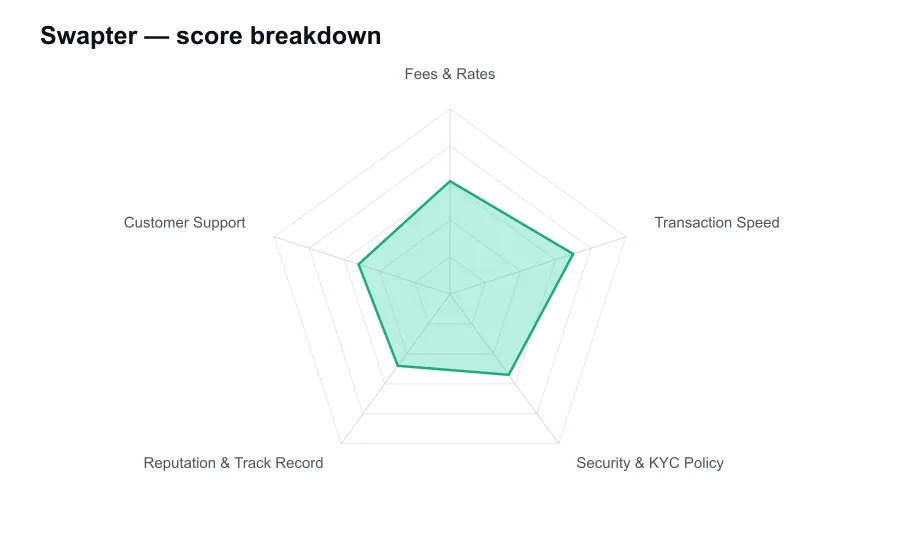
For small emergency conversions, that pricing model can be acceptable. You are paying for convenience and a one-screen transaction. For a larger swap, I would get fresh quotes from at least two competitors before sending anything. Swapter does not have the public fee transparency or volume-based discount structure that serious traders expect, so its fees score is held back despite the lack of an obvious account charge.
Floating-rate exchanges also expose users to price movement between deposit confirmation and execution. In a calm market this might barely matter. During a sharp BTC or ETH move, it can materially change the output. If Swapter offers a fixed-rate quote for a particular pair, read the conditions closely, because fixed quotes usually have shorter deposit windows and may carry a wider spread.
Speed depends on the asset, the chain, and the liquidity partner handling the trade. Simple swaps on fast networks can complete in minutes once the deposit is confirmed. Bitcoin deposits, congested Ethereum transactions, compliance checks, and thinly traded assets can extend that timeline considerably. Swapter cannot honestly guarantee a universal completion time because it does not control the underlying networks.
This is a service where sending the correct network matters more than usual. A token can share a ticker with another version of the same asset, but an ERC-20, TRC-20, and BEP-20 transfer are not interchangeable. Swapter's generated deposit address is specific to the route selected. Sending a token through the wrong network may create a recovery request, and recovery is never assured.
The non-custodial framing needs a little precision. Swapter does not hold a customer balance in the way a traditional exchange does, but it receives funds while the conversion is processed. That reduces the risk of maintaining a long-lived custodial account, yet it does not remove transaction risk. Once crypto has been sent to the generated address, execution relies on Swapter and its liquidity infrastructure.
The platform advertises a low-friction experience and does not appear to require routine account creation for ordinary swaps. That should not be mistaken for a guarantee of no identity request. Like comparable instant exchangers, it can request KYC material where automated anti-money-laundering systems flag a transfer, a source of funds issue, or a sanctioned-address risk. A held transaction is a realistic possibility.
Swapter's biggest weakness is its limited public track record. It has far less independently documented operating history, regulatory visibility, and customer-service evidence than long-running competitors. That does not prove poor conduct. It does mean users should avoid treating it as a venue for life-changing sums, especially if a delay would cause financial stress.
Public information about ownership, liquidity partners, security audits, and incident handling is thinner than I would like. For an instant exchanger, transparent policies matter because the customer is often unable to cancel once funds are in flight. A detailed terms page, explicit AML process, and clear transaction-status system do more to build confidence than generic claims about safety.
Support appears to centre on web contact channels and transaction assistance rather than a mature support operation with phone coverage or a large public help centre. Before a first swap, test the responsiveness of the available contact method with a simple question. Keep the transaction ID, deposit hash, selected pair, and screenshots of the quote. Those details are essential if the payment becomes delayed.
Swapter is best treated as a convenience tool, not a primary exchange. I can see the case for a modest one-off conversion where the quoted output beats familiar alternatives and the user is comfortable with the route. I would not use it for repeated high-value activity, fiat on-ramps, or a time-critical transfer that cannot tolerate a compliance review.
My view is cautious rather than hostile. The product is easy to understand and its non-account flow is attractive, but the value proposition is not strong enough to overcome the thin public record and uncertain all-in pricing. Check the rate carefully, begin small, and use a better-known exchange if transparency, support depth, or institutional-grade controls are important.