WhiteBIT is a centralized cryptocurrency exchange that has grown from a regional Eastern European platform into a serious international venue for spot trading, derivatives, earn products, and fiat onramps. It is not in Binance's class for depth or global reach, but it is far more substantial than the anonymous instant exchangers that dominate many comparison lists. Its strongest appeal is a polished trading experience with a broad asset list and an unusually active push into sports sponsorships and mainstream branding.
The exchange was founded in 2018 and has roots in Ukraine, though its operational structure is international. That background matters because WhiteBIT has spent years trying to look and behave like a regulated, public-facing business rather than a faceless offshore trading site. It has sponsored football clubs, worked with major commercial partners, and made a point of publicizing compliance work. That doesn't eliminate exchange risk, but it gives users a more visible company to assess.
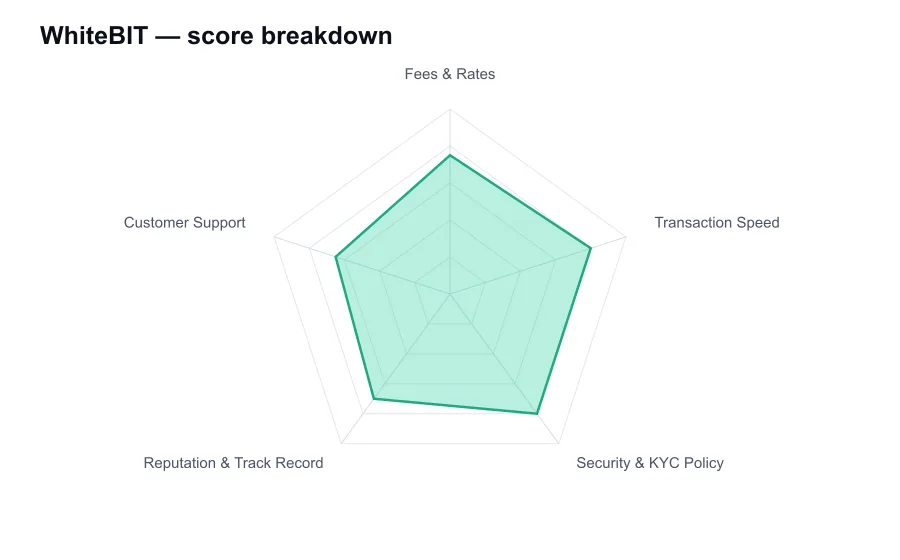
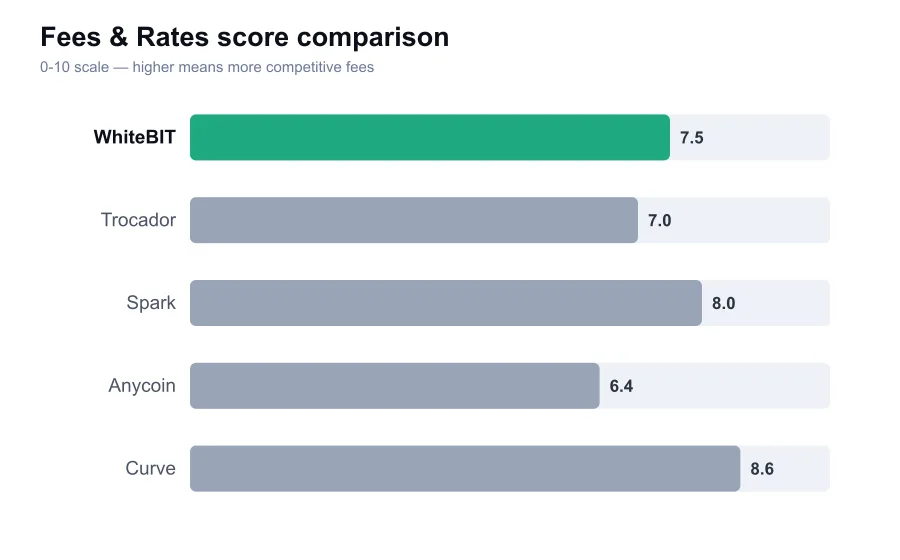
Fees are one of WhiteBIT's better points. Standard spot trading fees are typically up to 0.1 percent for makers and takers, which is competitive with many large exchanges and cheaper than the usual 0.25 percent charged by small retail-focused platforms. High-volume traders can qualify for lower rates. A 0.1 percent ceiling is also simple enough that beginners won't feel ambushed by a complicated maker and taker schedule.
The caveat is that the headline trading fee is not the whole cost. Fiat card purchases can be expensive because card processors, banks, and payment partners add their own charges. Withdrawal fees vary by asset and network, and those are more important than spot fees for a person moving funds regularly. A cheap trade followed by an expensive Bitcoin withdrawal is still expensive. Check the withdrawal page immediately before placing a trade, especially during busy network periods.
WhiteBIT's order book liquidity is good on major pairs, particularly USDT markets and widely traded coins such as Bitcoin, Ether, Solana, XRP, and Toncoin. Market orders in liquid pairs usually fill quickly, and the matching engine feels responsive in normal conditions. It is a clear step above small exchanges where a modest order can move the price or sit unfilled. Less popular altcoins are another matter, so don't assume every listed token has Binance-like depth.
Deposits and withdrawals are usually processed efficiently, but blockchain settlement still sets the real pace. Internal transfers between WhiteBIT users are fast, while on-chain deposits require the relevant network confirmations. Withdrawal review may add time, especially for a first withdrawal, an unusually large amount, or activity that triggers compliance checks. That friction can irritate a trader, though I would rather see review procedures than an exchange that sends every withdrawal without scrutiny.
Security is one of the reasons WhiteBIT deserves to be considered alongside established centralized exchanges rather than anonymous swap services. It supports two-factor authentication, withdrawal address controls, session and device management, anti-phishing protections, and account activity monitoring. The company has also publicly described using cold storage for the majority of client assets. These are sensible safeguards, but users should remember that no exchange feature makes custodial storage equivalent to holding your own keys.
KYC is mandatory for meaningful use of WhiteBIT. That places it firmly in the compliant centralized exchange category, closer to Kraken or Coinbase than to no-registration swap sites. Identity checks can be inconvenient, particularly for users who just want to exchange a small amount, but the policy is transparent about what kind of venue this is. If privacy is your first requirement, WhiteBIT is the wrong product. If you want fiat access and a more accountable service, mandatory verification is part of the deal.
WhiteBIT's reputation is stronger than its age might suggest. Its public profile, sponsorships, and Ukrainian charitable activity have made it recognizable well beyond its original audience. Still, it has not yet earned the decades-long institutional confidence attached to Coinbase, Kraken, or Bitstamp. Its history is short by financial-market standards, and crypto firms can change quickly. I would call WhiteBIT credible, but not immune to the risks that come with keeping assets on any centralized exchange.
The platform's product range is both a strength and a mild weakness. WhiteBIT offers spot markets, margin-related products, futures, staking-style earn products, launchpad activity, and a native token called WBT. That gives active users plenty to work with. It also means a newcomer can get lost in promotions and yield screens before learning the basics. The exchange is at its best as a straightforward trading venue, not as a place to chase every high-yield campaign that appears in the interface.
Customer support is available around the clock through the site and app, with a help center covering routine verification, deposits, trading, and withdrawal questions. Response quality is mixed in the way it is at many growing exchanges. Straightforward problems are usually handled through documentation or chat, but compliance reviews and disputed transactions can take longer and feel impersonal. That is frustrating, although it is not unique to WhiteBIT. The bigger issue is that urgent support is difficult anywhere once an on-chain transaction has been completed.
The mobile apps are solid for checking balances, placing basic orders, and receiving security prompts. Serious charting and complex order management are more comfortable on the web terminal. WhiteBIT has done a good job making the interface approachable without turning it into a toy. The clean layout is particularly helpful for users moving from an instant exchanger to their first order-book exchange.
There are limits to the platform's availability. WhiteBIT is not a universal substitute for locally licensed exchanges, and users should verify whether their residence and payment method are accepted before completing KYC. Availability can differ between trading, card purchases, and withdrawals. That is normal for a centralized exchange, but it means people should not transfer funds first and ask questions later.
My view is that WhiteBIT is a credible mid-to-large centralized exchange with attractive spot fees, useful liquidity, and better security controls than the smaller providers in this group. It is not the cheapest route for every fiat purchase, and it is not built for users seeking no-KYC swaps. For verified traders who want a practical exchange without the clutter and fee complexity found on some larger rivals, it is a good contender. Keep long-term holdings in self-custody, use every available account protection, and treat WhiteBIT as a trading venue rather than a vault.