Curve is one of DeFi's foundational decentralized exchanges, built primarily for efficient swaps between assets that should trade near the same value. Think stablecoin against stablecoin, or wrapped ETH against ETH. It is not trying to replace every kind of spot exchange. Its specialty is minimizing slippage where the underlying assets are closely correlated.
That narrow design made Curve enormously influential. A swap between USDC and DAI on a conventional automated market maker can suffer more price impact than users expect, particularly at size. Curve's StableSwap invariant was designed to keep liquidity concentrated around parity. For the right pair, it can offer execution that centralized exchanges and general-purpose DEXs struggle to match.
The protocol runs through smart contracts, and users connect a self-custody wallet such as MetaMask, Rabby, Coinbase Wallet or a hardware-wallet setup. There is no account application, no normal centralized login and no standard KYC process at the protocol level. Your wallet address is the account, which is efficient but unforgiving.
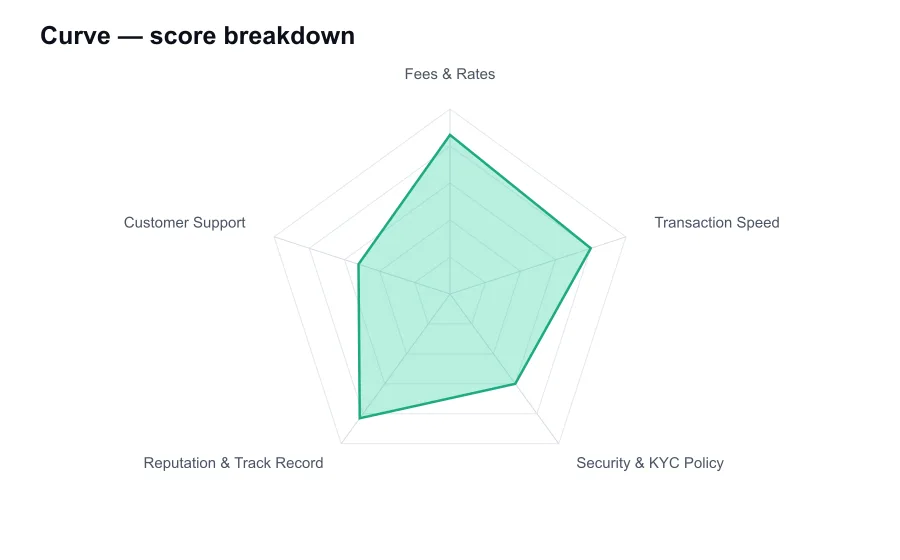
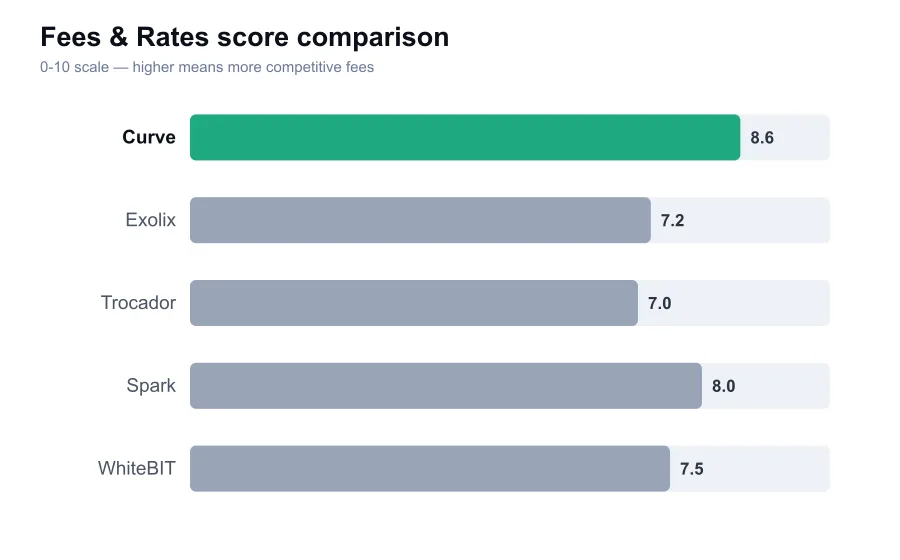
Curve's fees are generally low by DeFi standards. Most traditional pools charge a 0.04% swap fee, though pool configurations can differ and newer pool types may use different settings. That figure is only one part of the cost. Ethereum gas can dwarf the pool fee during busy periods, while cross-chain use introduces bridge, relayer or destination-chain costs.
For a modest swap on Ethereum mainnet, the raw Curve fee can be excellent while the total transaction remains uneconomic because gas is expensive. This is why users should not judge Curve by the 0.04% headline alone. On lower-cost supported networks, the economics improve dramatically, especially for stablecoin swaps that would otherwise require several exchange withdrawals.
Curve is often best accessed through an aggregator for price discovery, even if the final route uses Curve liquidity. 1inch, Matcha, CoW Swap and other routers can compare pools and routes. Direct use still makes sense when you know the pool you want, understand its composition, and want to avoid an unnecessary routing layer.
Execution speed is blockchain speed. On Ethereum, a transaction may be included quickly with a competitive gas setting, but final confidence takes multiple blocks and gas conditions can change before confirmation. On networks such as Arbitrum, Optimism, Polygon, Base and Avalanche, the interaction is generally much quicker and cheaper from the user's perspective.
There is no customer service desk that can stop a transaction after wallet approval. If you sign a malicious approval, send tokens to the wrong address, or choose a compromised imitation site, the protocol cannot reverse the result. This is a central trade-off of DeFi. Curve removes custodial risk, but it transfers operational responsibility directly to the user.
Security has to be assessed with more nuance than simply calling Curve decentralized. The core contracts have been extensively used and audited over the years, and the project is deeply embedded in DeFi. Yet its history includes serious security incidents. In July 2023, several Curve pools were exploited after a vulnerability in certain Vyper compiler versions, with losses initially estimated at roughly $60 million or more across affected pools.
The exploit did not mean every Curve pool or every user balance was automatically lost, but it demonstrated a hard truth about DeFi composability. A protocol can have mature contracts and still inherit risk from compiler tooling, pool implementations, oracle assumptions, liquidity-provider exposure and interlinked projects. Curve's response and recovery efforts mattered, but they do not erase the incident.
Liquidity provision deserves even more caution than swapping. A Curve LP can earn pool fees and CRV incentives, but the position is exposed to pool imbalance, depegs, smart-contract risk and the economic behavior of the assets in the pool. A stablecoin pool is not equivalent to holding cash. If one stablecoin breaks its peg, liquidity providers can end up holding more of the troubled asset.
The CRV token and vote-escrow model add another layer. Locking CRV into veCRV can direct gauge emissions and participate in governance, and the so-called Curve Wars created a substantial market around that influence. It is interesting infrastructure, but it is not beginner-friendly yield farming. Long locks, changing incentives and token-price risk can make a high displayed APR look far better than the realized outcome.
Curve's reputation is strong in the sense that it is a major, battle-tested DeFi primitive with a long history dating to 2020. It is not strong in the sense of being risk-free. The project has endured market stress, exploits, governance disputes and constant competition. That survival counts for something, but prudent users should still treat every pool as a separate risk decision.
Support is mainly documentation, Discord, community channels and transaction-level self-help rather than staffed account support. That is normal for a permissionless protocol, but newcomers can find it frustrating. If a transaction is pending, failed, or routed through a third-party front end, answers may require reading block explorers and wallet prompts rather than opening a ticket.
My view is that Curve remains excellent specialist infrastructure and a poor place to learn DeFi by trial and error. For an informed user swapping comparable assets on a well-understood chain, it can be among the cheapest and most capital-efficient choices available. For users chasing yield, using unfamiliar pools, or treating a smart contract as a savings account, the risks are easy to underestimate. Curve rewards precision, not optimism.