Sanctum is a Solana-focused liquid staking protocol and liquidity system, not a conventional retail crypto exchange. Its purpose is to make liquid staking tokens more usable and more interchangeable. That puts it closer to Solana DeFi infrastructure than to Binance or Coinbase. Users come to Sanctum because they want exposure to staked SOL while retaining liquidity, or because they want to trade between forms of liquid staked SOL without the usual awkwardness.
The key idea behind liquid staking is simple. Native SOL staking can require waiting through Solana's stake activation and deactivation process. A liquid staking token represents staked SOL while remaining transferable and usable in DeFi. The difficult part is fragmentation. Different validators and protocols issue different LSTs, and each can trade at a slightly different price. Sanctum was built to improve liquidity across that fragmented set.
Sanctum's Infinity pool is central to that design. It creates shared liquidity for supported liquid staking tokens, allowing swaps between eligible LSTs and SOL-related assets. In practice, this can reduce the friction of moving from one LST to another. It does not remove market risk, smart contract risk, validator risk, or the possibility that an LST trades below its underlying SOL value.
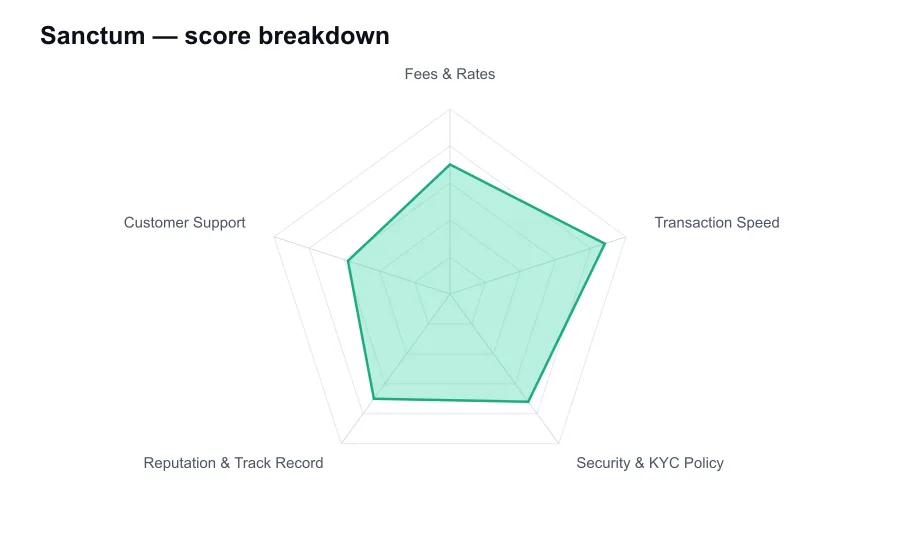
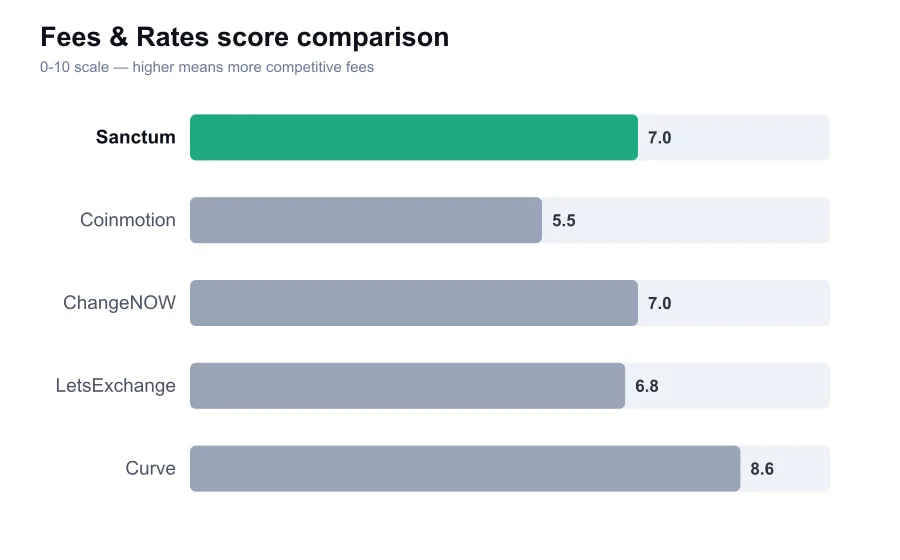
Fees are more nuanced here than on a standard exchange. Users may encounter swap fees, price impact, protocol fees, and the economics of staking yield. A route can appear cheap in nominal fee terms but still be costly if the pool is shallow for the size of the transaction. The correct approach is to inspect the actual output quote and price impact before signing. This is especially important during volatile SOL markets, when LST discounts can widen.
Sanctum's appeal is strongest for people already active in the Solana ecosystem. If you hold ordinary SOL and merely want a long-term validator stake, native staking may be simpler and carry fewer smart contract dependencies. If you want collateral, DeFi composability, or flexibility to rotate between supported LSTs, Sanctum provides a more specialized toolkit. It solves a real problem, but it is not a necessary layer for every SOL holder.
Speed is one of Solana's advantages. Swaps and staking-related interactions normally confirm quickly compared with Bitcoin or Ethereum mainnet activity. In a normal period, a transaction can finalize within seconds. Yet quick confirmation is not the same as guaranteed execution quality. A failed transaction, insufficient priority fee, wallet simulation issue, or sudden liquidity movement can still make the process frustrating.
Users must bring their own Solana wallet. That is a security benefit in one sense, because Sanctum does not operate like a custodial exchange holding a central account balance. It also shifts responsibility directly to the user. Lose the seed phrase, sign a malicious transaction, or connect to a fake frontend, and there is no support desk capable of restoring the assets.
Smart contract risk is the main security question. Audits, public code, and bug bounty efforts can improve confidence, but none of them turn a DeFi protocol into a risk-free bank account. A vulnerability in a contract, oracle dependency, integration, or related liquidity venue could affect users. The deeper a user goes into LST leverage loops and DeFi collateral strategies, the less appropriate it is to think of the position as simple staking.
Sanctum is also exposed to the characteristics of the LSTs it supports. Each token may have different validator relationships, redemption mechanics, liquidity, and governance assumptions. One LST is not automatically interchangeable in risk terms with another. The protocol helps with liquidity, but a user still needs to understand what they are holding and whether it can redeem at or near its expected SOL value.
There is no traditional KYC gate at the protocol level for ordinary onchain use. A connected wallet can interact with the smart contracts, subject to the availability of the interface and any legal restrictions relevant to the user. That privacy and accessibility will appeal to DeFi-native users. It also means users have fewer consumer protections than they would receive through a regulated exchange account.
Sanctum has become a recognizable name in Solana liquid staking, particularly through its Infinity system and the wider discussion around LST liquidity. Its reputation is meaningful inside Solana, although it does not have the decades-long operational history that major financial institutions or the oldest centralized exchanges can point to. Protocol reputation is fragile. It rests on code quality, transparent communications, liquidity resilience, and how a team behaves during stress.
Support is community and documentation oriented rather than account-manager oriented. Users can find protocol resources, wallet connection guidance, and community channels, but help cannot reverse an onchain signature. That distinction is frequently underestimated by newcomers. If a transaction is wrong but valid, it is usually final. Support can explain a route, not rewrite Solana history.
The most sensible way to use Sanctum is conservatively at first. Connect a separate wallet with a small amount of SOL, make a small swap, inspect the resulting token, and learn how the redemption and liquidity mechanics work. Avoid approving unlimited permissions where the wallet permits granular approval. Keep enough SOL for transaction fees, and do not chase an extra fraction of yield without understanding the associated token and validator exposure.
I like Sanctum for what it is: specialized infrastructure attempting to make Solana liquid staking less fragmented. Its best qualities are speed, self-custody, and clear relevance for DeFi users. Its weaknesses are the same ones that follow every sophisticated onchain protocol, namely smart contract risk, LST-specific risk, and no safety net for user mistakes. It is excellent for informed Solana users. It is a poor first stop for somebody who simply wants to buy crypto with a bank card.