Spark is not an instant exchange in the SimpleSwap or StealthEX sense. It is a DeFi lending and savings protocol connected to the Sky ecosystem, formerly MakerDAO. Its core products are designed around stablecoin lending, borrowing, and yield bearing savings positions, rather than swapping any coin into any other coin through a broker. That distinction matters. Spark is closer to Aave, Morpho, and Maker's old lending infrastructure than it is to a retail exchange desk.
The central attraction is straightforward: users can deposit accepted collateral, borrow supported stablecoins, or place eligible stablecoins into a savings product that earns a variable rate determined by protocol governance and market conditions. SparkLend is built on Ethereum and uses smart contracts to administer collateral and debt positions. Spark Savings gives users an onchain route into the Sky Savings Rate through tokenized savings assets such as sUSDS. The service is powerful, but it is not beginner friendly just because the interface looks clean.
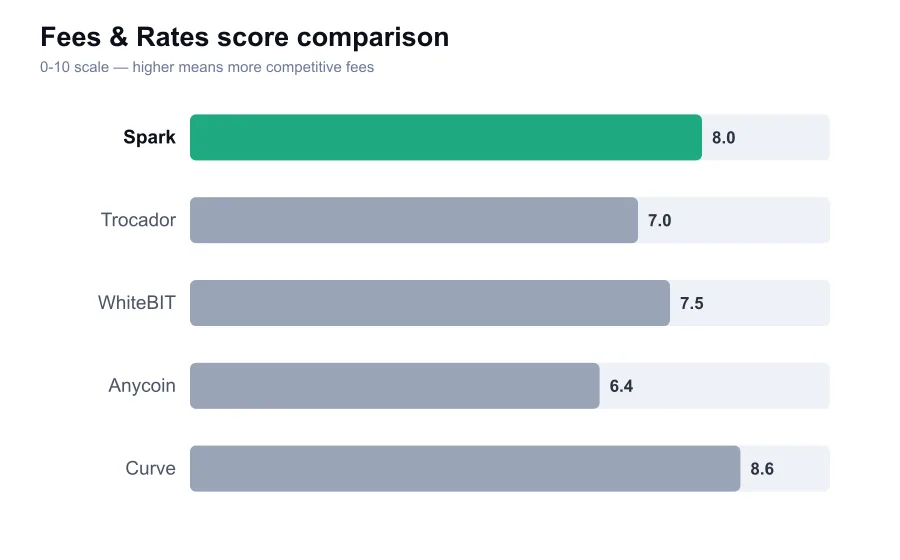
Spark's fee story is better understood as interest rate economics than exchange fees. There is no typical instant swap spread to compare. Borrowers pay a variable borrow rate, while depositors and savings users receive a variable yield after the relevant protocol mechanics and risk parameters are applied. Ethereum transactions also require gas, which can be trivial or expensive depending on network activity. A small deposit made during a busy period can be a poor economic decision even if the protocol itself charges no front end ticket fee.
For a borrower, the important numbers are the current annualized borrow rate, the loan to value limit, the liquidation threshold, and the health factor after the position opens. These figures change by collateral type and governance settings. A low advertised borrowing rate is meaningless if the collateral is volatile enough to put the position near liquidation after a modest market decline. Spark is relatively appealing for conservative stablecoin management, but borrowing against volatile collateral remains leveraged trading whether users describe it that way or not.
For savers, Spark's appeal rests heavily on the stablecoin yield route. USDS and related savings positions are not equivalent to a bank deposit, a money market fund, or insured cash. Their value and return depend on smart contracts, protocol governance, stablecoin mechanisms, and the broader Sky ecosystem. The return can change. The underlying token can face market stress. It is still one of the more mature stablecoin yield systems in DeFi, but maturity does not convert protocol risk into a guarantee.
Transaction speed is also a different question here. On Ethereum, a deposit, withdrawal, borrow, repayment, or collateral adjustment settles when the network confirms the transaction. Under normal conditions this may take seconds or a few minutes, depending on the gas chosen by the wallet. That is fast enough for many DeFi tasks. It is not fast enough to assume a risky position can always be rescued during an abrupt market fall, especially if Ethereum gas spikes or the user is away from their wallet.
Spark has expanded beyond a narrow Ethereum lending pool through Spark Liquidity Layer concepts and allocation strategies that connect capital with other DeFi venues. That can improve capital efficiency, but it introduces another level of design complexity. A user may see a simple savings product while the underlying protocol architecture includes governance directed allocations and external protocol exposure. This is normal for DeFi yield products. It is also why users should read current documentation and risk disclosures instead of assuming a familiar stablecoin label tells the whole story.
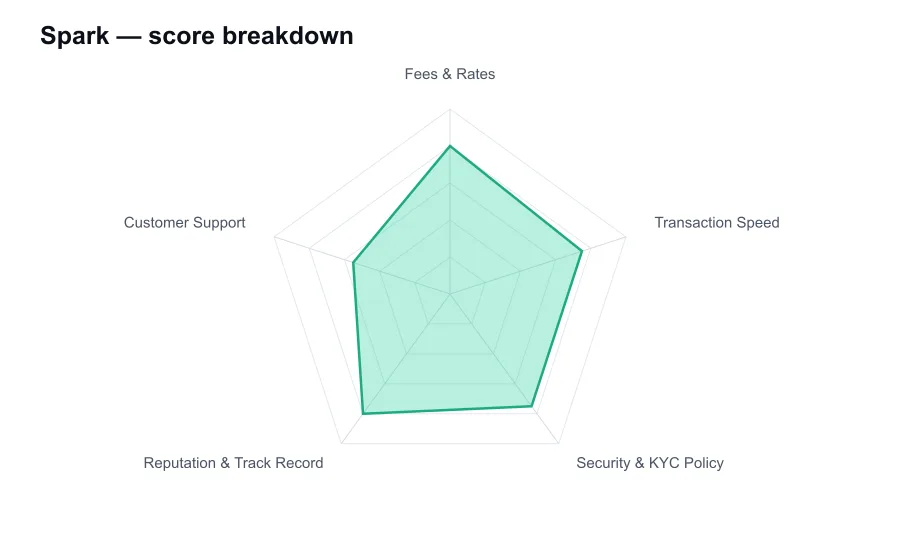
Security is Spark's strongest category, though it still should not be romanticized. Spark draws credibility from its relationship with the long running Maker and Sky technical ecosystem, a community that has operated collateralized stablecoin systems through several market cycles. The contracts and risk framework receive far more scrutiny than those of a new yield farm. Yet smart contract risk, oracle risk, governance risk, and integration risk remain present. A strong audit culture reduces the odds of failure. It does not erase the consequences if a flaw or governance error emerges.
There is no conventional KYC requirement at the protocol level for an onchain wallet interaction. That is a meaningful difference from brokered instant exchanges. The protocol does not ask a user to upload a passport before signing a transaction. However, wallet access, application interfaces, stablecoin issuers, and a user's chosen fiat ramps can each have their own restrictions. Users should avoid making broad claims about being anonymous simply because a smart contract did not ask for a name. Blockchain activity remains public and traceable.
The user experience is good by DeFi standards but demands attention. A wallet connects to the application, the user approves a token contract, then submits the actual deposit or borrow transaction. Token approvals can be unlimited if a wallet accepts a default setting, which is convenient but unwise for large balances. Every transaction needs to be read before signing. A malicious site can imitate a DeFi interface convincingly, and a careless approval can be more dangerous than a bad exchange rate.
Support is the category where Spark feels least like a retail financial product. There is documentation, community discussion, and ecosystem channels, but there is no traditional support desk that can reverse an onchain transaction, recover a seed phrase, or cancel a bad approval. That is inherent to self custody DeFi, not evidence of neglect. Still, it makes Spark unsuitable for people who expect a person to fix an error after they press confirm. You own the wallet, and you own the consequences.
Spark's reputation is notably stronger than that of most standalone yield apps because of its Sky connection and the history of Maker's stablecoin architecture. It has also inherited scrutiny that a small protocol would never receive. Critics are right to point out that governance controlled systems can change parameters and that stablecoin yield is not risk free. Supporters are right that Spark is built on infrastructure with deeper risk practices than the average DeFi project. Both statements can be true, and neither excuses careless use.
The most sensible Spark user is someone already comfortable with MetaMask, hardware wallets, gas fees, and collateral management. A stablecoin holder seeking onchain yield may find Spark Savings easier to understand than building a multi protocol strategy. A sophisticated borrower can use SparkLend as part of a carefully monitored position. Someone buying their first crypto, converting fiat, or looking for a simple fixed return should look elsewhere. Spark is a financial protocol, not a customer service product.
I rate Spark highly within DeFi lending because its technical lineage and stablecoin focus give it more substance than a flashy yield platform. Its fee efficiency can be excellent for the right user, especially one already operating on Ethereum with enough capital to make gas costs tolerable. The tradeoff is real responsibility. Spark is a strong tool for disciplined onchain users, but it can punish people who mistake a stablecoin interface for a savings account.