Exolix is a non-custodial instant cryptocurrency exchange designed for wallet-to-wallet swaps rather than conventional trading. It belongs beside services such as ChangeNOW, EasyBit, StealthEX, and LetsExchange, not beside order-book exchanges like Kraken or Binance. You do not park a balance there, study charts, or place limit orders. You select an asset pair, send a deposit, and receive the converted asset at a destination address.
That narrow focus is Exolix's attraction. The service is quick to understand, avoids the friction of a conventional account, and supports the kind of one-off conversion self-custody users make regularly. Someone holding BTC who needs USDT on Tron, or ETH who wants SOL in a personal wallet, can complete the whole process without surrendering their assets to a long-lived exchange account. The trade-off is that you accept Exolix's quoted price and execution process rather than controlling every detail of an order book.
Exolix offers both floating-rate and fixed-rate exchanges. The floating option gives an estimated output based on the market around the time of the request. The actual amount can change while the deposit receives confirmations and the service executes the conversion. Fixed-rate mode is the better choice for a customer who needs a known result, but it normally gives the exchanger more room to account for volatility and can therefore be less attractive than a floating quote.
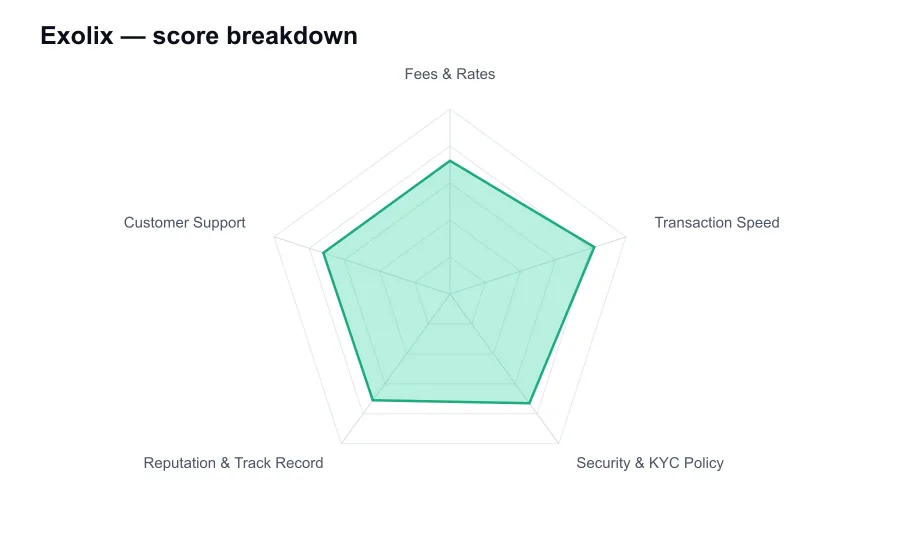
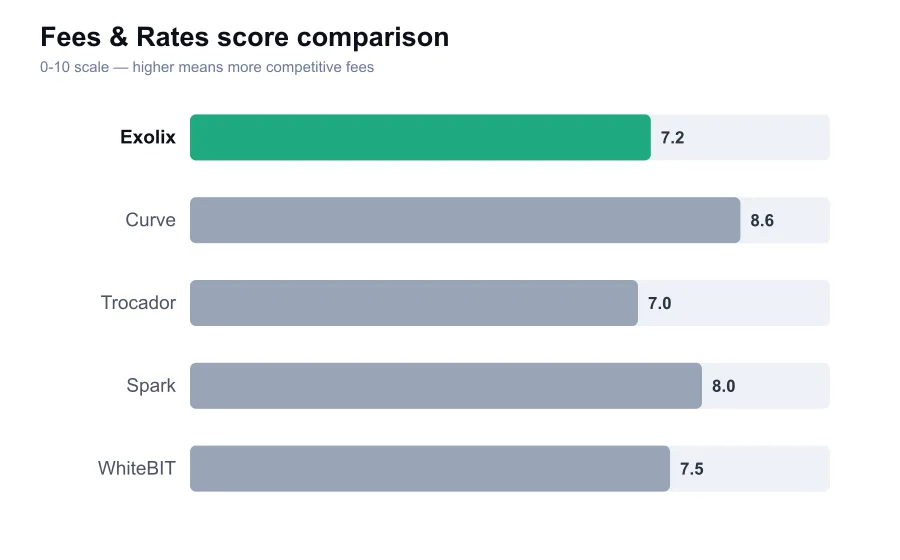
Fees are embedded in the offered exchange rate instead of displayed as a simple maker and taker schedule. That approach is common in instant exchange services, though it creates a comparison problem. A user cannot look at a single percentage and know the cost. The meaningful figure is the amount that arrives in the receiving wallet after Exolix's margin, liquidity cost, and blockchain fee have been accounted for. Compare the final output with at least one competitor before sending.
Exolix can be fairly competitive on liquid, large-cap pairs. It is usually less favorable on obscure tokens, thin networks, or low-value transfers where blockchain costs swallow a larger share of the transaction. Network selection can change the economics dramatically. Receiving USDT via Tron is often cheaper than receiving it through Ethereum, while an ERC-20 token swap may be expensive even if the platform's own spread is modest. The customer needs to choose the chain deliberately, not merely select the familiar ticker.
The service's speed is good in routine conditions. Once the inbound transaction has enough confirmations, Exolix can source the output and broadcast it to the receiving address. Swaps on fast chains can feel close to immediate after confirmation. Bitcoin, Ethereum during congestion, and coins with longer confirmation requirements are naturally slower. A transaction that remains pending on the source chain is not evidence that Exolix has failed to act.
Fixed-rate orders create a particular practical obligation. The customer has to send the exact requested amount before the quoted payment period expires. Sending less, sending after the timer, or using a sending wallet that deducts an unexpected fee can cause the order to be recalculated or handled manually. That is not a minor technicality. Before choosing a fixed quote, make sure the wallet can send the precise amount and that the selected network is correct.
Exolix calls its model non-custodial, and that is a fair description compared with a centralized exchange account. It does not operate as a place where retail customers maintain an ongoing trading balance. However, the provider still receives the deposited cryptocurrency for the duration of the swap. It must therefore be trusted to execute the conversion, manage liquidity, and send the output correctly. Non-custodial is a useful risk reduction, not a magic shield against all counterparty risk.
The KYC position is more nuanced than many advertisements for instant exchanges suggest. Exolix can process ordinary swaps without a permanent account, but it reserves the ability to seek information where compliance systems identify a risk. That can include identity verification or evidence connected to the transaction. Anyone who needs certainty that funds will never be paused should not use any centralized swap intermediary, because no serious provider can honestly guarantee that outcome.
On reputation, Exolix is better known than many obscure exchange widgets but does not have the long institutional history of Coinbase, Kraken, or Bitstamp. It has operated long enough to accumulate a substantial volume of public discussion, including positive reports about speed and critical reports about rate changes or verification-related delays. That is a normal pattern for this category. I would rank it as a recognizable mid-tier instant exchanger, not an unquestioned first-tier institution.
The support structure is important because a customer cannot reverse an on-chain deposit once it is sent. Exolix provides support through its website and transaction tracking tools. In a dispute, useful support should be able to identify whether the delay is caused by a missing deposit confirmation, a wrong amount, a wallet maintenance issue, or a compliance check. Customers can help themselves by submitting the order ID and transaction hash immediately instead of merely saying that funds are missing.
One thing Exolix does well is keeping the customer flow focused. There is no incentive to hold a portfolio inside the service or trade compulsively. You make the swap and withdraw to your own wallet. For disciplined users, that is a real advantage. It reduces exposure to exchange account takeovers, insolvency risk from held balances, and the temptation to leave funds in a hot wallet for convenience.
The downside is that there is little room for user error. A wrong network, a destination address that cannot receive the selected token, or an incorrect memo can be difficult or impossible to recover. Exolix cannot repair a transfer made to a valid but unintended blockchain address. Its convenience assumes that the user already has basic operational competence. That makes it more appropriate for people who have sent crypto before than for someone making their first transaction.
Exolix is a good working option for a self-custody user who needs an occasional swap and values a no-account workflow. It is not the cheapest tool in every case, and it is not the strongest choice for large transfers where regulated venues can offer deeper liquidity and clearer protections. Treat its quote as a quote, not a market price. If the numbers are competitive and the transaction is routine, Exolix is one of the more credible services in its lane.