Trocador is an instant-exchange aggregator, not a conventional exchange that takes custody of a customer account and matches traders on its own order book. It presents quotes from third-party swap partners, lets the user choose an offer, and routes the order to that provider. That puts it closer to a comparison desk for crypto swaps than to Kraken or Binance. It is a useful model, especially for people who want a non-custodial conversion flow without opening yet another trading account.
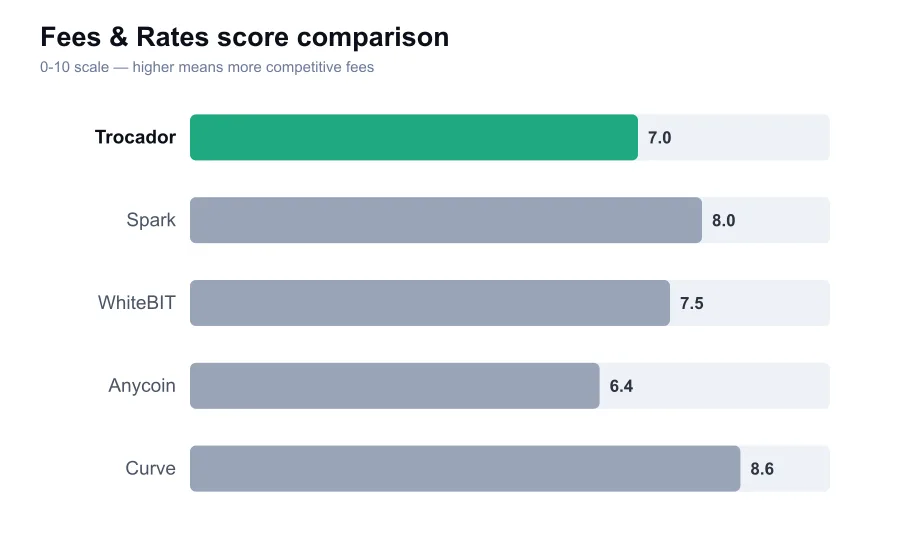
The strongest part of Trocador is that its business model is easy to understand. It earns a service fee on swaps while displaying offers from partner exchanges. The normal Trocador fee is 0.5 percent, and the platform's privacy option adds 1 percent. That means privacy-enhanced routing costs 1.5 percent before considering the underlying provider's rate, network fees, and spread. It is a real price, not a symbolic add-on.
I like the transparency of a stated fee more than the pretend-free language used by some instant exchangers. Still, users should not stop at the percentage. The best-looking offer can become poor value after a provider's spread is included. Check the exact amount you will receive, then compare it with another Trocador partner, a direct quote at ChangeNOW or FixedFloat, and, for larger swaps, the cost of trading on a liquid centralized exchange and withdrawing.
For small to medium privacy-minded swaps, the 0.5 percent base fee can be acceptable. For a frequent trader, it adds up quickly. Someone converting $10,000 several times a month should not pay convenience pricing by default. A liquid venue with a low maker or taker fee will often be cheaper, even after a withdrawal fee, provided the user is comfortable with account verification and custody risk.
Speed depends primarily on the selected provider and the chains involved. Trocador can show whether an offer is fixed rate or floating rate, and that distinction deserves attention. A fixed-rate order protects the quoted payout within its conditions, while a floating-rate order moves with the market during processing. On a fast, uncongested network, many swaps settle in minutes. Bitcoin, Monero, congested Ethereum transactions, and partner-side checks can take longer.
The platform's quote comparison is more than a convenience feature. It gives the customer a chance to choose between price, estimated time, rating, and exchange model. That is better than blindly accepting a single swap provider's route. It also means that Trocador cannot be assessed exactly like a standalone exchange. A good interface does not erase the operational risk of the partner that ultimately receives the deposit.
Trocador's privacy positioning is a reason many users find it attractive. The service is designed around non-custodial swaps and has promoted a no-KYC approach. In ordinary use, a customer generally supplies a receiving address rather than creating a full trading account. But the honest version of that statement is more nuanced: Trocador routes orders to independent providers, and those providers can apply compliance controls or ask for information under their own policies.
The platform makes an effort to give users route choices, which is valuable if avoiding certain providers matters to you. Its privacy option is intended to reduce direct linkage between the input and output sides of a transaction through additional routing. That feature is not magic anonymity. Public blockchains retain their own records, fees apply, and poor wallet hygiene can defeat privacy long before a swap reaches an exchange.
Security is good for its category because Trocador generally does not require customers to park assets in a permanent platform account. The user sends funds into a one-time swap flow and receives output at a chosen address. That materially reduces the risk of a large account balance being exposed to a centralized exchange hack. It does not eliminate the risk of entering a false destination address, choosing a malicious imitation site, or encountering a partner dispute.
The company has earned a recognizable name among privacy-focused crypto users, particularly among people swapping Monero, Bitcoin, Litecoin, and stablecoins. Its public reputation is stronger than that of a newly created anonymous exchanger, though it remains a specialized service rather than a household financial brand. Trocador's history and frequent community discussion count in its favor. The partner model, however, means a customer should evaluate both Trocador and the selected exchange.
Support is a meaningful differentiator in this category. Trocador has a support function and an order identifier that can help trace a problem, which is far better than an opaque wallet-to-wallet transfer with no intermediary. In a dispute, provide the order ID, deposit transaction hash, receiving address, amount, and screenshots of the quote. Do not send repeated replacement deposits unless support specifically confirms that doing so is safe.
There are limits to what support can solve. If a partner pauses an order for compliance review, Trocador may be able to mediate but may not control the final decision or timeline. This is the central drawback of aggregation. The site gives customers more choice at the front end, but the actual conversion occurs through a separate business with separate policies and liquidity.
The privacy fee also deserves a blunt assessment. One percent extra is expensive if the only goal is a slightly different route for a small transparent-chain swap. It can make sense for users who understand why they want it and who value that route selection. It is not something a newcomer should toggle merely because the word privacy sounds reassuring. Learn the chain's privacy properties, wallet behavior, and legal obligations first.
Trocador is at its best as a quote-comparison tool for a planned crypto-to-crypto swap. It is not a substitute for a regulated fiat on-ramp, a high-frequency trading venue, or a place to store coins. Use it with self-custody, select a partner deliberately, and accept that the cheapest displayed offer is not always the best operational choice.
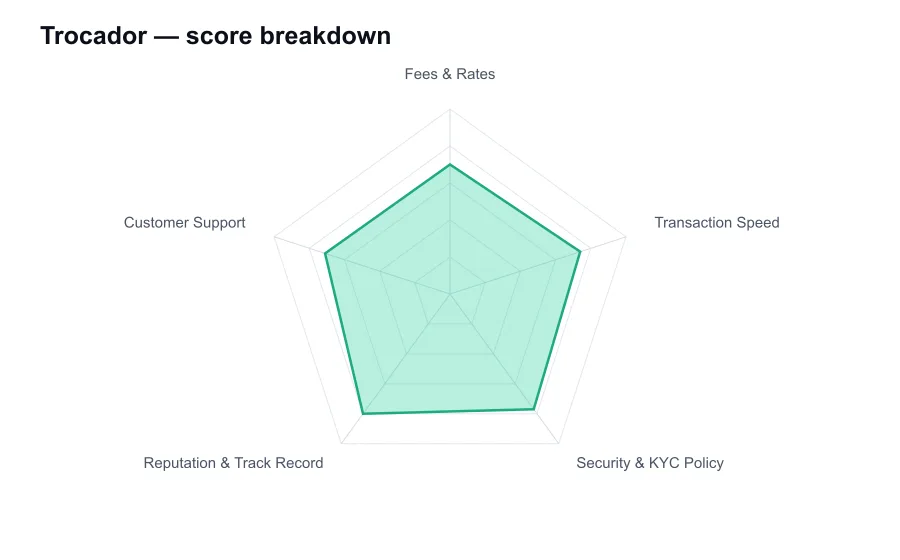
My take is positive, with clear boundaries. Trocador has a sensible product, stated fees, a useful route-selection interface, and a stronger reputation than most small instant exchangers. The 0.5 percent fee is fair for occasional use, while the 1.5 percent privacy-route cost makes it a premium option. I would happily use it for a modest self-custody swap after checking the quote and partner, but I would not use any aggregator for a rushed, high-value transfer that cannot tolerate a compliance hold.