Symbiosis is not an instant exchanger in the usual centralised-routing sense. It is a cross-chain decentralised exchange and liquidity protocol designed to let users swap assets between supported blockchain networks from one interface. That puts it closer to THORChain, LI.FI-based aggregators, and bridge-enabled DEX tools than to Swapter or Swapuz.
The distinction matters because the user experience carries different risks. With Symbiosis, you connect a self-custody wallet and approve smart-contract transactions. There is no support agent taking custody of a swap order in the conventional sense, and there is no routine personal account. The trade-off is that wallet permissions, gas settings, bridge mechanics, and smart-contract risk become the user's responsibility.
Symbiosis has focused on making cross-chain swaps less cumbersome than manually bridging assets, changing networks, and finding local liquidity. A user can begin with an asset on one supported chain and receive an asset on another supported chain. For DeFi users, that is genuinely useful. It cuts down a multi-step process that otherwise creates several opportunities for error.
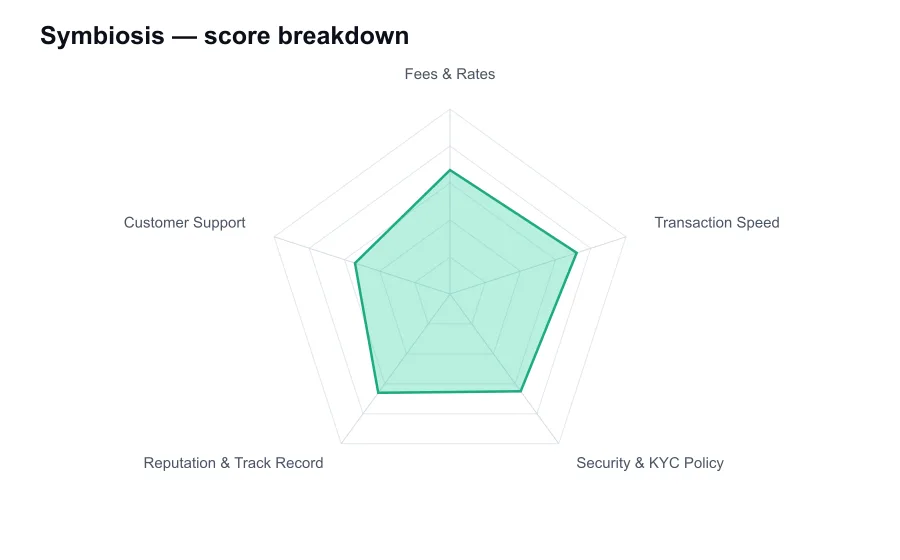
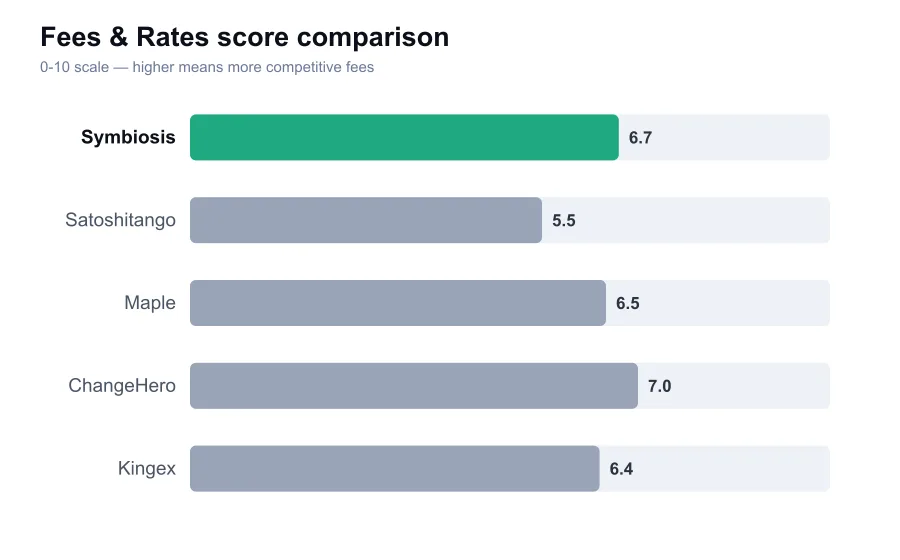
Fees are less tidy than a single trading commission. A transaction can include a liquidity-provider fee, a protocol or route fee, source-chain gas, destination-chain gas, and the cost of any bridge mechanism used. The app should show the expected output before confirmation, but an estimate is still an estimate. Gas and price movement can change the economics, particularly on Ethereum.
The protocol's pool fees have commonly been structured around automated-market-maker pricing, while cross-chain routes bring extra charges that vary by network and transaction path. This makes Symbiosis comparatively economical for a suitable route, but not automatically cheap. A small transfer can be swallowed by gas, and a large transfer can suffer from price impact if liquidity is shallow.
Speed is one of Symbiosis's better qualities on its supported fast chains. A cross-chain transfer can still require source-chain confirmation, bridge processing, destination-chain execution, and sometimes a final swap. That is more complex than a same-chain Uniswap trade. It may take minutes in normal conditions, and longer if a chain is congested, validators are delayed, or the destination route needs intervention.
The protocol's user interface is cleaner than many bridge tools, but it cannot make cross-chain infrastructure simple underneath. Users should look beyond the attractive estimated arrival time. Check which token version will arrive, whether the destination chain has native gas requirements, and whether the output token is useful without another swap. Receiving an obscure wrapped token is rarely a successful outcome.
There is no routine KYC because Symbiosis is a decentralised protocol accessed by wallet connection. That is useful for privacy and for global DeFi participation. It does not mean every legal or technical concern vanishes. Interface access can be affected by local restrictions, and on-chain activity remains public. Wallet addresses and transaction histories are visible to anyone who knows where to look.
Security is the central question. Symbiosis uses smart contracts and cross-chain messaging, two areas where DeFi has repeatedly suffered expensive failures. Audits and bug-bounty practices are valuable, but no audit is insurance. Bridges in particular have been among crypto's most attacked systems, so users should never confuse non-custody with a risk-free arrangement.
Symbiosis has earned more protocol-level recognition than a small instant exchanger, and its continued multi-chain product development is a point in its favour. It is still a younger DeFi project, however, without the long stress-tested history of Ethereum's largest protocols. Liquidity, route availability, and the reliability of connected chains all affect the real experience.
Support is naturally weaker than the support offered by a regulated brokerage. Documentation, community channels, and interface guidance can help, but they cannot undo an approval granted to a malicious website or recover a transfer sent to an incorrect address. The user must verify the official domain before connecting a wallet, because phishing copies of DeFi sites are common.
The protocol is most attractive to a user already comfortable with MetaMask, Rabby, or another Web3 wallet. Such users understand gas, approvals, and the fact that a bridge can be delayed. A crypto beginner looking merely to exchange euros for Bitcoin should not start here. The learning curve is real, and the consequences of a mistake are often irreversible.
I like Symbiosis more as infrastructure than as a casual consumer exchange. It tackles a real friction point in DeFi and can reduce the number of manual cross-chain steps. The product is strongest when liquidity is adequate and the user knows exactly which assets and networks are needed. It is weaker for tiny transactions, unfamiliar chains, and anyone expecting a help desk to fix errors.
My final view is constructive but strict. Symbiosis deserves credit for enabling cross-chain swaps without a custodial account and for keeping the flow relatively accessible. Yet its fee stack, smart-contract exposure, and bridge dependencies require a more sophisticated risk assessment than a simple exchange score can convey. Use it deliberately, revoke old permissions, and do a small test route before committing meaningful value.