ChangeHero is a non-custodial instant crypto exchange. You choose a pair, receive a deposit address, send the funds, and the service sources a conversion before sending the output to your wallet. It sits in the same broad category as ChangeNOW, Changelly, SimpleSwap, and StealthEX. The appeal is obvious: no trading screen, no account creation for an ordinary swap, and a relatively clean interface for people who just want to move from one coin to another.
The service has been operating since 2017, which gives it more history than the newest crop of instant swap sites. That matters, although it does not put ChangeHero in the same trust tier as a large exchange with deep public financial reporting, regulated entities, and years of institutional scrutiny. It is a smaller operator. I would use it for a normal personal conversion, not as a place to leave money sitting while I decide what to do next.
ChangeHero offers floating-rate and fixed-rate exchanges. Floating rate is the basic option. The final return changes with liquidity and market movement between the quote and execution. Fixed rate gives the user a locked quote for a limited period, usually at a slightly less attractive headline rate because the provider has to absorb more market risk. That distinction is much more useful than a vague claim that a swap is cheap.
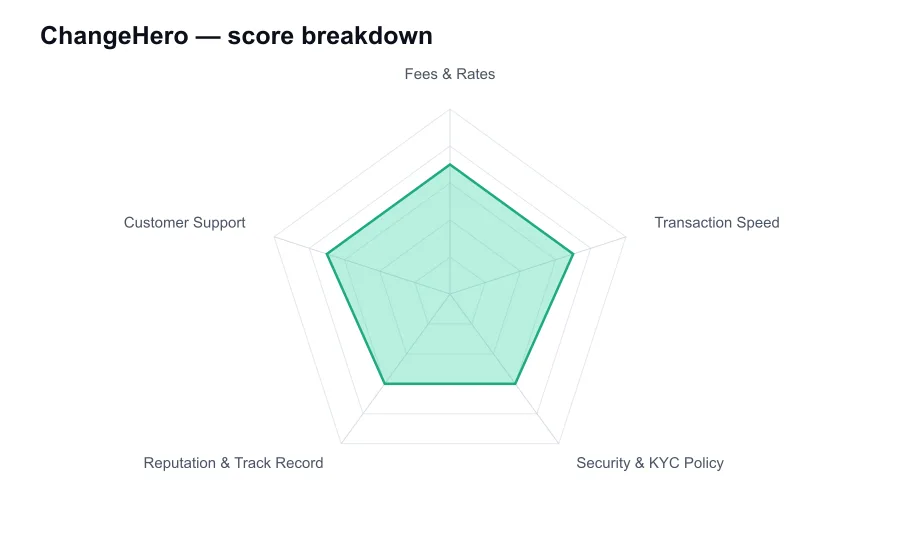
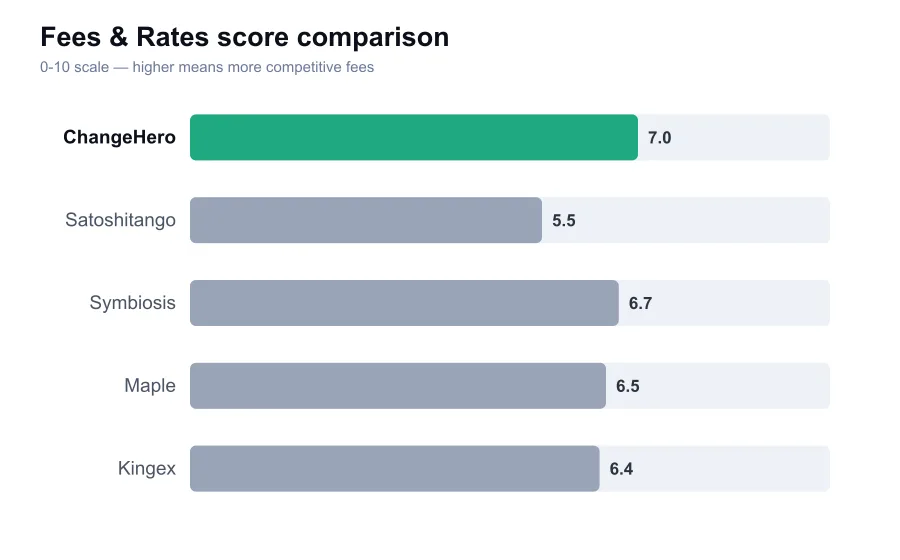
The company does not present a simple universal percentage fee for every route. Its costs are folded into the displayed quote, alongside partner liquidity, blockchain network fees, and spread. This is common among instant exchangers, but it makes price comparison essential. A quote that looks convenient can be meaningfully worse than a limit order on Kraken or Binance, especially for liquid pairs such as BTC to USDT or ETH to USDC.
For smaller, awkward conversions, ChangeHero can be reasonably priced because it saves several steps. You do not need to deposit into a centralised exchange, sell one asset, buy another, then withdraw it. That saving is real, particularly if you are moving across chains or working with an asset that is poorly served by mainstream trading venues. Still, convenience pricing is pricing. Check the amount you will receive, not just the rate displayed beside the pair.
Speed is generally good on uncomplicated swaps. Once the incoming transaction receives the required blockchain confirmations, ChangeHero can often complete a liquid conversion in minutes. Bitcoin deposits naturally take longer than an ERC-20 transfer, and a congested network can ruin any promise made by a swap provider. Fixed-rate orders may also need timely payment, so sending too late can lead to a revised quote or support intervention.
The practical weakness is that ChangeHero relies on external liquidity providers and blockchains that it does not control. If a partner pauses an asset, a wallet is under maintenance, or the network fee suddenly rises, a fast swap can become a manual case. That is not unique to ChangeHero, but larger competitors tend to have more liquidity connections and more polished status communication. The platform is fast when everything works. It is less reassuring when something does not.
ChangeHero calls itself non-custodial, correctly in the limited sense that it does not offer a user balance or long-term account wallet. Yet every swap still involves sending funds to an address controlled for the transaction. That is a temporary custody risk. The right mental model is a transaction processor, not a self-custody wallet. Send the exact requested amount, use the correct network, and do not treat the generated address as reusable.
Routine swaps can usually be completed without account registration or standard identity checks. That is a major attraction for privacy-minded users. It is not an unconditional no-KYC promise. ChangeHero has an AML policy and can ask for verification or source-of-funds information if its compliance systems flag a transaction. A user whose funds are reviewed may find the absence of an account suddenly less convenient, because the service is holding a transaction rather than simply declining it before payment.
That policy deserves plain language. No-KYC instant exchanges are not anonymous cash machines. Chain analytics, sanctions screening, stolen-fund reports, and unusual transaction patterns can all trigger a review. If your coin history is complicated, or you received assets from a high-risk service, use a regulated exchange where the compliance path is clearer. Trying to route questionable funds through a swap service is a poor idea and can create a long, frustrating hold.
ChangeHero has a respectable public reputation for a smaller swap brand. Reviews commonly praise the simple flow and responsive live chat, while complaints tend to involve delayed orders, rate changes on floating swaps, and transactions paused for checks. None of those complaints is unusual in this sector. What matters is whether the company can trace an order, explain the issue, and resolve it. ChangeHero does publish transaction tracking tools, which is more useful than a generic support inbox.
Support is available around the clock through live chat and email. In my experience with this category, chat is best for a delayed but ordinary transaction, while a compliance review is rarely solved instantly by a friendly first-line agent. Keep the transaction ID, deposit hash, expected amount, wallet address, and screenshots ready. Support cannot undo a transfer sent on the wrong chain, but good documentation makes a genuine processing issue much easier to handle.
The asset range is broad enough for most retail users, with major coins and a changing selection of smaller assets. Availability can differ by network, though. USDT is not one interchangeable thing. Sending USDT on Tron to a deposit address intended for Ethereum can turn a simple conversion into a recovery request, if recovery is possible at all. The same caution applies to wrapped assets, memo-based coins, and newly introduced networks.
ChangeHero is best judged as a practical convenience service rather than a bargain exchange. It is faster and simpler than moving funds through a conventional trading account, and it has earned a fair amount of operating history. Its weak points are familiar: opaque all-in pricing, no guaranteed rescue from a compliance hold, and less institutional depth than top exchanges. For a carefully checked, moderate-sized swap, I would consider it. For large trades, repeated trading, or funds with a complicated history, I would choose a venue with more transparency and stronger controls.