LetsExchange is a crypto swap platform built around convenience rather than an exchange account. It aggregates liquidity and presents users with a conversion quote, allowing them to exchange assets from a personal wallet without depositing into a long-term custodial balance. It belongs in the same broad category as ChangeNOW, ChangeHero, and SimpleSwap, though its route coverage and partner integrations make it a more substantial player than many lookalike swap sites.
The service is designed for people who want to move between assets quickly, including cross-chain conversions that would otherwise require several manual steps. You select the asset to send, choose what you want to receive, enter a destination address, and transfer to a generated deposit address. LetsExchange handles the conversion path behind the scenes. That can be genuinely useful, especially for users moving across ecosystems.
Its headline figure is support for more than 5,000 cryptocurrencies, a very large catalogue by instant-exchange standards. That number needs context. A large asset list does not mean every token has deep liquidity, low spreads, or equally reliable routing. Popular pairs such as BTC to ETH, ETH to USDC, or SOL to USDT are a different proposition from thinly traded tokens on less common networks.
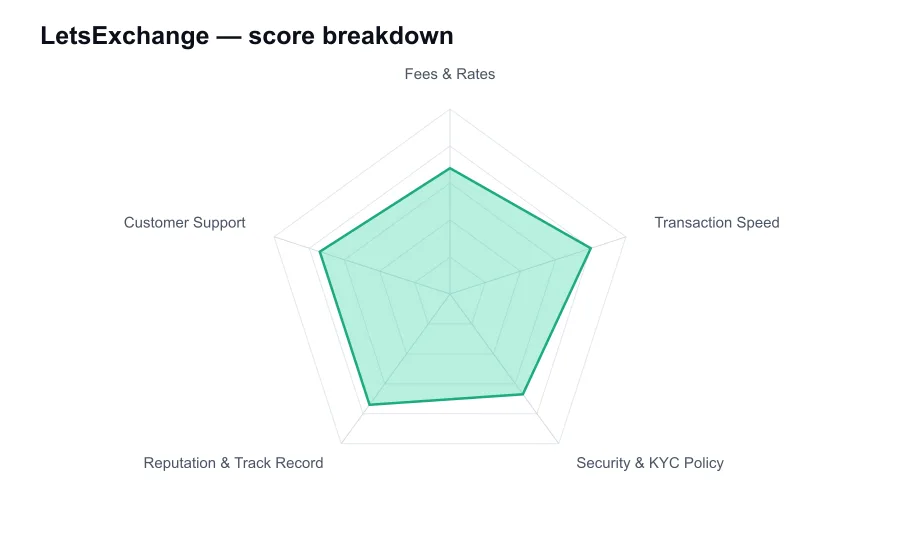
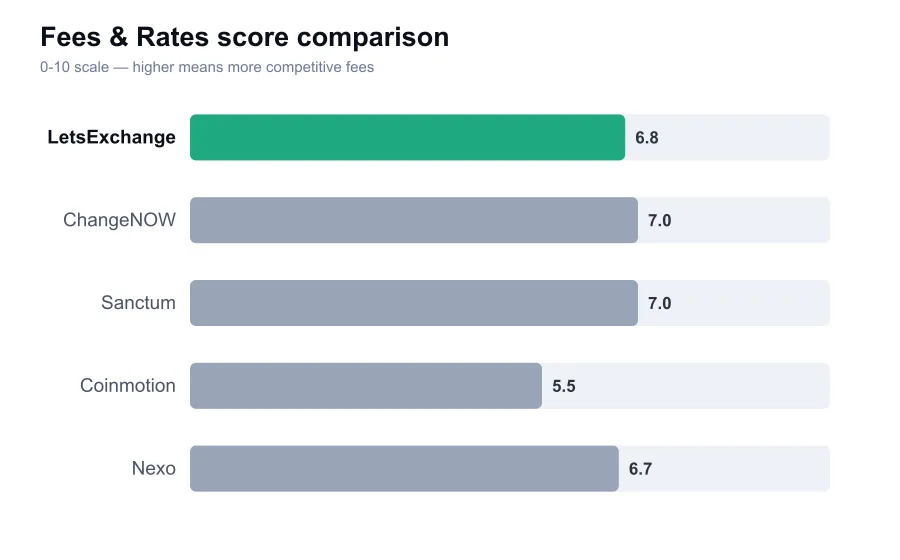
Fees are quote-based rather than stated as a simple platform percentage. LetsExchange says its displayed rate includes the relevant costs, but users still need to judge value by the output amount. This model is convenient because it avoids a maze of separate charges. It is also hard to audit at a glance. A centralized exchange with a 0.1% trading fee may beat an instant swap once spreads are included, even after accounting for withdrawal fees.
The platform offers fixed-rate and floating-rate swaps. Floating rate is normally the better value if prices are stable and you can tolerate some variance. Fixed rate is more useful during a sharp market move because it protects the expected output if the deposit arrives within the stated time and amount requirements. It is not a free guarantee. The quote will often be less favorable because the liquidity provider is absorbing execution risk.
Execution speed is generally good for a non-custodial swap service. Many routine conversions finish within minutes after sufficient deposit confirmations. LetsExchange cannot make Bitcoin confirm faster or force an Ethereum transaction through during a gas spike. The source and destination network, the selected asset, the availability of partner liquidity, and security checks determine the practical wait time.
Cross-chain functionality is a real attraction, but it also adds complexity. Sending USDT is not one universal operation. USDT exists on several networks, and the receiving wallet must support the exact selected chain. The same issue arises with USDC, wrapped Bitcoin, and tokens sharing a ticker across different ecosystems. A swap can complete perfectly on-chain while still becoming inaccessible to a user who selected the wrong network for their wallet.
LetsExchange generally does not require users to create an account or complete routine identity verification before making a swap. That makes it more private and faster to start than a fiat exchange. The important qualification is its AML policy. The service can pause an order and request KYC or source-of-funds information if its risk systems flag a transaction. Users should read that policy before treating a no-registration flow as an assurance of no review.
From a security perspective, avoiding a persistent custodial balance is an advantage. You are not leaving coins sitting in a platform wallet for months. Yet the conversion itself still requires trust. You transfer assets to a deposit address and depend on LetsExchange and its liquidity path to deliver the output. The service is not a decentralized atomic swap protocol, even though it can feel close to self-custody from the user interface.
LetsExchange has established a respectable market presence since launching in 2020. It has built partnerships and API integrations, and it is commonly listed among the better-known instant swap providers. Its record is stronger than a newly created swap page with no history. It still does not offer the public financial disclosures, segregated-client-fund protections, or broad licensing profile that a large regulated centralized exchange may provide.
Support is better developed than at many instant exchangers. LetsExchange offers live chat and a support team, alongside an exchange tracker that lets users follow a transaction. That is valuable when a deposit has confirmed but a conversion has not completed. The limits are structural, though. If an order is under compliance review or an external liquidity venue is unavailable, support can communicate status but cannot always produce an immediate result.
The service has a few thoughtful features for experienced users, including rate selection, affiliate and API options, and broad network coverage. Its user interface is simple enough for a basic swap, although beginners should resist the temptation to treat the huge token list as a recommendation list. A token being available to exchange says little about its legitimacy, liquidity, or long-term value.
For small and medium wallet-to-wallet conversions, LetsExchange can be very practical. I would use it only after comparing the final amount with a second aggregator and verifying the destination network. For frequent trading, the economics usually favor a liquid order-book exchange. For a large one-time conversion, I would split the process or run a test transfer first rather than trusting any instant exchanger with an untested route.
LetsExchange is one of the more capable services in its category, mainly because of its extensive asset coverage, fixed-rate option, and usable support channels. Its model is still built on quoted spreads and temporary counterparty exposure, so it should not be sold as equivalent to a decentralized exchange or a regulated brokerage. It is a good tool for the right task. Just make the comparison, check the network, and keep the transaction size sensible.