Kamino is one of Solana's most important DeFi applications, though calling it simply a lending protocol misses the point. It combines lending, borrowing, automated liquidity strategies, leverage tools, and vault management in a single interface. That makes it more ambitious than a plain money market such as Solend, and more practical for active Solana users who would otherwise stitch together several protocols.
The core lending product lets users supply supported assets to earn variable interest or borrow against posted collateral. Rates move according to pool utilisation, so there is no promised yield. Depositors earn borrowing interest, while borrowers pay an annualised rate that can change quickly in a volatile market. Anyone treating the displayed APY as fixed income is misunderstanding what they are buying.
Kamino's technical attraction is its use of isolated markets as well as broader main pools. Isolated pools can allow assets with distinct risk profiles to be listed without exposing every lender to the same collateral set. That is a smarter design than throwing all tokens into one giant shared pool. It does not make obscure collateral safe, but it contains potential damage more effectively than older, simpler lending architectures.
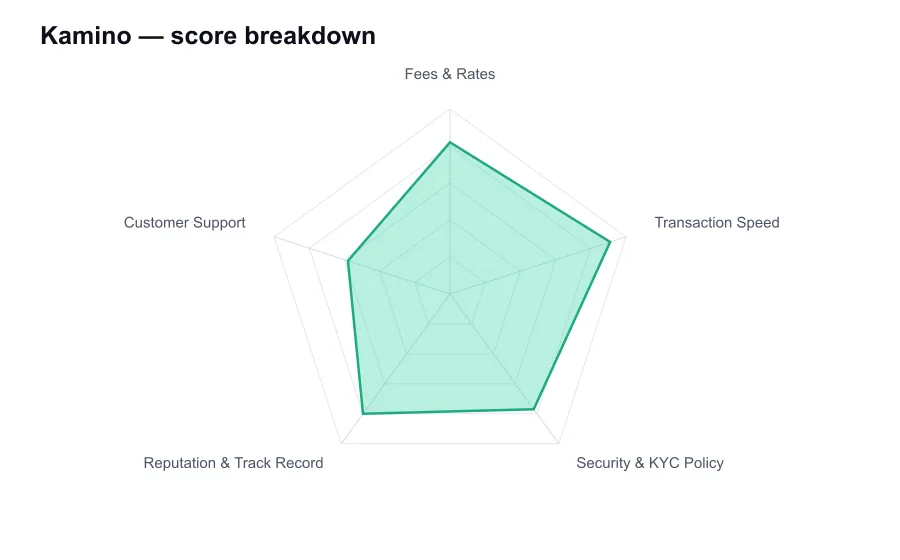
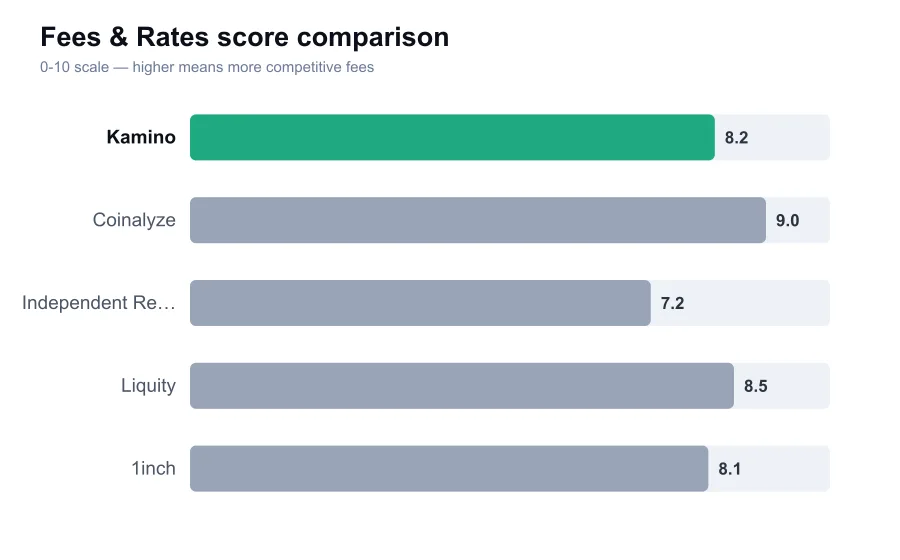
Fees are not as simple as a centralized exchange's published trading commission. Lenders face no conventional deposit fee in the normal flow, while borrowers pay interest driven by utilisation and reserve parameters. Liquidations carry penalties, and leveraged liquidity strategies have embedded trading, borrow, and network costs. The cost of using Kamino can be very low on quiet days, then suddenly expensive when borrow demand rises or Solana activity becomes congested.
Solana is central to the speed story. A supply, withdrawal, borrow, or repayment normally settles in seconds once the transaction lands on chain, and fees are commonly only a fraction of a dollar. That is a major advantage over Ethereum mainnet lending, where smaller positions can be uneconomic. Still, users should not confuse chain speed with a guarantee of execution. Congestion, RPC failures, priority fees, and failed simulations can interrupt a time-sensitive action.
The real speed test comes during liquidations. Kamino's interface may show health factors and projected liquidation prices, but the protocol cannot protect a borrower whose collateral falls sharply while they are offline. On Solana, fast blocks are helpful, yet automated liquidators can be faster than a human with a mobile phone. Leveraged positions should be monitored closely, with a healthy buffer rather than a position sized to the last decimal.
Kamino is non-custodial in the usual DeFi sense. You connect a Solana wallet such as Phantom, approve transactions, and retain control of the wallet keys. There is no conventional identity verification for basic protocol use. That privacy is attractive, but it shifts responsibility onto the user. A mistaken signature, a compromised wallet extension, or a malicious clone site has no support agent who can reverse it.
The protocol has undergone security audits from firms including OtterSec and has maintained a public bug bounty through Immunefi. Those are positive signals, especially for a protocol handling lending positions and concentrated liquidity. They are not insurance. Audits review code at a point in time, while oracle failures, integration mistakes, governance decisions, and novel economic attacks can emerge later. DeFi users should always distinguish an audited protocol from a risk-free protocol.
Kamino's oracle and liquidation dependencies deserve serious attention. Borrowing relies on price feeds and risk parameters, so a bad oracle event or a rushed collateral listing can create losses even if the smart contracts execute exactly as designed. This is not unique to Kamino. It is the trade-off behind on-chain credit. The protocol's risk dashboards and isolated markets are helpful, but users need to understand the assets they are using.
Its reputation within Solana DeFi is strong. Kamino became a prominent venue during Solana's recovery because it offered a polished product at a time when many users wanted better capital efficiency than a basic swap interface could provide. The team has shipped consistently and has become part of the infrastructure stack for borrowers, liquidity providers, and vault users. It is far more credible than an anonymous yield site promising suspicious returns.
That said, Kamino is young compared with Aave, and its operating history has mostly occurred within Solana's particular technical and economic environment. Solana's outages are much less frequent than they once were, but network dependency remains relevant. The protocol is also exposed to the tendency of DeFi users to chase incentives into newer collateral types. A high APY may reflect genuine demand, but it can also reflect substantial liquidation and token risk.
Support is community-led. Kamino maintains documentation, a Discord community, social channels, and interface guidance, but there is no traditional customer service desk that can take custody of a problem. For a wallet connection issue or a question about a transaction, public support can be useful. For a liquidation, it will not change the result. That is the proper expectation for a permissionless protocol, though it still leaves beginners with little room for error.
Kamino's best users are people already comfortable with Solana wallets, token accounts, transaction signing, and variable-rate borrowing. For them, the integrated interface is genuinely good. It reduces friction between lending and liquidity deployment, and its low-cost environment makes modest positions viable. For a newcomer, the same integration can encourage overconfidence because several types of risk are presented in one slick dashboard.
My view is that Kamino is among the better DeFi lending choices on Solana, particularly for experienced users who want more than a basic lending pool. Its strengths are speed, product design, and serious security efforts. Its weaknesses are the permanent realities of smart-contract risk, liquidation risk, and self-custody. Use it for carefully sized positions, not as a savings account substitute or a place to take leverage you cannot actively manage.