Coinalyze is a derivatives-data and market-analysis platform, not an exchange where you custody coins or execute a spot swap. That distinction matters. It belongs in a review of crypto trading services because many active traders use it beside Binance, Bybit, OKX, TradingView, or a broker, but it is fundamentally a screen for interpreting futures activity rather than a venue for placing an order.
Its specialty is straightforward: open interest, funding rates, liquidations, long versus short ratios, futures volume, and price charts across major centralized and decentralized perpetual markets. The service is especially useful for traders who believe price alone tells an incomplete story. A sharp move with expanding open interest, aggressive funding, and liquidation clusters can mean something very different from the same candle printed on thin volume.
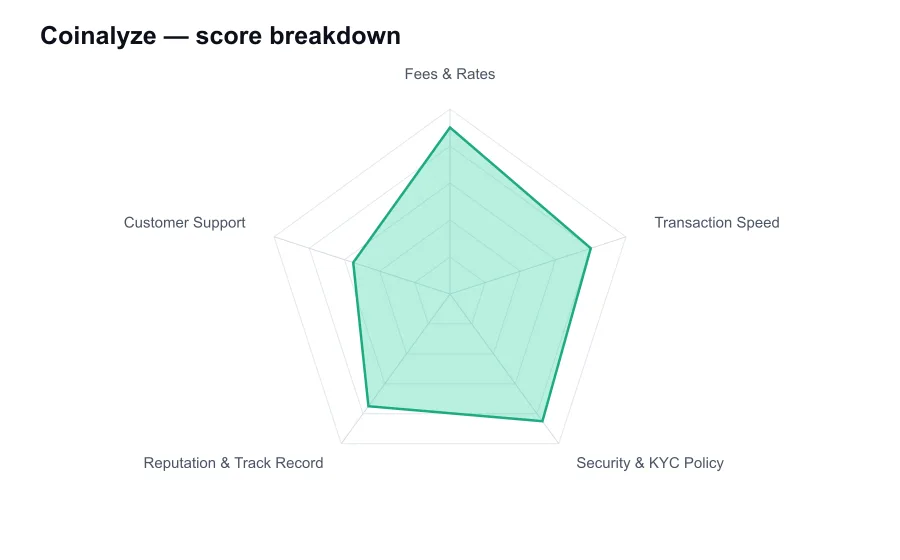
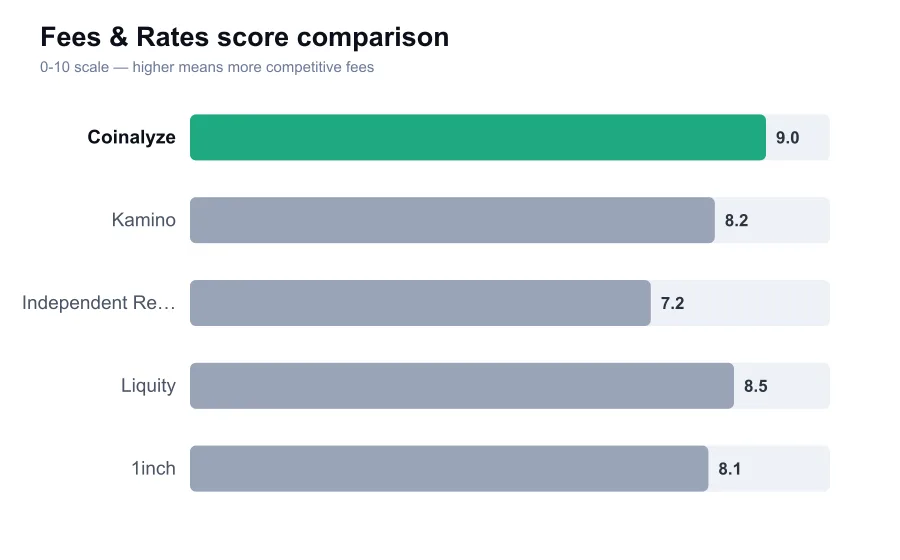
The best part of Coinalyze is that a surprising amount of this data is accessible without an account and without paying. Basic charts, liquidation information, funding data, market lists, and exchange comparisons are available in the browser. That makes its direct financial cost far lower than institutional analytics terminals such as Kaiko, Amberdata, or certain paid CryptoQuant plans. For a retail derivatives trader, free access is a serious advantage.
There is no conventional maker and taker fee here because Coinalyze does not match trades. The cost question is really about whether the free product gives enough historical depth and alerting capability for your workflow, or whether you need API access and paid data features. That is a more favorable proposition than paying a monthly subscription before you can even decide whether the platform's signals suit your trading style.
The catch is that free data tools can encourage careless use. Open interest and funding are descriptive metrics, not automatic buy and sell signals. Traders often see high positive funding and immediately expect a crash, then watch the market keep climbing for days. Coinalyze gives you the raw material, but it does not protect you from treating one indicator as a prediction machine.
Data delivery is generally quick enough for discretionary charting. The platform presents market updates in a way that feels close to real time, and the liquidation and open-interest views are responsive in normal use. Still, it should not be mistaken for exchange-native order-book infrastructure. If you are running latency-sensitive strategies, making automated execution decisions, or arbitraging venues, you need to validate timestamps, API limits, and data completeness independently.
For ordinary traders, the speed is more than adequate. A person checking BTC funding across Binance, Bybit, OKX, and other tracked venues before entering a perpetual position will get practical value quickly. The interface is less intimidating than many professional data terminals, and the chart overlays make it easy to compare price with aggregate open interest or liquidations without exporting a spreadsheet.
Coinalyze also does well at making fragmentation visible. Crypto derivatives do not trade in one neat central market. Funding can differ sharply between venues, and a liquidation wave concentrated on one exchange may not carry the same meaning as a broad move across several large platforms. Seeing that spread is one of the platform's strongest practical uses.
Security is unusually simple here because Coinalyze does not ask users to deposit crypto, connect a wallet for basic analytics, or surrender trading custody. There is no withdrawal-address risk and no exchange balance waiting to be hacked. That lowers the consequence of using the service substantially compared with signing up for a centralized trading platform.
It also means KYC is not part of the ordinary browsing experience. You can use much of the public site without identity verification. That is appropriate for a research product, although it should not be confused with privacy guarantees. Like almost any web service, it can collect technical and usage information, and users should read its current privacy terms before creating an account or requesting API access.
The more meaningful security issue is data integrity. A trader can lose money from a misleading chart just as surely as from a compromised login. Exchange reporting methods differ, perpetual contract symbols differ, and aggregate figures can be misunderstood. Coinalyze appears careful about identifying exchanges and contract types, but serious users should cross-check unusual readings with the source venue, especially before acting on a sudden liquidation spike.
Its reputation is respectable within the derivatives-trader community, though it is not a household consumer brand like Coinbase or Kraken. It has built recognition by providing a broad set of futures metrics in a clean public interface rather than by spending heavily on retail marketing. That is a good fit for the product. Traders tend to find it because they need the data, not because a celebrity advertised it.
I would not put Coinalyze in the same trust category as a regulated financial custodian, because it is not one. Nor would I judge it by that standard. The sensible comparison is with Coinglass, Velo Data, Laevitas, and CryptoQuant. Against those services, Coinalyze is particularly attractive for a trader who wants rapid access to mainstream derivatives statistics without building a paid analytics stack.
Support is the weak point, although that is common among low-cost data platforms. The site provides contact routes and documentation, but users should not expect the phone support, named account management, or operational escalation process offered to institutional customers by large data vendors. If an indicator appears wrong during volatile conditions, you may need to verify it yourself rather than wait for a support reply.
The interface is strongest for traders who already understand perpetual futures. A newcomer can learn from it, but labels such as cumulative volume delta, open interest change, funding rate, and liquidation delta need context. Coinalyze is not really an education-first product. It assumes you can read a chart and know why an annualized funding rate differs from the periodic payment actually charged by an exchange.
There are some practical limits to relying on any aggregator. Coverage changes as exchanges list, delist, restrict, or alter contracts. A chart may aggregate markets that do not share identical settlement conventions, collateral types, or liquidity. Smaller venues can also produce noisy data. The right approach is to use the aggregate panel as a directional clue, then inspect the specific venue where you plan to trade.
The lack of a custody layer remains its biggest virtue. You can keep your funds at a venue you have chosen, or preferably in self-custody when they are not needed for trading, while using Coinalyze strictly as research. That separation reduces the temptation to treat every platform in a trading workflow as a place to park assets.
My view is that Coinalyze is a strong, practical analytics service with a much better value proposition than its modest public profile suggests. It is not a substitute for risk management, and its customer-service model will disappoint anyone expecting concierge treatment. But for a derivatives trader who wants funding, open interest, liquidations, and cross-exchange context without paying a large monthly bill, it is one of the more useful tools to keep open beside the trading terminal.