EasyBit is a non-custodial instant crypto exchange service built for people who want to swap one asset for another without opening a trading account. It sits in the same broad category as ChangeNOW, StealthEX, SimpleSwap, and Exolix. The pitch is straightforward: choose a pair, send crypto to a generated address, and receive the requested asset in a wallet you control. EasyBit does that job competently, though it remains a smaller name than the category leaders and that matters when trust is part of the purchase.
The interface is one of EasyBit's stronger points. It is clean, fast to load, and does not force a newcomer through a long sequence of screens before showing an estimated result. You select the deposit currency, select what you want to receive, enter the destination wallet address, and approve the exchange. For a simple BTC to USDT or ETH to SOL conversion, the flow is much less intimidating than a conventional exchange order book.
EasyBit offers floating and fixed-rate swaps. A floating quote follows the market during processing, so the final amount can move if the underlying asset is volatile or network confirmation is slow. Fixed-rate swaps reserve a quoted result for a short period, provided the exact required amount reaches the deposit address before the timer expires. That option is valuable during sharp market movement, but users should understand that fixed quotes typically include a wider spread because the provider is taking price risk.
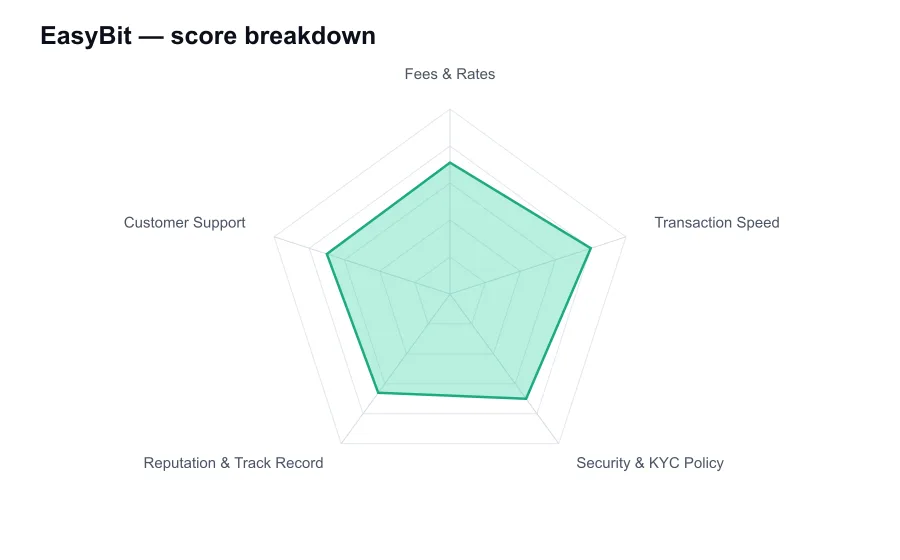
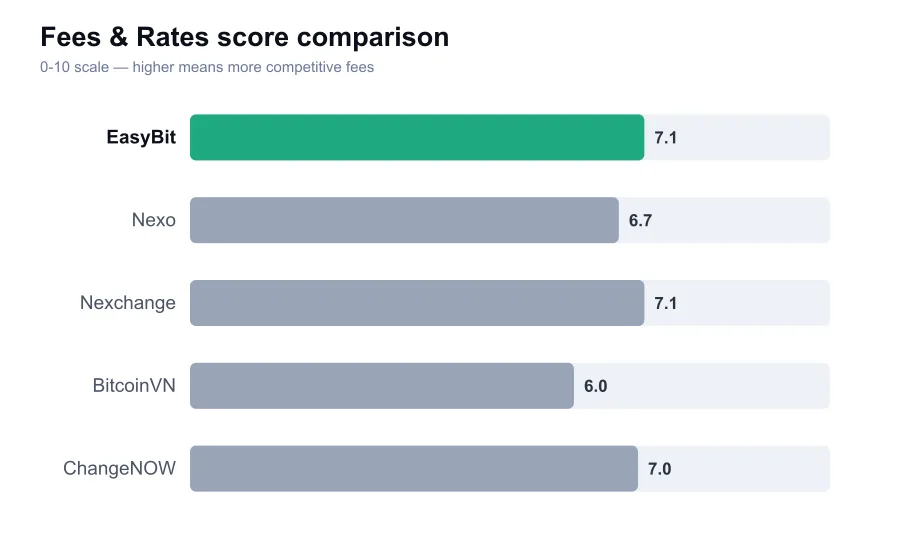
Its fees are not presented as a single transparent percentage that applies to every trade. This is normal for instant exchangers, but it remains a weak spot for comparison shopping. EasyBit's quote incorporates its service margin, market execution costs, and the relevant blockchain network fee. A BTC to ETH quote may look attractive while a smaller ERC-20 swap can be materially more expensive because Ethereum gas has a larger effect on the result. You need to compare the final received amount, not just the rate shown near the pair selector.
For larger swaps, EasyBit can be competitive with other no-account services, particularly on liquid pairs such as BTC, ETH, USDT, USDC, SOL, LTC, and XRP. It is less compelling for very small transactions. Minimums change by asset and network, and sending an amount just above the displayed minimum leaves little room for a network fee or a changed quote. Small swaps are where flat blockchain costs and exchange spreads punish users hardest.
Speed is generally good if both chains are behaving normally. A swap involving fast networks such as Solana, Tron, Polygon, or Litecoin can often complete within minutes after the deposit is confirmed. Bitcoin and Ethereum transactions are more dependent on block confirmations, mempool congestion, and the fee attached to the transaction sent by the customer. EasyBit cannot release an outgoing payment until it has enough confidence that the inbound funds are final.
That distinction is important because customers often blame an exchanger for a delay caused by their own low-fee deposit. If a Bitcoin wallet broadcasts with a weak miner fee, the transaction may sit unconfirmed for a long time before EasyBit can process it. The transaction page gives users a useful way to follow status, but it does not remove the practical fact that blockchain settlement is outside the exchanger's control. In normal conditions, the service feels quick. During congestion, it is merely as quick as the chains allow.
EasyBit describes itself as non-custodial, which is broadly accurate in the limited sense that it does not hold a standing customer balance like a centralized exchange. There is no account wallet where customers leave funds for weeks. Still, every instant swap has a custody window: the service receives the deposit, converts it through its liquidity arrangements, then sends the output onward. That is safer than keeping a speculative balance on an exchange, but it is not trustless and should not be treated as such.
The company uses standard website protections and transaction monitoring, but its no-registration design does not mean every transfer is beyond review. EasyBit's terms reserve the right to request identity documents or additional source-of-funds information where its compliance systems flag a transaction. This is common among instant exchangers. The issue is that a user who needs guaranteed frictionless settlement cannot safely assume that a no-KYC front page is a promise that no verification will ever happen.
This is where EasyBit trails a long-established regulated exchange. It has less public corporate visibility, fewer independently audited disclosures, and a shorter public record than Kraken, Coinbase, or Bitstamp. Those firms ask more of the customer, but they also provide clearer legal entities, stronger licensing footprints, deeper reserves of public information, and more formal complaint channels. EasyBit's model has a place, but the trust calculation is different.
Its public reputation is decent rather than exceptional. Customer feedback often praises the simple interface and completed swaps, while negative reports tend to focus on rate movement, compliance checks, or delayed orders. None of those complaints is unique to EasyBit, yet they are precisely the incidents that reveal how an exchanger behaves under pressure. A service is easy to like when every chain is quiet and every transaction is ordinary. The difficult cases are where its reputation is still less battle-tested than the leading brands.
Support is available through the website and is intended to handle order-level issues, missing deposits, and payout delays. In a good case, support can use the order ID and blockchain transaction hash to identify the stage where a transfer is held up. The quality of that process depends on how clearly the customer provides the hash, amount, network, and receiving address. Chat-style support is useful for time-sensitive swaps, though it is not the same as having a dedicated account manager or a regulated complaints department.
EasyBit is a sensible tool for users who already understand wallet addresses, network selection, and confirmation times. It is not the service I would choose for a first purchase of crypto with fiat, for storing funds, or for moving life-changing amounts without testing the route first. The lack of a standing account is a genuine advantage for privacy-conscious users, but the trade-off is less recourse and less institutional transparency.
My view is that EasyBit earns a place among practical instant swap services, especially for a one-off conversion between mainstream coins. It is not a bargain platform in every market condition, because its quoted rate can hide a meaningful spread. Use fixed-rate mode if price certainty matters, check the final output against at least one competitor, and keep a transaction record. EasyBit is useful, but it should be treated as a transaction tool, not a financial home.