Godex is an account-free instant crypto exchanger aimed at people who want a direct wallet-to-wallet conversion rather than a trading platform. It has operated for years and is regularly mentioned alongside FixedFloat, ChangeNOW, LetsExchange, and SimpleSwap. The product is simple: pick a pair, provide a receiving address, and send the deposit.
The service's calling card is a fixed-rate exchange model. Godex presents a quoted outcome before the user sends funds and advertises that the rate is protected from market movement during the exchange window. That is attractive during fast markets, particularly for a Bitcoin-to-stablecoin conversion where a few minutes of price movement can make a visible difference.
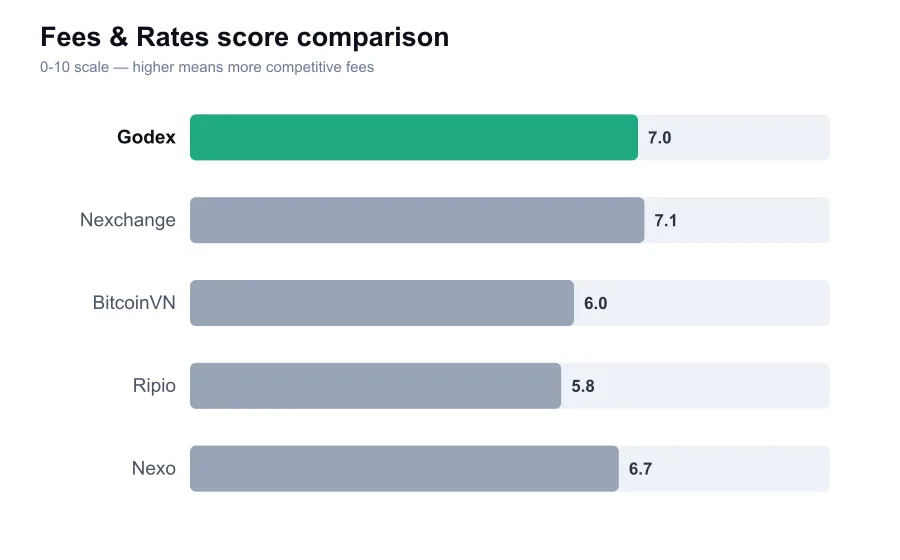
There is a cost to that certainty. Godex has commonly advertised a 0.5% service fee, but the effective price includes network fees and the spread available from its liquidity sources. A quoted amount is what matters, not the headline percentage. Compare it against at least one competitor and a spot market if the transaction is large enough to justify the effort.
For small swaps, Godex can be competitively priced because it avoids withdrawal fees charged by some centralized exchanges. For larger trades, the spread can become more important than the published fee. A user swapping several thousand dollars of ETH should not assume a fixed-rate aggregator is cheaper than a limit order on Kraken or Coinbase Advanced. It often isn't.
Speed depends mostly on the coin being deposited. Godex can process a confirmed Litecoin, Tron, or XRP transaction quickly. Bitcoin deposits need confirmations, Ethereum can slow down during high gas periods, and token swaps sometimes depend on liquidity-provider execution. The website may show an estimated time, but that number is an estimate rather than a service-level promise.
Godex's interface is one of its strengths. It is less cluttered than many rivals, and it makes the one-time exchange flow easy to understand. The platform does not require a user account, password, or two-factor authentication setup because it is not designed to retain a customer balance. That convenience is real, though it removes the account controls some users expect.
The no-registration design should be understood carefully. Godex does not normally ask for KYC before a standard conversion, and it markets privacy as a central feature. It can still apply anti-money-laundering checks, pause an exchange, or ask for information in unusual cases. Anyone who believes instant exchangers are immune to compliance screening is taking an unnecessary risk.
Godex says it does not store customer assets after a swap has finished, which is preferable to leaving coins on a centralized exchange. During processing, however, the service and its partners temporarily control the deposit. That creates counterparty risk. A non-custodial label reduces the time funds are exposed, but it does not turn a third-party conversion into a trustless on-chain trade.
The brand has a longer and calmer operating record than many anonymous swap sites. It has not built the mainstream institutional reputation of Coinbase or Kraken, and it has less public transparency than regulated firms, but it has survived long enough to be recognizable. That is a modest positive, not a blank cheque.
Customer support is available around the clock through the site's chat and support channels. For normal delays, the exchange ID and transaction hash give staff enough information to investigate. The more difficult cases are familiar: a deposit sent on an unsupported chain, an incorrect memo, or an amount below the minimum. Those situations can take time and may require a manual refund less network costs.
Godex is particularly useful for users who dislike opening accounts for occasional swaps. It has broad asset coverage, supports many familiar coin pairs, and can be a practical escape hatch when a centralized exchange is unavailable or demands more verification than the user wants to provide. It is not a replacement for a serious trading venue.
The service does not offer the market depth, order control, or audit visibility of an exchange with a public order book. You cannot place a limit order and wait. You cannot see the liquidity source. You are accepting a one-time quote from an intermediary. That is fine for convenience, but it is a meaningful trade-off.
I prefer Godex to obscure, recently launched swap pages because the product is established and the fixed-rate proposition is easy to grasp. I still would not send a large amount without comparing the displayed output elsewhere. The best use case is a moderate, uncomplicated swap between well-supported networks, funded from a wallet you control.
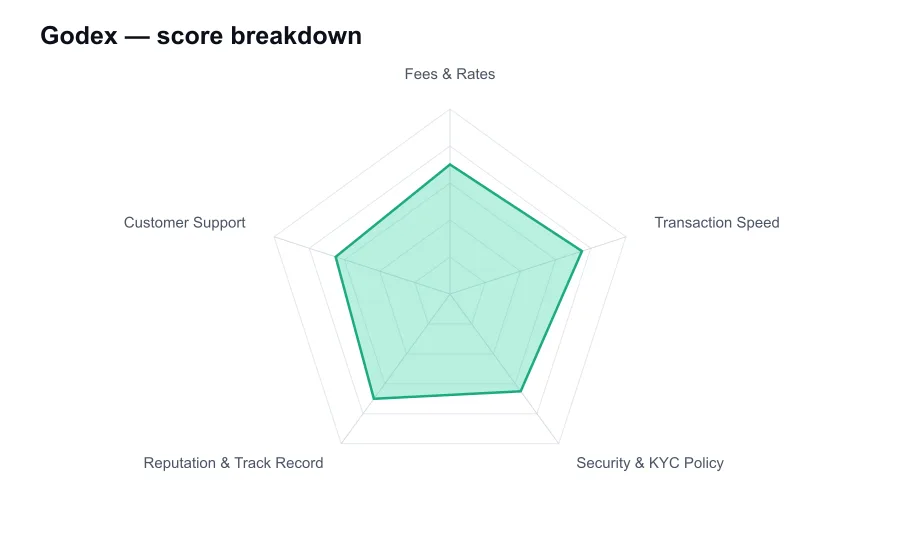
Godex earns a respectable score for usability and its no-account workflow, while its opaque liquidity and limited public corporate detail keep it from the top tier. It is a reasonable utility service, not a trusted vault or professional execution venue. Treat the quote as a retail convenience price, double-check every address, and keep your transaction size sensible.